{"title":"Systemic Immune Dysregulation in Allergic Rhinitis: Mechanisms, Comorbidities, and Implications for Targeted Therapy.","authors":"Danni Hui, Caizhen Shi, Yanpeng Fan, Mengjie Han, Yueyao Wang, Jundi Sun, Yajuan Xue, Erle Li","doi":"10.2147/JAA.S589195","DOIUrl":null,"url":null,"abstract":"<p><p>Allergic rhinitis (AR) has traditionally been regarded as a localized inflammatory disorder of the nasal mucosa. However, accumulating evidence indicates that AR is associated with systemic immune dysregulation characterized by peripheral eosinophilia, altered T helper cell polarization, circulating cytokine imbalances, and widespread inflammatory signaling. This systemic immune disturbance contributes to the frequent coexistence of AR with asthma, atopic dermatitis, and other immune-mediated conditions. These associations support the concept of AR as part of a unified airway and systemic allergic disease spectrum. In this review, we summarize current insights into the immunopathogenesis of AR from both local and systemic perspectives. We focus on epithelial barrier dysfunction, type 2 immune responses, and immune cell trafficking between the upper and lower airways. We further discuss emerging systemic inflammatory biomarkers and their potential clinical relevance in disease stratification and management. Finally, we highlight recent advances in allergen immunotherapy and targeted biologic therapies, emphasizing their implications for precision treatment of AR and its comorbidities. Recognizing AR as a manifestation of systemic immune dysregulation may facilitate improved disease classification and support the development of more effective, individualized therapeutic strategies.</p>","PeriodicalId":15079,"journal":{"name":"Journal of Asthma and Allergy","volume":"19 ","pages":"589195"},"PeriodicalIF":3.0000,"publicationDate":"2026-03-09","publicationTypes":"Journal Article","fieldsOfStudy":null,"isOpenAccess":false,"openAccessPdf":"https://www.ncbi.nlm.nih.gov/pmc/articles/PMC12984071/pdf/","citationCount":"0","resultStr":null,"platform":"Semanticscholar","paperid":null,"PeriodicalName":"Journal of Asthma and Allergy","FirstCategoryId":"3","ListUrlMain":"https://doi.org/10.2147/JAA.S589195","RegionNum":3,"RegionCategory":"医学","ArticlePicture":[],"TitleCN":null,"AbstractTextCN":null,"PMCID":null,"EPubDate":"2026/1/1 0:00:00","PubModel":"eCollection","JCR":"Q2","JCRName":"ALLERGY","Score":null,"Total":0}
引用次数: 0
Abstract
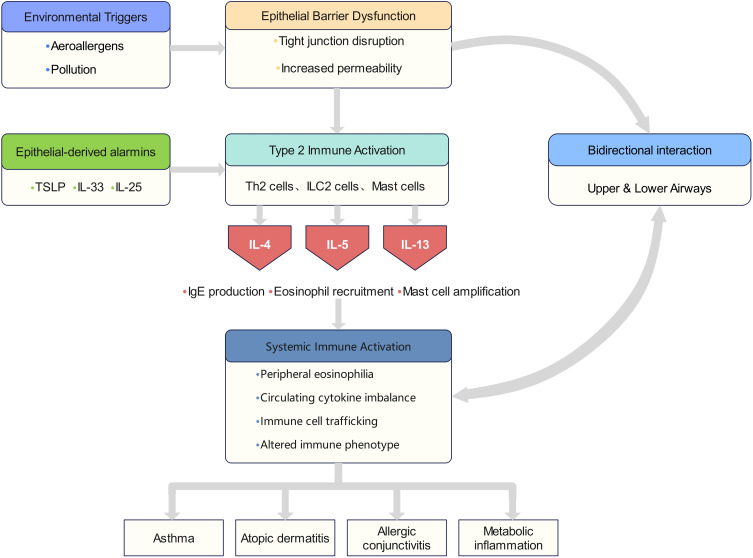
Allergic rhinitis (AR) has traditionally been regarded as a localized inflammatory disorder of the nasal mucosa. However, accumulating evidence indicates that AR is associated with systemic immune dysregulation characterized by peripheral eosinophilia, altered T helper cell polarization, circulating cytokine imbalances, and widespread inflammatory signaling. This systemic immune disturbance contributes to the frequent coexistence of AR with asthma, atopic dermatitis, and other immune-mediated conditions. These associations support the concept of AR as part of a unified airway and systemic allergic disease spectrum. In this review, we summarize current insights into the immunopathogenesis of AR from both local and systemic perspectives. We focus on epithelial barrier dysfunction, type 2 immune responses, and immune cell trafficking between the upper and lower airways. We further discuss emerging systemic inflammatory biomarkers and their potential clinical relevance in disease stratification and management. Finally, we highlight recent advances in allergen immunotherapy and targeted biologic therapies, emphasizing their implications for precision treatment of AR and its comorbidities. Recognizing AR as a manifestation of systemic immune dysregulation may facilitate improved disease classification and support the development of more effective, individualized therapeutic strategies.
期刊介绍:
An international, peer-reviewed journal publishing original research, reports, editorials and commentaries on the following topics: Asthma; Pulmonary physiology; Asthma related clinical health; Clinical immunology and the immunological basis of disease; Pharmacological interventions and new therapies.
Although the main focus of the journal will be to publish research and clinical results in humans, preclinical, animal and in vitro studies will be published where they shed light on disease processes and potential new therapies.

 求助内容:
求助内容: 应助结果提醒方式:

 京公网安备 11010802042870号


