Nancy Bedingfield, Kuhle Fiphaza, Mahilet Girma, Liyabuya Majiza, Lindsey De Vos, Dawie Olivier, Aaron M Kipp, Andrew Medina-Marino, Amrita Daftary
{"title":"Quality of life among people with tuberculosis in the Eastern Cape, South Africa: a qualitative study.","authors":"Nancy Bedingfield, Kuhle Fiphaza, Mahilet Girma, Liyabuya Majiza, Lindsey De Vos, Dawie Olivier, Aaron M Kipp, Andrew Medina-Marino, Amrita Daftary","doi":"10.1186/s44263-026-00258-x","DOIUrl":null,"url":null,"abstract":"<p><strong>Background: </strong>Quality of life (QoL) for people affected by tuberculosis (TB) is generally poor. However, little is known about when and why it changes during treatment. Such knowledge is key to the development and implementation of meaningful interventions. We sought to explore perceptions of QoL amongst people with pulmonary TB during and after treatment.</p><p><strong>Methods: </strong>This study was embedded within a larger study exploring multilevel determinants on TB cascade-of-care outcomes in Eastern Cape, South Africa. Between November 2023 and April 2024, 33 adults were purposively sampled for individual semi-structured interviews early, mid, and at the conclusion of treatment. Questions explored perspectives on current QoL and changes in specific domains (e.g., role functioning, mental wellbeing) during illness and treatment. Inductive and deductive techniques were combined in thematic analysis which incorporated QoL and chronic illness frameworks.</p><p><strong>Results: </strong>Participants described a common trajectory in QoL changes; however, overall assessments of QoL were highly personal. Shared trajectory was characterized by four phases: 'progressive disability to diagnosis', 'treatment challenges and QoL bottom', 'inflection and hope', and 'stability and incomplete resolution'. TB symptoms limited functional mobility, causing a financial crisis for many. Intense need for caregiving, emotional, and financial support persisted for weeks and months until physical gains eased problems in other domains. However, many who had completed treatment described continued weakness and inability to work. Participants provided highly varied assessments of current QoL rooted in personal priorities and individual circumstances. While few clear trends were noted, those with recurrent TB (48%, n = 16) were more often dissatisfied with their wellbeing. By the end of treatment, participants were no more likely to evaluate QoL positively compared to those earlier in treatment.</p><p><strong>Conclusions: </strong>Adaptable interventions that can be tailored to individual needs are required to help those with TB feel good about their life position. Intervention components should be delivered in the setting of long-term relationships with providers and prioritize financial wellbeing and counselling. High levels of support are needed during early treatment but supports must remain accessible through treatment completion and beyond.</p>","PeriodicalId":519903,"journal":{"name":"BMC global and public health","volume":"4 1","pages":""},"PeriodicalIF":0.0000,"publicationDate":"2026-03-12","publicationTypes":"Journal Article","fieldsOfStudy":null,"isOpenAccess":false,"openAccessPdf":"https://www.ncbi.nlm.nih.gov/pmc/articles/PMC12980979/pdf/","citationCount":"0","resultStr":null,"platform":"Semanticscholar","paperid":null,"PeriodicalName":"BMC global and public health","FirstCategoryId":"1085","ListUrlMain":"https://doi.org/10.1186/s44263-026-00258-x","RegionNum":0,"RegionCategory":null,"ArticlePicture":[],"TitleCN":null,"AbstractTextCN":null,"PMCID":null,"EPubDate":"","PubModel":"","JCR":"","JCRName":"","Score":null,"Total":0}
引用次数: 0
Abstract
Background: Quality of life (QoL) for people affected by tuberculosis (TB) is generally poor. However, little is known about when and why it changes during treatment. Such knowledge is key to the development and implementation of meaningful interventions. We sought to explore perceptions of QoL amongst people with pulmonary TB during and after treatment.
Methods: This study was embedded within a larger study exploring multilevel determinants on TB cascade-of-care outcomes in Eastern Cape, South Africa. Between November 2023 and April 2024, 33 adults were purposively sampled for individual semi-structured interviews early, mid, and at the conclusion of treatment. Questions explored perspectives on current QoL and changes in specific domains (e.g., role functioning, mental wellbeing) during illness and treatment. Inductive and deductive techniques were combined in thematic analysis which incorporated QoL and chronic illness frameworks.
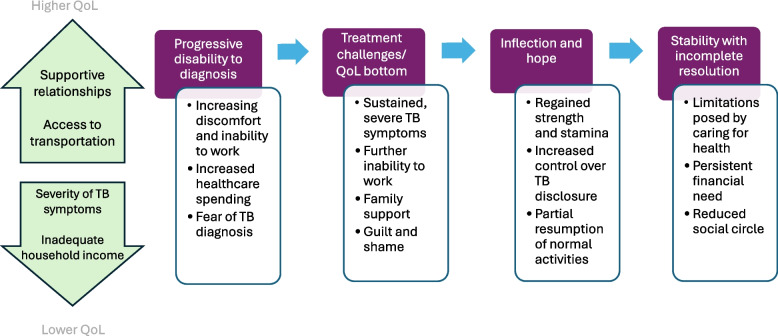
Results: Participants described a common trajectory in QoL changes; however, overall assessments of QoL were highly personal. Shared trajectory was characterized by four phases: 'progressive disability to diagnosis', 'treatment challenges and QoL bottom', 'inflection and hope', and 'stability and incomplete resolution'. TB symptoms limited functional mobility, causing a financial crisis for many. Intense need for caregiving, emotional, and financial support persisted for weeks and months until physical gains eased problems in other domains. However, many who had completed treatment described continued weakness and inability to work. Participants provided highly varied assessments of current QoL rooted in personal priorities and individual circumstances. While few clear trends were noted, those with recurrent TB (48%, n = 16) were more often dissatisfied with their wellbeing. By the end of treatment, participants were no more likely to evaluate QoL positively compared to those earlier in treatment.
Conclusions: Adaptable interventions that can be tailored to individual needs are required to help those with TB feel good about their life position. Intervention components should be delivered in the setting of long-term relationships with providers and prioritize financial wellbeing and counselling. High levels of support are needed during early treatment but supports must remain accessible through treatment completion and beyond.


 求助内容:
求助内容: 应助结果提醒方式:

 京公网安备 11010802042870号


