{"title":"Impact of nucleos(t)ide analogues on the risk of hepatocellular carcinoma in chronic hepatitis B patients: a time-dependent Cox regression analysis.","authors":"Makoto Moriyama, Ryosuke Tateishi, Mizuki Nishibatake Kinoshita, Tsuyoshi Fukumoto, Tomoharu Yamada, Taijiro Wake, Ryo Nakagomi, Takuma Nakatsuka, Tatsuya Minami, Masaya Sato, Mitsuhiro Fujishiro, Kazuhiko Koike","doi":"10.3389/fgstr.2025.1585760","DOIUrl":null,"url":null,"abstract":"<p><strong>Background and aims: </strong>The preventive effect of nucleos(t)ide analog (NA) use on HCC development in patients with chronic hepatitis B (CHB) is controversial due to the difficulty of conducting randomized controlled trials.</p><p><strong>Approach and results: </strong>In this single-center, retrospective study, NA-naïve CHB patients without a history of HCC were enrolled and followed-up from the first visit on or after January 2000 to December 2020. Patients were categorized into the NA group, including those who started NA after study enrollment, and the non-NA group, including patients who were never administered NA during the follow-up period. After propensity score matching (PSM) to balance the confounding factors, we applied a multivariable time-dependent Cox proportional regression analysis with the initiation of NA as a time-dependent covariate. We further performed a subgroup analysis according to the presence or absence of cirrhosis. The baseline characteristics of 212 pairs of patients retrieved by PSM were comparable. During the mean follow-up of 12.9 and 6.8 years in the NA and non-NA groups, respectively, 25 and 28 patients developed HCC, respectively. Multivariable analysis with time-dependent covariates showed that NA did not affect HCC risk (HR, 0.68; 95% CI, 0.36-1.31; <i>p</i> = 0.25) after adjusting for other risk factors, including age, sex, and HBV viral load. Subgroup analysis showed that NA use significantly reduced the risk of HCC in cirrhotic patients (HR, 0.26; 95% CI, 0.08-0.85; <i>p</i> = 0.03).</p><p><strong>Conclusions: </strong>The preventive effect of NA on hepatocarcinogenesis may be limited to cirrhotic patients.</p>","PeriodicalId":73085,"journal":{"name":"Frontiers in gastroenterology (Lausanne, Switzerland)","volume":"4 ","pages":"1585760"},"PeriodicalIF":0.0000,"publicationDate":"2025-06-03","publicationTypes":"Journal Article","fieldsOfStudy":null,"isOpenAccess":false,"openAccessPdf":"https://www.ncbi.nlm.nih.gov/pmc/articles/PMC12952401/pdf/","citationCount":"0","resultStr":null,"platform":"Semanticscholar","paperid":null,"PeriodicalName":"Frontiers in gastroenterology (Lausanne, Switzerland)","FirstCategoryId":"1085","ListUrlMain":"https://doi.org/10.3389/fgstr.2025.1585760","RegionNum":0,"RegionCategory":null,"ArticlePicture":[],"TitleCN":null,"AbstractTextCN":null,"PMCID":null,"EPubDate":"2025/1/1 0:00:00","PubModel":"eCollection","JCR":"","JCRName":"","Score":null,"Total":0}
引用次数: 0
Abstract
Background and aims: The preventive effect of nucleos(t)ide analog (NA) use on HCC development in patients with chronic hepatitis B (CHB) is controversial due to the difficulty of conducting randomized controlled trials.
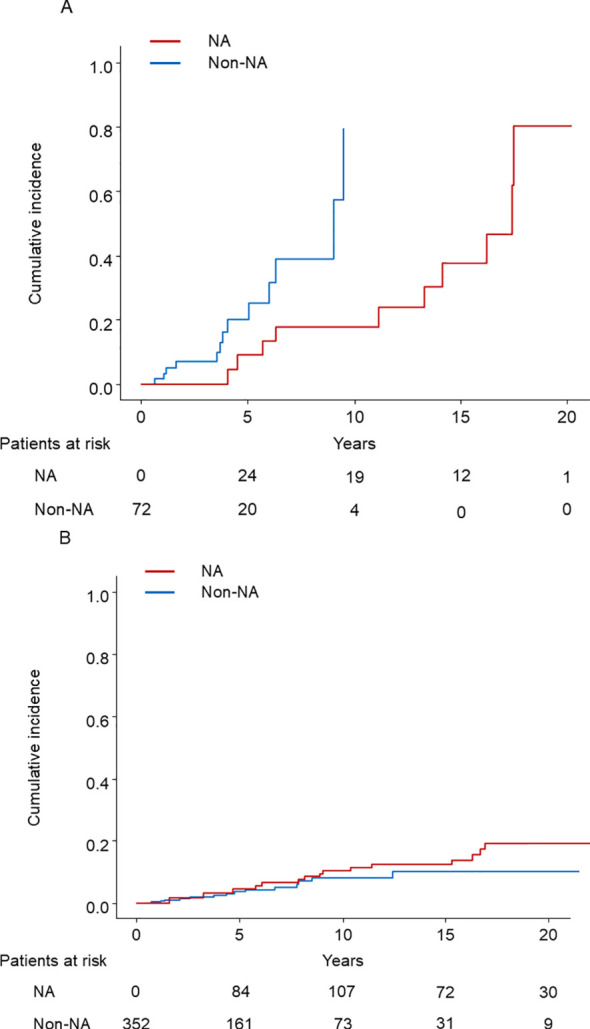
Approach and results: In this single-center, retrospective study, NA-naïve CHB patients without a history of HCC were enrolled and followed-up from the first visit on or after January 2000 to December 2020. Patients were categorized into the NA group, including those who started NA after study enrollment, and the non-NA group, including patients who were never administered NA during the follow-up period. After propensity score matching (PSM) to balance the confounding factors, we applied a multivariable time-dependent Cox proportional regression analysis with the initiation of NA as a time-dependent covariate. We further performed a subgroup analysis according to the presence or absence of cirrhosis. The baseline characteristics of 212 pairs of patients retrieved by PSM were comparable. During the mean follow-up of 12.9 and 6.8 years in the NA and non-NA groups, respectively, 25 and 28 patients developed HCC, respectively. Multivariable analysis with time-dependent covariates showed that NA did not affect HCC risk (HR, 0.68; 95% CI, 0.36-1.31; p = 0.25) after adjusting for other risk factors, including age, sex, and HBV viral load. Subgroup analysis showed that NA use significantly reduced the risk of HCC in cirrhotic patients (HR, 0.26; 95% CI, 0.08-0.85; p = 0.03).
Conclusions: The preventive effect of NA on hepatocarcinogenesis may be limited to cirrhotic patients.




 求助内容:
求助内容: 应助结果提醒方式:

 京公网安备 11010802042870号


