Development and Validation of a Prognostic Model to Predict Mortality in Patients With Heart Failure With Mildly Reduced Ejection Fraction After Acute Myocardial Infarction.
Zhi Can Liu, Ling Ling Zhang, Li Peng, Jian Ping Zeng, Ming Yan Jiang
{"title":"Development and Validation of a Prognostic Model to Predict Mortality in Patients With Heart Failure With Mildly Reduced Ejection Fraction After Acute Myocardial Infarction.","authors":"Zhi Can Liu, Ling Ling Zhang, Li Peng, Jian Ping Zeng, Ming Yan Jiang","doi":"10.14740/cr2096","DOIUrl":null,"url":null,"abstract":"<p><strong>Background: </strong>Accurately assessing mortality risk in patients with heart failure with mildly reduced ejection fraction (HFmrEF) after acute myocardial infarction (AMI) remains challenging. This study developed and validated a mortality risk predictive model for such patients.</p><p><strong>Methods: </strong>In this single-center retrospective study of 873 hospitalized patients with HFmrEF after AMI, 611 patients were included in the training cohort and 262 in the validation cohort. The primary outcome was all-cause mortality over an average 33-month follow-up. Least absolute shrinkage and selection operator (LASSO) regression identified predictive variables for post-discharge mortality, with model performance assessed via receiver operating characteristic (ROC) analysis and decision curve analysis (DCA).</p><p><strong>Results: </strong>Six mortality risk predictors were identified: age, stroke history, New York Heart Association (NYHA) classification, hemoglobin (Hb) levels, estimated glomerular filtration rate (eGFR), and primary percutaneous coronary intervention (PPCI) implementation. The C-index for training and validation cohorts was 0.795 (95% confidence interval (CI), 0.758-0.832) and 0.741 (95% CI, 0.672-0.81), respectively. Training cohort area under the curve (AUC) metrics for 6-month, 2-year, and 3-year survival were 0.861, 0.805, and 0.815; for the validation cohort, they were 0.722, 0.742, and 0.736.</p><p><strong>Conclusions: </strong>A validated predictive model assessing mortality risk in HFmrEF patients post-AMI was established. External validation in future studies is recommended.</p>","PeriodicalId":9424,"journal":{"name":"Cardiology Research","volume":"17 1","pages":"10-22"},"PeriodicalIF":1.4000,"publicationDate":"2026-02-28","publicationTypes":"Journal Article","fieldsOfStudy":null,"isOpenAccess":false,"openAccessPdf":"https://www.ncbi.nlm.nih.gov/pmc/articles/PMC12978395/pdf/","citationCount":"0","resultStr":null,"platform":"Semanticscholar","paperid":null,"PeriodicalName":"Cardiology Research","FirstCategoryId":"1085","ListUrlMain":"https://doi.org/10.14740/cr2096","RegionNum":0,"RegionCategory":null,"ArticlePicture":[],"TitleCN":null,"AbstractTextCN":null,"PMCID":null,"EPubDate":"2026/2/1 0:00:00","PubModel":"eCollection","JCR":"Q3","JCRName":"CARDIAC & CARDIOVASCULAR SYSTEMS","Score":null,"Total":0}
引用次数: 0
Abstract
Background: Accurately assessing mortality risk in patients with heart failure with mildly reduced ejection fraction (HFmrEF) after acute myocardial infarction (AMI) remains challenging. This study developed and validated a mortality risk predictive model for such patients.
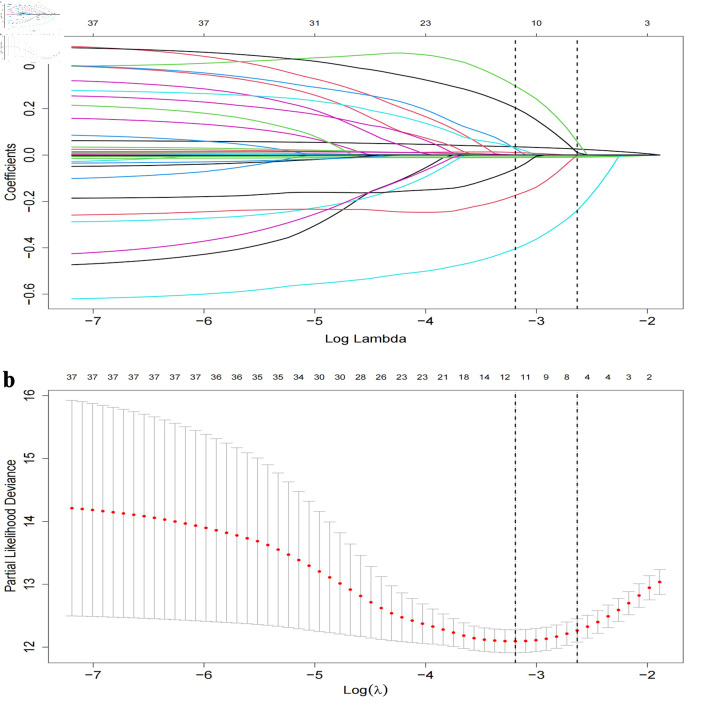
Methods: In this single-center retrospective study of 873 hospitalized patients with HFmrEF after AMI, 611 patients were included in the training cohort and 262 in the validation cohort. The primary outcome was all-cause mortality over an average 33-month follow-up. Least absolute shrinkage and selection operator (LASSO) regression identified predictive variables for post-discharge mortality, with model performance assessed via receiver operating characteristic (ROC) analysis and decision curve analysis (DCA).
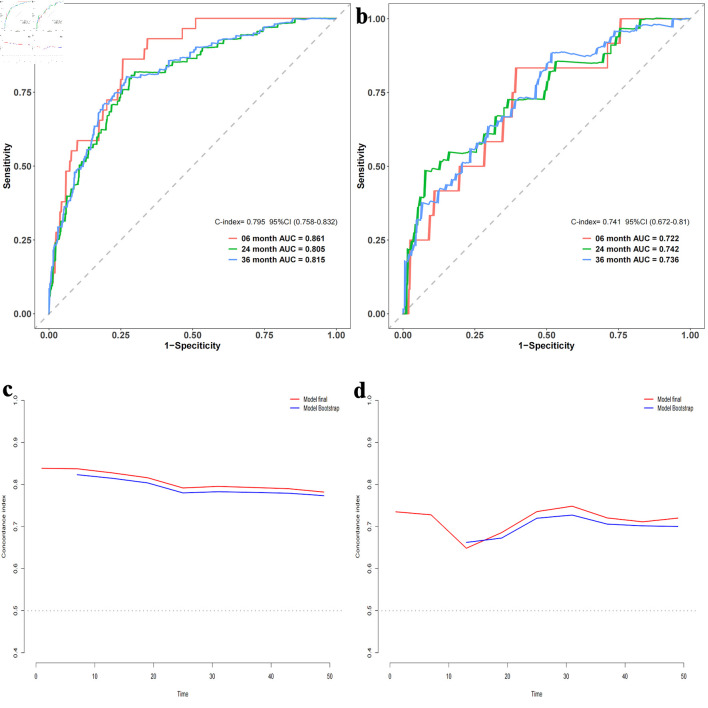
Results: Six mortality risk predictors were identified: age, stroke history, New York Heart Association (NYHA) classification, hemoglobin (Hb) levels, estimated glomerular filtration rate (eGFR), and primary percutaneous coronary intervention (PPCI) implementation. The C-index for training and validation cohorts was 0.795 (95% confidence interval (CI), 0.758-0.832) and 0.741 (95% CI, 0.672-0.81), respectively. Training cohort area under the curve (AUC) metrics for 6-month, 2-year, and 3-year survival were 0.861, 0.805, and 0.815; for the validation cohort, they were 0.722, 0.742, and 0.736.
Conclusions: A validated predictive model assessing mortality risk in HFmrEF patients post-AMI was established. External validation in future studies is recommended.
期刊介绍:
Cardiology Research is an open access, peer-reviewed, international journal. All submissions relating to basic research and clinical practice of cardiology and cardiovascular medicine are in this journal''s scope. This journal focuses on publishing original research and observations in all cardiovascular medicine aspects. Manuscript types include original article, review, case report, short communication, book review, letter to the editor.



 求助内容:
求助内容: 应助结果提醒方式:

 京公网安备 11010802042870号


