{"title":"Preheparin Serum Lipoprotein Lipase Mass as a Coronary Risk Factor in Patients With Chronic Kidney Disease.","authors":"Takashi Hitsumoto","doi":"10.14740/cr2192","DOIUrl":null,"url":null,"abstract":"<p><strong>Background: </strong>A significant association between lower preheparin serum lipoprotein lipase mass (pre-LpL mass) and coronary artery disease (CAD) has been reported in several clinical studies. However, the predictor of a pre-LpL mass as a CAD event in patients with chronic kidney disease (CKD) remains unclear. This prospective study aimed to investigate the clinical significance of a pre-LpL mass as a predictor of primary CAD events in patients with CKD.</p><p><strong>Methods: </strong>A total of 480 CKD patients who did not develop CAD among outpatients who visited the clinic were enrolled. Using receiver operating characteristic curve analysis for a primary CAD event, participants were divided into two groups (low pre-LpL mass (group L, n = 211) or high pre-LpL mass (group H, n = 269)) by pre-LpL mass, and significance of a pre-LpL mass as a predictor for the primary CAD events was performed.</p><p><strong>Results: </strong>At baseline, skin autofluorescence, an indicator of advanced glycation end products <i>in vivo</i>, and high-sensitivity C-reactive protein (hs-CRP) concentration, an indicator of inflammation, were significantly higher in group L than in group H. During the median observation period of 107 months, 42 patients experienced a CAD event (group L: n = 31 (14.7%) vs. group H: n = 11 (4.1%)). Group L had a significantly higher incidence of primary CAD events than group H (P < 0.001, log-rank test). Furthermore, patients in group L were at a significantly higher risk of developing a primary CAD event than those in group H based on the multivariate Cox regression analysis (hazard ratio: 2.80; 95% confidence interval, 1.39-5.64; P = 0.003). However, skin autofluorescence and hs-CRP were also significant factors for a primary CAD event.</p><p><strong>Conclusions: </strong>The prospective study showed that a decrease in pre-LpL mass is a useful predictor of a primary CAD event in patients with CKD. Additionally, background factors such as an increase in advanced glycation end products and inflammation are also an important factor in these patients.</p>","PeriodicalId":9424,"journal":{"name":"Cardiology Research","volume":"17 1","pages":"1-9"},"PeriodicalIF":1.4000,"publicationDate":"2026-02-28","publicationTypes":"Journal Article","fieldsOfStudy":null,"isOpenAccess":false,"openAccessPdf":"https://www.ncbi.nlm.nih.gov/pmc/articles/PMC12978400/pdf/","citationCount":"0","resultStr":null,"platform":"Semanticscholar","paperid":null,"PeriodicalName":"Cardiology Research","FirstCategoryId":"1085","ListUrlMain":"https://doi.org/10.14740/cr2192","RegionNum":0,"RegionCategory":null,"ArticlePicture":[],"TitleCN":null,"AbstractTextCN":null,"PMCID":null,"EPubDate":"2026/2/1 0:00:00","PubModel":"eCollection","JCR":"Q3","JCRName":"CARDIAC & CARDIOVASCULAR SYSTEMS","Score":null,"Total":0}
引用次数: 0
Abstract
Background: A significant association between lower preheparin serum lipoprotein lipase mass (pre-LpL mass) and coronary artery disease (CAD) has been reported in several clinical studies. However, the predictor of a pre-LpL mass as a CAD event in patients with chronic kidney disease (CKD) remains unclear. This prospective study aimed to investigate the clinical significance of a pre-LpL mass as a predictor of primary CAD events in patients with CKD.
Methods: A total of 480 CKD patients who did not develop CAD among outpatients who visited the clinic were enrolled. Using receiver operating characteristic curve analysis for a primary CAD event, participants were divided into two groups (low pre-LpL mass (group L, n = 211) or high pre-LpL mass (group H, n = 269)) by pre-LpL mass, and significance of a pre-LpL mass as a predictor for the primary CAD events was performed.
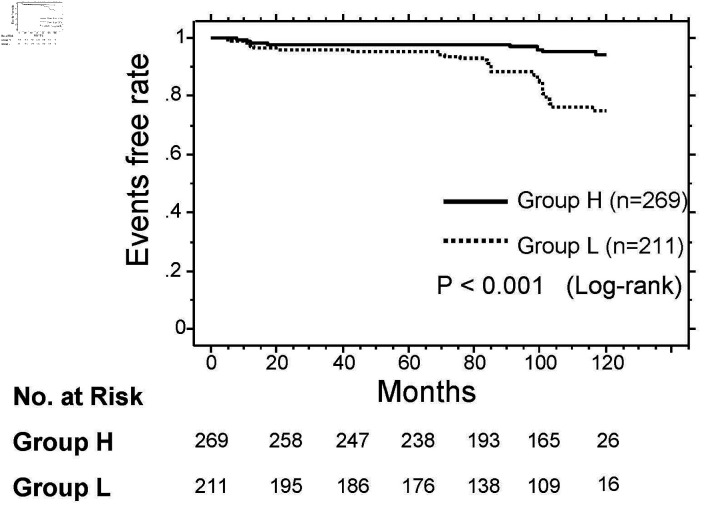
Results: At baseline, skin autofluorescence, an indicator of advanced glycation end products in vivo, and high-sensitivity C-reactive protein (hs-CRP) concentration, an indicator of inflammation, were significantly higher in group L than in group H. During the median observation period of 107 months, 42 patients experienced a CAD event (group L: n = 31 (14.7%) vs. group H: n = 11 (4.1%)). Group L had a significantly higher incidence of primary CAD events than group H (P < 0.001, log-rank test). Furthermore, patients in group L were at a significantly higher risk of developing a primary CAD event than those in group H based on the multivariate Cox regression analysis (hazard ratio: 2.80; 95% confidence interval, 1.39-5.64; P = 0.003). However, skin autofluorescence and hs-CRP were also significant factors for a primary CAD event.
Conclusions: The prospective study showed that a decrease in pre-LpL mass is a useful predictor of a primary CAD event in patients with CKD. Additionally, background factors such as an increase in advanced glycation end products and inflammation are also an important factor in these patients.
期刊介绍:
Cardiology Research is an open access, peer-reviewed, international journal. All submissions relating to basic research and clinical practice of cardiology and cardiovascular medicine are in this journal''s scope. This journal focuses on publishing original research and observations in all cardiovascular medicine aspects. Manuscript types include original article, review, case report, short communication, book review, letter to the editor.



 求助内容:
求助内容: 应助结果提醒方式:

 京公网安备 11010802042870号


