Mediating Effects of Mindfulness Compassion-based Peer Counseling Program for Breast Cancer Survivors: From Mindfulness, Compassion to Others to Depression Reduction.
{"title":"Mediating Effects of Mindfulness Compassion-based Peer Counseling Program for Breast Cancer Survivors: From Mindfulness, Compassion to Others to Depression Reduction.","authors":"Fei-Hsiu Hsiao, Chiao Lo, Chiun-Sheng Huang, Wen-Hung Kuo, Feng-Ying Huang, Yu-Ting Chen, Chia-Chen Hsieh","doi":"10.5093/pi2026a6","DOIUrl":null,"url":null,"abstract":"<p><strong>Objective: </strong>The study aimed to test a mindfulness compassion-based intervention for breast cancer survivors serving as peer counselors, exploring whether mindfulness influenced depressive symptoms via a serial pathway of self-compassion, compassion to others, anxiety reduction, and improved quality of life.</p><p><strong>Method: </strong>This 8-month study adopted the randomized controlled trial (RCT) design. Survivors who are diagnosed with breast and complete treatments for at least one year were recruited from outpatient department of the General Hospital Breast Center and non-profit organization. They were randomly assigned into MC-BMS experimental group (the 8 weekly mindfulness compassion-based integrated with body-mind-spirit group therapy), and BMS control group (8 weekly body-mind-spirit group therapy).</p><p><strong>Results: </strong>There was a similarity in increasing general QOL functioning between the BMS and MC-BMS groups. The better improvements in QOL symptoms distress were more favored in MC-BMS than BMS groups. For within-group analyses, significant improvements in the MC-BMS group were depressive symptoms, search for meaning, mindfulness, while the BMS group showed significant improvements in global health, and breast cancer-related functioning. The three serial mediation pathways indicated that increases in mindfulness predicted greater self-compassion, which was associated with increased compassion to others. This, in turn, led to reduced anxiety, enhanced quality of life and breast cancer-related functioning, and ultimately, reduced depression.</p><p><strong>Conclusions: </strong>Enhancing mindfulness and compassionate processes in peer-counselor training serve a central role in improving anxiety and functional quality of life, thereby alleviating depressive symptoms in breast cancer survivors.</p>","PeriodicalId":51641,"journal":{"name":"Psychosocial Intervention","volume":"35 ","pages":"e260814"},"PeriodicalIF":4.4000,"publicationDate":"2026-03-05","publicationTypes":"Journal Article","fieldsOfStudy":null,"isOpenAccess":false,"openAccessPdf":"https://www.ncbi.nlm.nih.gov/pmc/articles/PMC12974539/pdf/","citationCount":"0","resultStr":null,"platform":"Semanticscholar","paperid":null,"PeriodicalName":"Psychosocial Intervention","FirstCategoryId":"102","ListUrlMain":"https://doi.org/10.5093/pi2026a6","RegionNum":1,"RegionCategory":"心理学","ArticlePicture":[],"TitleCN":null,"AbstractTextCN":null,"PMCID":null,"EPubDate":"2026/1/1 0:00:00","PubModel":"eCollection","JCR":"Q1","JCRName":"PSYCHOLOGY, MULTIDISCIPLINARY","Score":null,"Total":0}
引用次数: 0
Abstract
Objective: The study aimed to test a mindfulness compassion-based intervention for breast cancer survivors serving as peer counselors, exploring whether mindfulness influenced depressive symptoms via a serial pathway of self-compassion, compassion to others, anxiety reduction, and improved quality of life.
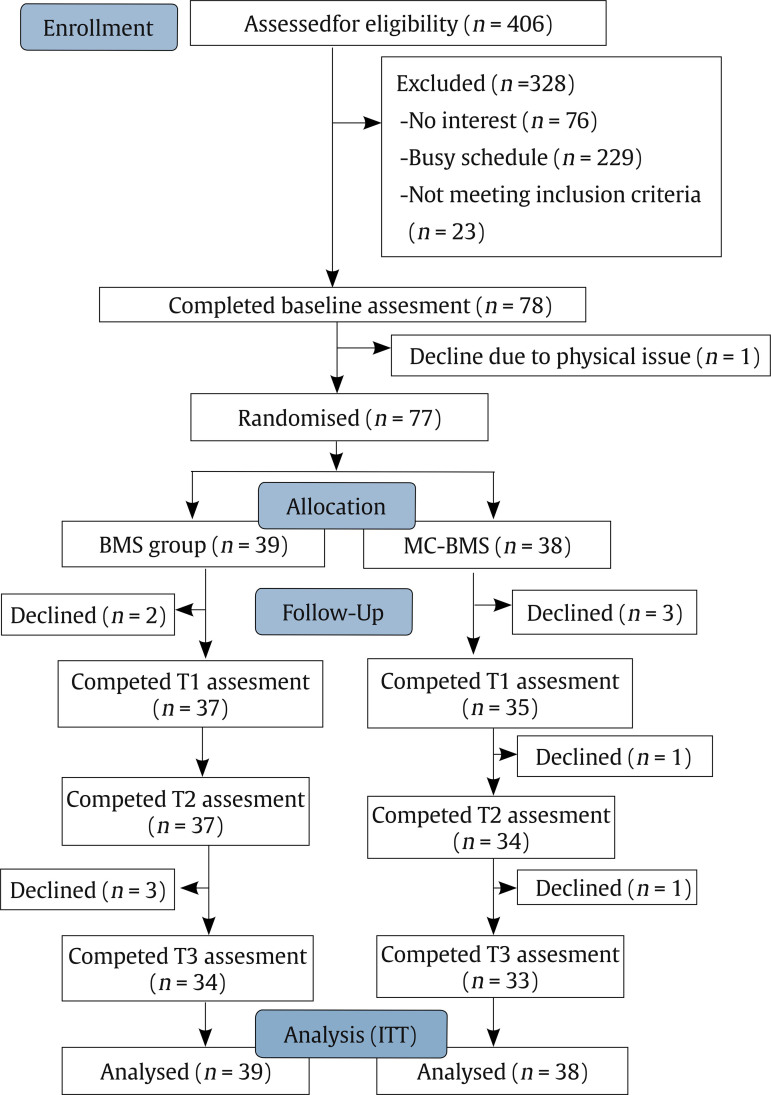
Method: This 8-month study adopted the randomized controlled trial (RCT) design. Survivors who are diagnosed with breast and complete treatments for at least one year were recruited from outpatient department of the General Hospital Breast Center and non-profit organization. They were randomly assigned into MC-BMS experimental group (the 8 weekly mindfulness compassion-based integrated with body-mind-spirit group therapy), and BMS control group (8 weekly body-mind-spirit group therapy).
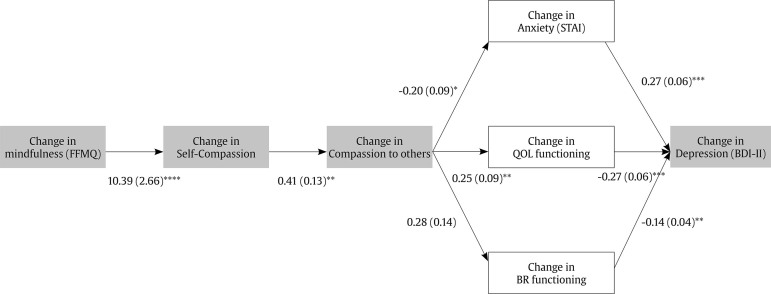
Results: There was a similarity in increasing general QOL functioning between the BMS and MC-BMS groups. The better improvements in QOL symptoms distress were more favored in MC-BMS than BMS groups. For within-group analyses, significant improvements in the MC-BMS group were depressive symptoms, search for meaning, mindfulness, while the BMS group showed significant improvements in global health, and breast cancer-related functioning. The three serial mediation pathways indicated that increases in mindfulness predicted greater self-compassion, which was associated with increased compassion to others. This, in turn, led to reduced anxiety, enhanced quality of life and breast cancer-related functioning, and ultimately, reduced depression.
Conclusions: Enhancing mindfulness and compassionate processes in peer-counselor training serve a central role in improving anxiety and functional quality of life, thereby alleviating depressive symptoms in breast cancer survivors.
期刊介绍:
Psychosocial Intervention is a peer-reviewed journal that publishes papers in all areas relevant to psychosocial intervention at the individual, family, social networks, organization, community, and population levels. The Journal emphasizes an evidence-based perspective and welcomes papers reporting original basic and applied research, program evaluation, and intervention results. The journal will also feature integrative reviews, and specialized papers on theoretical advances and methodological issues. Psychosocial Intervention is committed to advance knowledge, and to provide scientific evidence informing psychosocial interventions tackling social and community problems, and promoting social welfare and quality of life. Psychosocial Intervention welcomes contributions from all areas of psychology and allied disciplines, such as sociology, social work, social epidemiology, and public health. Psychosocial Intervention aims to be international in scope, and will publish papers both in Spanish and English.



 求助内容:
求助内容: 应助结果提醒方式:

 京公网安备 11010802042870号


