Delong Peng, Chunxiao Han, LuLu Yan, Haibo Li, Haiya Yan
{"title":"[Clinical features and genetic analysis of a child with STISS syndrome due to variant of PSMD12 gene].","authors":"Delong Peng, Chunxiao Han, LuLu Yan, Haibo Li, Haiya Yan","doi":"10.3760/cma.j.cn511374-20250225-00107","DOIUrl":null,"url":null,"abstract":"<p><strong>Objective: </strong>To explore the clinical characteristics and genetic etiology of STISS syndrome (an autosomal dominant disorder characterized by ubiquitin-proteasome system dysfunction) in a child.</p><p><strong>Methods: </strong>A child with STISS syndrome diagnosed at the Affiliated Women and Children's Hospital of Ningbo University in September 2024 due to \"abnormal development of external genitalia\" was selected as the study subject. Clinical data were retrospectively collected. Peripheral blood samples were obtained from the child and his family members. Following genomic DNA extraction, whole-exome sequencing (WES) and Sanger sequencing validation were carried out. Pathogenicity of the candidate variants was assessed based on the guidelines from American College of Medical Genetics and Genomics (ACMG). The study was approved by the Ethics Committee of the hospital (Ethics No.: EC2023-094).</p><p><strong>Results: </strong>The proband, a 16-year-old boy, presented with micropenis, testicular hypoplasia, delayed sexual development, insulin resistance, diabetes mellitus, and obesity. WES revealed that he has harbored a c.934del; p.Met312TrpfsTer3 frameshifting variant of the PSMD12 gene, which was unreported previously. Sanger sequencing confirmed that the variant to be de novo in origin. Based on the guidelines from the ACMG, the variant was classified as pathogenic (PVS1+PM2_supporting+PM6_supporting). The variant was predicted to result in a premature termination codon. Bioinformatics analysis suggested that the amino acid at position 312 is highly conserved, and the variant may therefore affect the protein structure.</p><p><strong>Conclusion: </strong>Patients with STISS syndrome exhibit clinical features including psychomotor retardation, intellectual disability, distinctive facial features, and urogenital abnormalities. The c.934del (p.Met312TrpfsTer3) frameshift variant of the PSMD12 gene probably underlay the pathogenesis in the proband. Above finding has enriched the mutational spectrum of the PSMD12 gene.</p>","PeriodicalId":39319,"journal":{"name":"中华医学遗传学杂志","volume":"42 12","pages":"1459-1464"},"PeriodicalIF":0.0000,"publicationDate":"2025-12-10","publicationTypes":"Journal Article","fieldsOfStudy":null,"isOpenAccess":false,"openAccessPdf":"","citationCount":"0","resultStr":null,"platform":"Semanticscholar","paperid":null,"PeriodicalName":"中华医学遗传学杂志","FirstCategoryId":"3","ListUrlMain":"https://doi.org/10.3760/cma.j.cn511374-20250225-00107","RegionNum":0,"RegionCategory":null,"ArticlePicture":[],"TitleCN":null,"AbstractTextCN":null,"PMCID":null,"EPubDate":"","PubModel":"","JCR":"Q4","JCRName":"Medicine","Score":null,"Total":0}
引用次数: 0
Abstract
Objective: To explore the clinical characteristics and genetic etiology of STISS syndrome (an autosomal dominant disorder characterized by ubiquitin-proteasome system dysfunction) in a child.
Methods: A child with STISS syndrome diagnosed at the Affiliated Women and Children's Hospital of Ningbo University in September 2024 due to "abnormal development of external genitalia" was selected as the study subject. Clinical data were retrospectively collected. Peripheral blood samples were obtained from the child and his family members. Following genomic DNA extraction, whole-exome sequencing (WES) and Sanger sequencing validation were carried out. Pathogenicity of the candidate variants was assessed based on the guidelines from American College of Medical Genetics and Genomics (ACMG). The study was approved by the Ethics Committee of the hospital (Ethics No.: EC2023-094).
Results: The proband, a 16-year-old boy, presented with micropenis, testicular hypoplasia, delayed sexual development, insulin resistance, diabetes mellitus, and obesity. WES revealed that he has harbored a c.934del; p.Met312TrpfsTer3 frameshifting variant of the PSMD12 gene, which was unreported previously. Sanger sequencing confirmed that the variant to be de novo in origin. Based on the guidelines from the ACMG, the variant was classified as pathogenic (PVS1+PM2_supporting+PM6_supporting). The variant was predicted to result in a premature termination codon. Bioinformatics analysis suggested that the amino acid at position 312 is highly conserved, and the variant may therefore affect the protein structure.
Conclusion: Patients with STISS syndrome exhibit clinical features including psychomotor retardation, intellectual disability, distinctive facial features, and urogenital abnormalities. The c.934del (p.Met312TrpfsTer3) frameshift variant of the PSMD12 gene probably underlay the pathogenesis in the proband. Above finding has enriched the mutational spectrum of the PSMD12 gene.
期刊介绍:
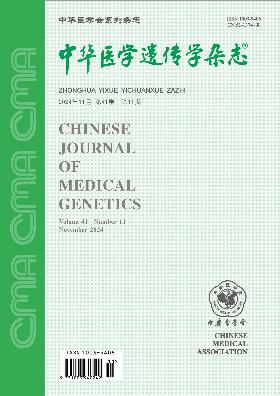
Chinese Journal of Medical Genetics is a medical journal, founded in 1984, under the supervision of the China Association for Science and Technology, sponsored by the Chinese Medical Association (hosted by Sichuan University), and is now a monthly magazine, which attaches importance to academic orientation, adheres to the scientific, scholarly, advanced, and innovative, and has a certain degree of influence in the industry.
Chinese Journal of Medical Genetics is a journal of Peking University, and is now included in Peking University Journal (Chinese Journal of Humanities and Social Sciences), CSCD Source Journals of Chinese Science Citation Database (with extended version), Statistical Source Journals (China Science and Technology Dissertation Outstanding Journals), Zhi.com (in Chinese), Wipu (in Chinese), Wanfang (in Chinese), CA Chemical Abstracts (U.S.), JST (Japan Science and Technology Science and Technology), and JST (Japan Science and Technology Science and Technology Research Center). ), JST (Japan Science and Technology Agency), Pж (AJ) Abstracts Journal (Russia), Copernicus Index (Poland), Cambridge Scientific Abstracts, Abstracts and Citation Database, Abstracts Magazine, Medical Abstracts, and so on.

 求助内容:
 应助结果提醒方式:


 京公网安备 11010802042870号


