Benjamin R Caruso, Suzanna M Ohlsen, Keinan Agonias, Robert L Van Pelt, Michelle M Son, Michael G Saper, Jason Rhodes, J Marc Cardelia, Jay C Albright, Shital N Parikh, Kevin G Shea, Henry B Ellis, Philip L Wilson, Sheila Algan, Jennifer J Beck, Richard E Bowen, Jennifer M Brey, Matthew J Brown, Christian Clark, Allison Crepeau, Eric W Edmonds, Matthew Ellington, Peter D Fabricant, Jeremy Frank, Theodore J Ganley, Daniel W Green, Benton Heyworth, Ryan J Koehler, Alfred A Mansour, Stephanine Mayer, Scott D McKay, Molly C Meadows, Matthew Milewski, Emily L Niu, Donna M Pacicca, Stephanie S Pearce, Matthew R Schmitz, Stephen Storer, Curtis VandenBerg, Yi-Meng Yen, Gregory A Schmale
{"title":"Complications Leading to Reoperation After Pediatric Tibial Spine Fracture Fixation.","authors":"Benjamin R Caruso, Suzanna M Ohlsen, Keinan Agonias, Robert L Van Pelt, Michelle M Son, Michael G Saper, Jason Rhodes, J Marc Cardelia, Jay C Albright, Shital N Parikh, Kevin G Shea, Henry B Ellis, Philip L Wilson, Sheila Algan, Jennifer J Beck, Richard E Bowen, Jennifer M Brey, Matthew J Brown, Christian Clark, Allison Crepeau, Eric W Edmonds, Matthew Ellington, Peter D Fabricant, Jeremy Frank, Theodore J Ganley, Daniel W Green, Benton Heyworth, Ryan J Koehler, Alfred A Mansour, Stephanine Mayer, Scott D McKay, Molly C Meadows, Matthew Milewski, Emily L Niu, Donna M Pacicca, Stephanie S Pearce, Matthew R Schmitz, Stephen Storer, Curtis VandenBerg, Yi-Meng Yen, Gregory A Schmale","doi":"10.1177/23259671261419525","DOIUrl":null,"url":null,"abstract":"<p><strong>Background: </strong>Tibial spine fractures (TSFs) are uncommon injuries in pediatric patients, often requiring operative fixation. While complications such as arthrofibrosis and anterior cruciate ligament (ACL) insufficiency have been previously reported, the risk factors associated with unplanned reoperation remain incompletely understood.</p><p><strong>Purpose: </strong>To identify the most common complications leading to reoperation and to evaluate associated risk factors, using a multicenter quality improvement registry.</p><p><strong>Study design: </strong>Case-control study; Level of evidence, 3.</p><p><strong>Methods: </strong>A multicenter registry of operatively treated pediatric TSFs was retrospectively reviewed from July 2018 to March 2025 across 27 institutions. Grade 3 complications were defined as complications resulting in reoperation, unplanned hospitalization, or interventional radiologic procedures. Complication types, patient and injury characteristics, fixation methods, and intraoperative findings were analyzed. Bivariate and multivariate logistic regression analyses were performed to identify independent risk factors for Clavien-Dindo grade 3 complications.</p><p><strong>Results: </strong>A total of 532 patients were included (mean age, 12.1 years; 73.4% men). Overall, 56 patients (10.5%) underwent reoperation. The most common reasons for reoperation were stiffness (4.9%) and ACL insufficiency (3.6%). Screw fixation of TSFs was associated with a 4.5-fold increased risk of grade 3 complications compared with suture fixation (<i>P</i> = .009). Both suture and anchor fixation (<i>P</i> = .045) and longer operative times (<i>P</i> = .020) were also associated with higher complication rates. Meniscal or intermeniscal ligament entrapment was significantly associated with increased stiffness-related reoperation (<i>P</i> = .045). Patients who underwent delayed ACL reconstruction (ACLR) were older (<i>P</i> = .041) and more likely to have concomitant meniscal tears (<i>P</i> = .011) at the time of their TSF.</p><p><strong>Conclusion: </strong>Stiffness and ACL insufficiency represented the most frequent indications for reoperation after TSF fixation. Screw fixation, meniscal entrapment, and prolonged operative time were significant predictors of reoperation. Older age and concomitant meniscal injuries increased the risk of delayed ACLR.</p>","PeriodicalId":19646,"journal":{"name":"Orthopaedic Journal of Sports Medicine","volume":"14 3","pages":"23259671261419525"},"PeriodicalIF":2.5000,"publicationDate":"2026-03-09","publicationTypes":"Journal Article","fieldsOfStudy":null,"isOpenAccess":false,"openAccessPdf":"https://www.ncbi.nlm.nih.gov/pmc/articles/PMC12972563/pdf/","citationCount":"0","resultStr":null,"platform":"Semanticscholar","paperid":null,"PeriodicalName":"Orthopaedic Journal of Sports Medicine","FirstCategoryId":"3","ListUrlMain":"https://doi.org/10.1177/23259671261419525","RegionNum":3,"RegionCategory":"医学","ArticlePicture":[],"TitleCN":null,"AbstractTextCN":null,"PMCID":null,"EPubDate":"2026/3/1 0:00:00","PubModel":"eCollection","JCR":"Q2","JCRName":"ORTHOPEDICS","Score":null,"Total":0}
引用次数: 0
Abstract
Background: Tibial spine fractures (TSFs) are uncommon injuries in pediatric patients, often requiring operative fixation. While complications such as arthrofibrosis and anterior cruciate ligament (ACL) insufficiency have been previously reported, the risk factors associated with unplanned reoperation remain incompletely understood.
Purpose: To identify the most common complications leading to reoperation and to evaluate associated risk factors, using a multicenter quality improvement registry.
Study design: Case-control study; Level of evidence, 3.
Methods: A multicenter registry of operatively treated pediatric TSFs was retrospectively reviewed from July 2018 to March 2025 across 27 institutions. Grade 3 complications were defined as complications resulting in reoperation, unplanned hospitalization, or interventional radiologic procedures. Complication types, patient and injury characteristics, fixation methods, and intraoperative findings were analyzed. Bivariate and multivariate logistic regression analyses were performed to identify independent risk factors for Clavien-Dindo grade 3 complications.
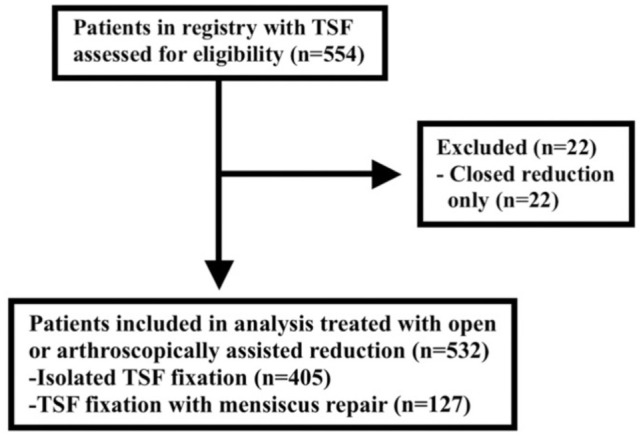
Results: A total of 532 patients were included (mean age, 12.1 years; 73.4% men). Overall, 56 patients (10.5%) underwent reoperation. The most common reasons for reoperation were stiffness (4.9%) and ACL insufficiency (3.6%). Screw fixation of TSFs was associated with a 4.5-fold increased risk of grade 3 complications compared with suture fixation (P = .009). Both suture and anchor fixation (P = .045) and longer operative times (P = .020) were also associated with higher complication rates. Meniscal or intermeniscal ligament entrapment was significantly associated with increased stiffness-related reoperation (P = .045). Patients who underwent delayed ACL reconstruction (ACLR) were older (P = .041) and more likely to have concomitant meniscal tears (P = .011) at the time of their TSF.
Conclusion: Stiffness and ACL insufficiency represented the most frequent indications for reoperation after TSF fixation. Screw fixation, meniscal entrapment, and prolonged operative time were significant predictors of reoperation. Older age and concomitant meniscal injuries increased the risk of delayed ACLR.
期刊介绍:
The Orthopaedic Journal of Sports Medicine (OJSM), developed by the American Orthopaedic Society for Sports Medicine (AOSSM), is a global, peer-reviewed, open access journal that combines the interests of researchers and clinical practitioners across orthopaedic sports medicine, arthroscopy, and knee arthroplasty.
Topics include original research in the areas of:
-Orthopaedic Sports Medicine, including surgical and nonsurgical treatment of orthopaedic sports injuries
-Arthroscopic Surgery (Shoulder/Elbow/Wrist/Hip/Knee/Ankle/Foot)
-Relevant translational research
-Sports traumatology/epidemiology
-Knee and shoulder arthroplasty
The OJSM also publishes relevant systematic reviews and meta-analyses.
This journal is a member of the Committee on Publication Ethics (COPE).



 求助内容:
求助内容: 应助结果提醒方式:

 京公网安备 11010802042870号


