{"title":"Circumferential Labral Tears: Instability History and Outcomes of Arthroscopic Repair.","authors":"Ibrahim Kaya, Ethem Burak Oklaz, Semih Yas, Furkan Aral, Tayfun Ozel, Oguzhan Ak, Asim Ahmadov, Ulunay Kanatli","doi":"10.1177/23259671261418674","DOIUrl":null,"url":null,"abstract":"<p><strong>Background: </strong>Circumferential labral tears are characterized by complete detachment of the labrum from the glenoid rim, and studies have reported significant improvements in patient-reported outcome measures (PROMs) after arthroscopic repair. However, patients' perspectives on the meaningfulness of these outcomes remain unknown, and debate continues regarding whether circumferential tears can occur after a single instability event.</p><p><strong>Purpose: </strong>To investigate the number of preoperative instability events in patients with circumferential tears and evaluate their clinical outcomes after arthroscopic repair according to the minimal clinically important difference (MCID), Substantial Clinical Benefit (SCB), and Patient Acceptable Symptom State (PASS) parameters.</p><p><strong>Study design: </strong>Case series; Level of evidence, 4.</p><p><strong>Methods: </strong>This study was retrospective review of a consecutive series of patients who underwent shoulder arthroscopy for instability between February 2015 and July 2023. Patients with primary circumferential tears repaired using arthroscopic suture anchors, glenoid bone defects <13.5%, and a minimum 24-month follow-up were included. Analysis was conducted of patient demographics, clinical characteristics, and PROMs, including American Shoulder and Elbow Surgeons (ASES), Western Ontario Shoulder Instability Index (WOSI), and visual analog scale (VAS) scores. Patients who achieved the MCID, SCB, and PASS thresholds for these scores were determined.</p><p><strong>Results: </strong>Circumferential tears were identified in 3.6% (n = 41) of 1147 patients undergoing arthroscopic procedures for shoulder instability. Of these, 31 patients (mean age, 29.5 ± 9.3 years; 90% male; mean instability events, 5.5 ± 6.9; mean follow-up, 60.4 ± 30.1 months) meeting the inclusion criteria were analyzed. Overall, 39% (n = 12) had a single instability event, with 6 participating in contact sports and 4 in overhead or throwing sports, 9 of them at a competitive level. The proportions of patients who achieved MCID, PASS, and SCB thresholds were as follows: ASES (100, 80.6, and 80.6, respectively), WOSI total (100, 90.3, and 80.6, respectively), and VAS (90.3, 87.1, and 80.6, respectively).</p><p><strong>Conclusion: </strong>Circumferential labral tears are rare. One-third of them may occur even after a single instability event and, therefore, should be considered during clinical evaluation, regardless of the number of prior instability events. Reassuringly, most patients who underwent arthroscopic repair of circumferential tears using suture anchors achieved successful clinically meaningful outcomes at a mean follow-up of approximately 5 years.</p>","PeriodicalId":19646,"journal":{"name":"Orthopaedic Journal of Sports Medicine","volume":"14 3","pages":"23259671261418674"},"PeriodicalIF":2.5000,"publicationDate":"2026-03-09","publicationTypes":"Journal Article","fieldsOfStudy":null,"isOpenAccess":false,"openAccessPdf":"https://www.ncbi.nlm.nih.gov/pmc/articles/PMC12972565/pdf/","citationCount":"0","resultStr":null,"platform":"Semanticscholar","paperid":null,"PeriodicalName":"Orthopaedic Journal of Sports Medicine","FirstCategoryId":"3","ListUrlMain":"https://doi.org/10.1177/23259671261418674","RegionNum":3,"RegionCategory":"医学","ArticlePicture":[],"TitleCN":null,"AbstractTextCN":null,"PMCID":null,"EPubDate":"2026/3/1 0:00:00","PubModel":"eCollection","JCR":"Q2","JCRName":"ORTHOPEDICS","Score":null,"Total":0}
引用次数: 0
Abstract
Background: Circumferential labral tears are characterized by complete detachment of the labrum from the glenoid rim, and studies have reported significant improvements in patient-reported outcome measures (PROMs) after arthroscopic repair. However, patients' perspectives on the meaningfulness of these outcomes remain unknown, and debate continues regarding whether circumferential tears can occur after a single instability event.
Purpose: To investigate the number of preoperative instability events in patients with circumferential tears and evaluate their clinical outcomes after arthroscopic repair according to the minimal clinically important difference (MCID), Substantial Clinical Benefit (SCB), and Patient Acceptable Symptom State (PASS) parameters.
Study design: Case series; Level of evidence, 4.
Methods: This study was retrospective review of a consecutive series of patients who underwent shoulder arthroscopy for instability between February 2015 and July 2023. Patients with primary circumferential tears repaired using arthroscopic suture anchors, glenoid bone defects <13.5%, and a minimum 24-month follow-up were included. Analysis was conducted of patient demographics, clinical characteristics, and PROMs, including American Shoulder and Elbow Surgeons (ASES), Western Ontario Shoulder Instability Index (WOSI), and visual analog scale (VAS) scores. Patients who achieved the MCID, SCB, and PASS thresholds for these scores were determined.
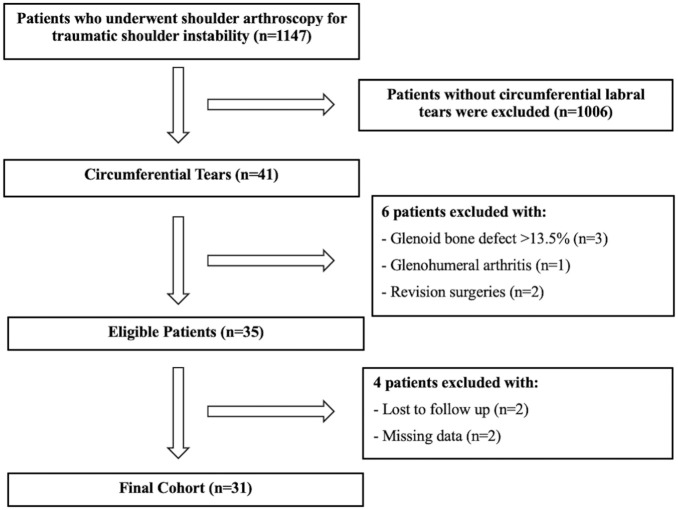
Results: Circumferential tears were identified in 3.6% (n = 41) of 1147 patients undergoing arthroscopic procedures for shoulder instability. Of these, 31 patients (mean age, 29.5 ± 9.3 years; 90% male; mean instability events, 5.5 ± 6.9; mean follow-up, 60.4 ± 30.1 months) meeting the inclusion criteria were analyzed. Overall, 39% (n = 12) had a single instability event, with 6 participating in contact sports and 4 in overhead or throwing sports, 9 of them at a competitive level. The proportions of patients who achieved MCID, PASS, and SCB thresholds were as follows: ASES (100, 80.6, and 80.6, respectively), WOSI total (100, 90.3, and 80.6, respectively), and VAS (90.3, 87.1, and 80.6, respectively).
Conclusion: Circumferential labral tears are rare. One-third of them may occur even after a single instability event and, therefore, should be considered during clinical evaluation, regardless of the number of prior instability events. Reassuringly, most patients who underwent arthroscopic repair of circumferential tears using suture anchors achieved successful clinically meaningful outcomes at a mean follow-up of approximately 5 years.
期刊介绍:
The Orthopaedic Journal of Sports Medicine (OJSM), developed by the American Orthopaedic Society for Sports Medicine (AOSSM), is a global, peer-reviewed, open access journal that combines the interests of researchers and clinical practitioners across orthopaedic sports medicine, arthroscopy, and knee arthroplasty.
Topics include original research in the areas of:
-Orthopaedic Sports Medicine, including surgical and nonsurgical treatment of orthopaedic sports injuries
-Arthroscopic Surgery (Shoulder/Elbow/Wrist/Hip/Knee/Ankle/Foot)
-Relevant translational research
-Sports traumatology/epidemiology
-Knee and shoulder arthroplasty
The OJSM also publishes relevant systematic reviews and meta-analyses.
This journal is a member of the Committee on Publication Ethics (COPE).



 求助内容:
求助内容: 应助结果提醒方式:

 京公网安备 11010802042870号


