{"title":"Assessing the Quality of Consumer Health Information Within the Realm of Shoulder Injuries on TikTok.","authors":"Bashar Jawich, Haytham Alqasmi, Alqasim Elnaggar, Shadi Kotob, Omar Abdalla, Imran Bitar, Ameen Suhrawardy, Rahul Vaidya","doi":"10.1177/23259671261419114","DOIUrl":null,"url":null,"abstract":"<p><strong>Background: </strong>Shoulder pain and injury are among the most prevalent musculoskeletal presentations in primary care. With the rise of consumer health information on TikTok, it is pivotal to assess and determine whether the information produced by content creators can serve as a supplement for shoulder rehabilitation and injury prevention.</p><p><strong>Hypothesis: </strong>It was hypothesized that content creators with professional degrees and extensive knowledge within the realm of shoulder injuries would yield valuable and accurate health information.</p><p><strong>Study design: </strong>Cross-sectional study.</p><p><strong>Methods: </strong>On June 18, 2025, #ShoulderInjury was used as the search item under the TikTok search engine. A total of 9286 videos appeared after the initial search. The authors applied an inclusion criteria of at least 100 likes. Exclusion criteria removed irrelevant, non-English, and duplicate videos, resulting in 209 eligible videos for further analysis. These were evaluated using the DISCERN questionnaire, an instrument used to assess consumer health information on a 1 to 5 scale. Two independent raters scored the videos, and interrater reliability was calculated using weighted Cohen kappa.</p><p><strong>Results: </strong>The 209 analyzed videos garnered 1,408,268 likes and 12,536 comments, with a mean DISCERN score of 2.61. Physicians' videos (n = 41) had the highest mean score (3.52), significantly outperforming nonprofessionals (2.18), physical therapists (2.87), and other professionals (2.79) in critical DISCERN areas (<i>P</i> < .001). Educational content yielded the highest mean score (3.29), whereas personal story videos had the lowest (1.89). Weighted Cohen kappa showed very good agreement for physician videos (κ = 0.82), moderate for physical therapists (κ = 0.59), good for nonprofessionals (κ = 0.79), and fair for other professionals (κ = 0.40).</p><p><strong>Conclusion: </strong>This study highlights the potential of TikTok as an effective educational tool when used by qualified professionals. Professionally produced content consistently scored higher on the DISCERN scale. Although the findings are promising, it is important to note limitations, like potential biases in DISCERN scoring due to nonblinded raters, the influence of TikTok's algorithm, and the exclusion of videos with <100 likes. Future research should explore social media's role in medical education and assess how to optimize content delivery and engagement.</p>","PeriodicalId":19646,"journal":{"name":"Orthopaedic Journal of Sports Medicine","volume":"14 3","pages":"23259671261419114"},"PeriodicalIF":2.5000,"publicationDate":"2026-03-09","publicationTypes":"Journal Article","fieldsOfStudy":null,"isOpenAccess":false,"openAccessPdf":"https://www.ncbi.nlm.nih.gov/pmc/articles/PMC12972568/pdf/","citationCount":"0","resultStr":null,"platform":"Semanticscholar","paperid":null,"PeriodicalName":"Orthopaedic Journal of Sports Medicine","FirstCategoryId":"3","ListUrlMain":"https://doi.org/10.1177/23259671261419114","RegionNum":3,"RegionCategory":"医学","ArticlePicture":[],"TitleCN":null,"AbstractTextCN":null,"PMCID":null,"EPubDate":"2026/3/1 0:00:00","PubModel":"eCollection","JCR":"Q2","JCRName":"ORTHOPEDICS","Score":null,"Total":0}
引用次数: 0
Abstract
Background: Shoulder pain and injury are among the most prevalent musculoskeletal presentations in primary care. With the rise of consumer health information on TikTok, it is pivotal to assess and determine whether the information produced by content creators can serve as a supplement for shoulder rehabilitation and injury prevention.
Hypothesis: It was hypothesized that content creators with professional degrees and extensive knowledge within the realm of shoulder injuries would yield valuable and accurate health information.
Study design: Cross-sectional study.
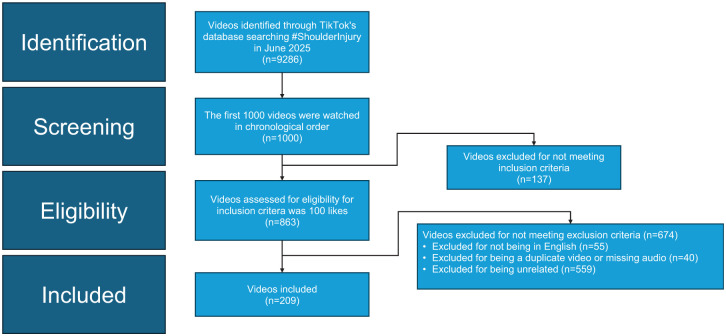
Methods: On June 18, 2025, #ShoulderInjury was used as the search item under the TikTok search engine. A total of 9286 videos appeared after the initial search. The authors applied an inclusion criteria of at least 100 likes. Exclusion criteria removed irrelevant, non-English, and duplicate videos, resulting in 209 eligible videos for further analysis. These were evaluated using the DISCERN questionnaire, an instrument used to assess consumer health information on a 1 to 5 scale. Two independent raters scored the videos, and interrater reliability was calculated using weighted Cohen kappa.
Results: The 209 analyzed videos garnered 1,408,268 likes and 12,536 comments, with a mean DISCERN score of 2.61. Physicians' videos (n = 41) had the highest mean score (3.52), significantly outperforming nonprofessionals (2.18), physical therapists (2.87), and other professionals (2.79) in critical DISCERN areas (P < .001). Educational content yielded the highest mean score (3.29), whereas personal story videos had the lowest (1.89). Weighted Cohen kappa showed very good agreement for physician videos (κ = 0.82), moderate for physical therapists (κ = 0.59), good for nonprofessionals (κ = 0.79), and fair for other professionals (κ = 0.40).
Conclusion: This study highlights the potential of TikTok as an effective educational tool when used by qualified professionals. Professionally produced content consistently scored higher on the DISCERN scale. Although the findings are promising, it is important to note limitations, like potential biases in DISCERN scoring due to nonblinded raters, the influence of TikTok's algorithm, and the exclusion of videos with <100 likes. Future research should explore social media's role in medical education and assess how to optimize content delivery and engagement.
期刊介绍:
The Orthopaedic Journal of Sports Medicine (OJSM), developed by the American Orthopaedic Society for Sports Medicine (AOSSM), is a global, peer-reviewed, open access journal that combines the interests of researchers and clinical practitioners across orthopaedic sports medicine, arthroscopy, and knee arthroplasty.
Topics include original research in the areas of:
-Orthopaedic Sports Medicine, including surgical and nonsurgical treatment of orthopaedic sports injuries
-Arthroscopic Surgery (Shoulder/Elbow/Wrist/Hip/Knee/Ankle/Foot)
-Relevant translational research
-Sports traumatology/epidemiology
-Knee and shoulder arthroplasty
The OJSM also publishes relevant systematic reviews and meta-analyses.
This journal is a member of the Committee on Publication Ethics (COPE).



 求助内容:
求助内容: 应助结果提醒方式:

 京公网安备 11010802042870号


