Ruben Valle, Nora Morrison, Vijaya Raghavan, Srividya N Iyer
{"title":"Availability and effectiveness of multicomponent interventions for early psychosis in 20 low-income and middle-income countries: a systematic review.","authors":"Ruben Valle, Nora Morrison, Vijaya Raghavan, Srividya N Iyer","doi":"10.1016/j.eclinm.2026.103795","DOIUrl":null,"url":null,"abstract":"<p><strong>Background: </strong>Most individuals with psychosis live in low and middle-income countries (LMICs) where treatment delays and gaps are common. Little is known about the types of interventions for first-episode psychosis (FEP) and clinical high-risk (CHR) for psychosis in LMICs and their effectiveness. This systematic review aimed to identify treatment components delivered for FEP or CHR in LMICs and evaluate their effectiveness.</p><p><strong>Methods: </strong>In this systematic review, we searched PsycINFO, Embase, and Medline for relevant studies published, without any language restrictions, between database inception and Jan 23, 2022. This search was updated on May 15, 2024 and on January 2, 2026. Records were included if they evaluated at least one more intervention beyond medication and assessment for FEP and beyond assessment for CHR, in LMICs with at least one follow-up. Included papers were classified as programmes (offering FEP/CHR services) or research studies of intervention(s)/outcomes in FEP/CHR. Treatment components were categorised as guideline-based or additional. Effectiveness was assessed across 15 outcomes defined <i>a priori</i>. Study quality was evaluated using the Mixed Methods Appraisal Tool, and findings were synthesised narratively. This study was pre-registered with PROSPERO, CRD42022308467.</p><p><strong>Findings: </strong>Of 6046 screened records, 125 were included (average: 152 participants; range: 10-1268) across 20 countries and five languages (English, Spanish, Portuguese, Turkish, and Persian). These comprised 10 programmes and 30 studies for FEP in 16 countries (11.7% of LMICs), and eight programmes and eight studies for CHR across eight countries (5.8%). They delivered guideline-based and additional components; however, psychological and psychosocial components were scarce. For FEP, the addition of any psychological or psychosocial component was associated with improved outcomes relative to medication alone. Patient psychoeducation and family interventions were the most frequently implemented components. For CHR, limited data prevented conclusions about the effectiveness of treatment components in LMICs.</p><p><strong>Interpretation: </strong>Despite limited and moderate-quality evidence, our findings suggest that early intervention can improve outcomes in FEP. However, coverage remains limited to few LMICs and even they struggle to provide comprehensive care. Further research is needed to strengthen, scale, and culturally adapt such services.</p><p><strong>Funding: </strong>Canadian Institutes of Health Research, Canada Research Chairs program.</p>","PeriodicalId":11393,"journal":{"name":"EClinicalMedicine","volume":"93 ","pages":"103795"},"PeriodicalIF":10.0000,"publicationDate":"2026-03-05","publicationTypes":"Journal Article","fieldsOfStudy":null,"isOpenAccess":false,"openAccessPdf":"https://www.ncbi.nlm.nih.gov/pmc/articles/PMC12972994/pdf/","citationCount":"0","resultStr":null,"platform":"Semanticscholar","paperid":null,"PeriodicalName":"EClinicalMedicine","FirstCategoryId":"3","ListUrlMain":"https://doi.org/10.1016/j.eclinm.2026.103795","RegionNum":1,"RegionCategory":"医学","ArticlePicture":[],"TitleCN":null,"AbstractTextCN":null,"PMCID":null,"EPubDate":"2026/3/1 0:00:00","PubModel":"eCollection","JCR":"Q1","JCRName":"MEDICINE, GENERAL & INTERNAL","Score":null,"Total":0}
引用次数: 0
Abstract
Background: Most individuals with psychosis live in low and middle-income countries (LMICs) where treatment delays and gaps are common. Little is known about the types of interventions for first-episode psychosis (FEP) and clinical high-risk (CHR) for psychosis in LMICs and their effectiveness. This systematic review aimed to identify treatment components delivered for FEP or CHR in LMICs and evaluate their effectiveness.
Methods: In this systematic review, we searched PsycINFO, Embase, and Medline for relevant studies published, without any language restrictions, between database inception and Jan 23, 2022. This search was updated on May 15, 2024 and on January 2, 2026. Records were included if they evaluated at least one more intervention beyond medication and assessment for FEP and beyond assessment for CHR, in LMICs with at least one follow-up. Included papers were classified as programmes (offering FEP/CHR services) or research studies of intervention(s)/outcomes in FEP/CHR. Treatment components were categorised as guideline-based or additional. Effectiveness was assessed across 15 outcomes defined a priori. Study quality was evaluated using the Mixed Methods Appraisal Tool, and findings were synthesised narratively. This study was pre-registered with PROSPERO, CRD42022308467.
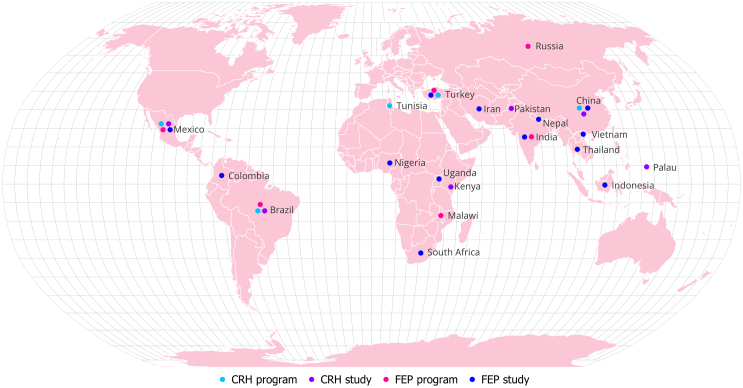
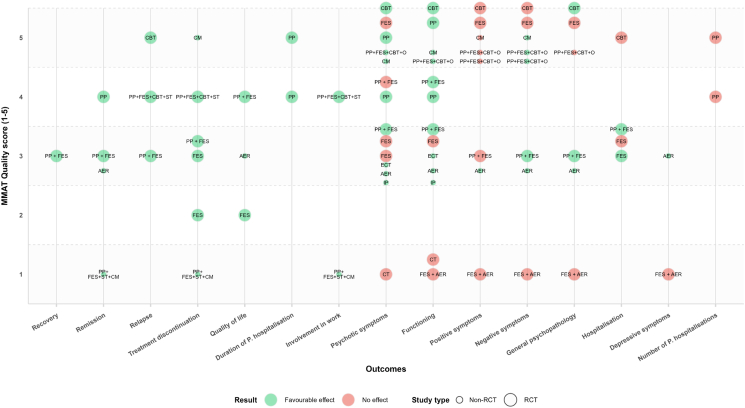
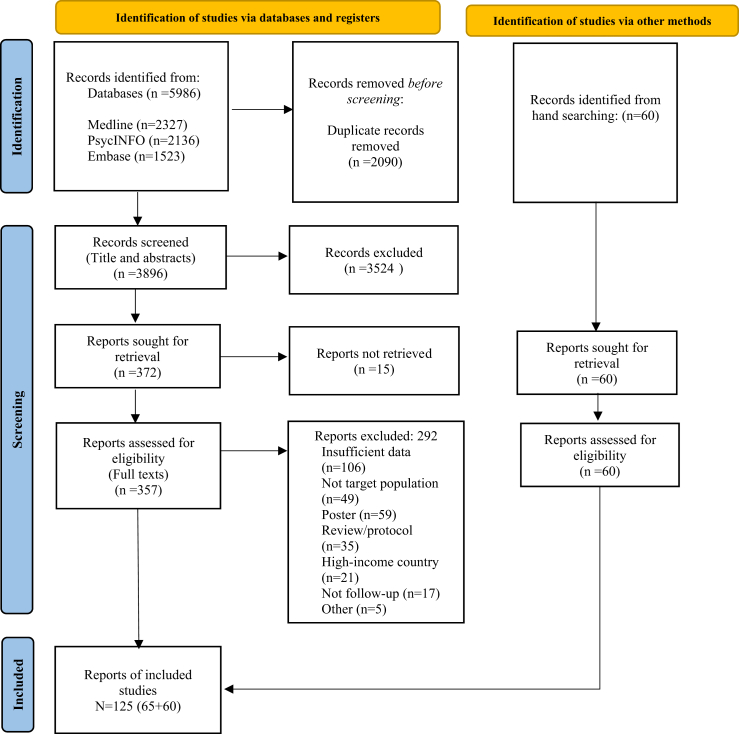
Findings: Of 6046 screened records, 125 were included (average: 152 participants; range: 10-1268) across 20 countries and five languages (English, Spanish, Portuguese, Turkish, and Persian). These comprised 10 programmes and 30 studies for FEP in 16 countries (11.7% of LMICs), and eight programmes and eight studies for CHR across eight countries (5.8%). They delivered guideline-based and additional components; however, psychological and psychosocial components were scarce. For FEP, the addition of any psychological or psychosocial component was associated with improved outcomes relative to medication alone. Patient psychoeducation and family interventions were the most frequently implemented components. For CHR, limited data prevented conclusions about the effectiveness of treatment components in LMICs.
Interpretation: Despite limited and moderate-quality evidence, our findings suggest that early intervention can improve outcomes in FEP. However, coverage remains limited to few LMICs and even they struggle to provide comprehensive care. Further research is needed to strengthen, scale, and culturally adapt such services.
Funding: Canadian Institutes of Health Research, Canada Research Chairs program.
期刊介绍:
eClinicalMedicine is a gold open-access clinical journal designed to support frontline health professionals in addressing the complex and rapid health transitions affecting societies globally. The journal aims to assist practitioners in overcoming healthcare challenges across diverse communities, spanning diagnosis, treatment, prevention, and health promotion. Integrating disciplines from various specialties and life stages, it seeks to enhance health systems as fundamental institutions within societies. With a forward-thinking approach, eClinicalMedicine aims to redefine the future of healthcare.

 求助内容:
求助内容: 应助结果提醒方式:

 京公网安备 11010802042870号


