Marco Milone, Sara Vertaldi, Pietro Anoldo, Simona Borin, Graziano Ceccarelli, Anna D'Amore, Maurizio Degiuli, Paolo Delrio, Uberto Romario Fumagalli, Mario Guerrieri, Michele Manigrasso, Monica Ortenzi, Ugo Pace, Felice Pirozzi, Lucia Puca, Wanda Petz, Rossella Reddavid, Daniela Rega, Fabio Rondelli, Antonio Sciuto, Giovanni Domenico De Palma
{"title":"Interim analysis of short-term outcomes between robotic and laparoscopic surgery for colon cancer: results from the ESSIMIC trial.","authors":"Marco Milone, Sara Vertaldi, Pietro Anoldo, Simona Borin, Graziano Ceccarelli, Anna D'Amore, Maurizio Degiuli, Paolo Delrio, Uberto Romario Fumagalli, Mario Guerrieri, Michele Manigrasso, Monica Ortenzi, Ugo Pace, Felice Pirozzi, Lucia Puca, Wanda Petz, Rossella Reddavid, Daniela Rega, Fabio Rondelli, Antonio Sciuto, Giovanni Domenico De Palma","doi":"10.3393/ac.2025.00339.0048","DOIUrl":null,"url":null,"abstract":"<p><strong>Purpose: </strong>This study aimed to determine whether the benefits of robotic surgery can be applied to the treatment of colon cancer by evaluating short-term outcomes of robotic versus laparoscopic colonic resection.</p><p><strong>Methods: </strong>This interim analysis of an interventional multicenter randomized trial was conducted to compare outcomes of robotic and laparoscopic colorectal surgery performed between January 2017 and December 2019. The study specifically assessed short-term outcomes in patients undergoing laparoscopic or robotic right or left colectomy for cancer. In addition, all short-term outcomes were evaluated in separate subgroups of right and left colonic resections through prespecified subgroup analyses.</p><p><strong>Results: </strong>A total of 323 patients were analyzed, of whom 142 underwent robotic-assisted surgery and 181 underwent laparoscopic surgery. Overall, 109 complications (33.7%) occurred in the short-term period, 41 (28.9%) in the robotic group and 68 (37.6%) in the laparoscopic group, with no differences between groups in intraoperative or postoperative complications. However, grade III complications were significantly more frequent in the laparoscopic group, with 17 cases (9.4%) compared to 5 cases (3.5%) in the robotic group. Oncological radicality was similar between groups. Functional recovery after surgery was superior in the robotic group, as reflected by a shorter time to mobilization (17.5±10.2 hours vs. 21.1±11.5 hours). In the right colectomy subgroup, rates of grade III complications (1.9% vs. 11.7%) and lymph nodes retrieved (20.3±10.3 vs. 20.2±6.4) favored robotic surgery. In the left colon cancer subgroup, functional recovery was also improved with robotic surgery (44.3±22.2 hours vs. 61.1±31.1 hours, as measured by the composite recovery outcome).</p><p><strong>Conclusion: </strong>Robotic surgery is associated with fewer severe complications and improved postoperative recovery following colonic resections. Trial registration: ClinicalTrials.gov identifier: NCT02871960.</p>","PeriodicalId":8267,"journal":{"name":"Annals of Coloproctology","volume":"42 1","pages":"86-93"},"PeriodicalIF":2.1000,"publicationDate":"2026-02-01","publicationTypes":"Journal Article","fieldsOfStudy":null,"isOpenAccess":false,"openAccessPdf":"https://www.ncbi.nlm.nih.gov/pmc/articles/PMC12971168/pdf/","citationCount":"0","resultStr":null,"platform":"Semanticscholar","paperid":null,"PeriodicalName":"Annals of Coloproctology","FirstCategoryId":"1085","ListUrlMain":"https://doi.org/10.3393/ac.2025.00339.0048","RegionNum":0,"RegionCategory":null,"ArticlePicture":[],"TitleCN":null,"AbstractTextCN":null,"PMCID":null,"EPubDate":"2026/2/23 0:00:00","PubModel":"Epub","JCR":"Q2","JCRName":"GASTROENTEROLOGY & HEPATOLOGY","Score":null,"Total":0}
引用次数: 0
Abstract
Purpose: This study aimed to determine whether the benefits of robotic surgery can be applied to the treatment of colon cancer by evaluating short-term outcomes of robotic versus laparoscopic colonic resection.
Methods: This interim analysis of an interventional multicenter randomized trial was conducted to compare outcomes of robotic and laparoscopic colorectal surgery performed between January 2017 and December 2019. The study specifically assessed short-term outcomes in patients undergoing laparoscopic or robotic right or left colectomy for cancer. In addition, all short-term outcomes were evaluated in separate subgroups of right and left colonic resections through prespecified subgroup analyses.
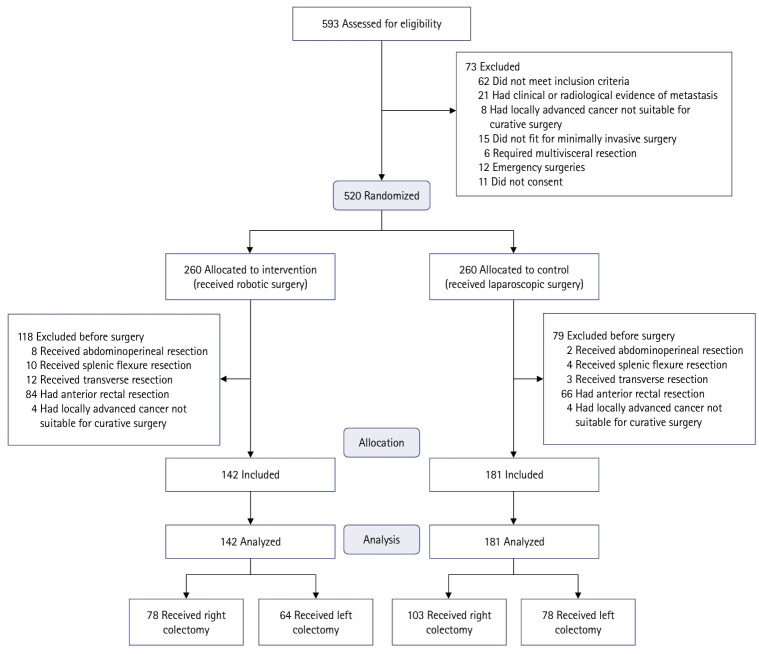
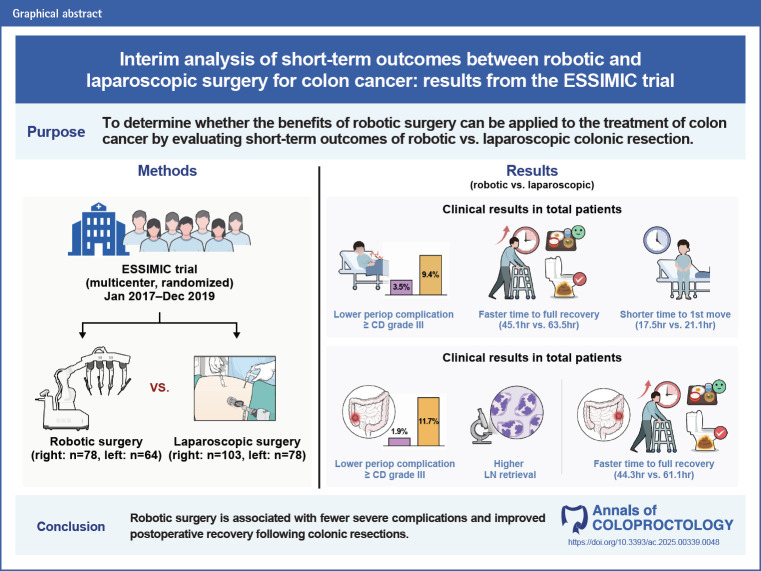
Results: A total of 323 patients were analyzed, of whom 142 underwent robotic-assisted surgery and 181 underwent laparoscopic surgery. Overall, 109 complications (33.7%) occurred in the short-term period, 41 (28.9%) in the robotic group and 68 (37.6%) in the laparoscopic group, with no differences between groups in intraoperative or postoperative complications. However, grade III complications were significantly more frequent in the laparoscopic group, with 17 cases (9.4%) compared to 5 cases (3.5%) in the robotic group. Oncological radicality was similar between groups. Functional recovery after surgery was superior in the robotic group, as reflected by a shorter time to mobilization (17.5±10.2 hours vs. 21.1±11.5 hours). In the right colectomy subgroup, rates of grade III complications (1.9% vs. 11.7%) and lymph nodes retrieved (20.3±10.3 vs. 20.2±6.4) favored robotic surgery. In the left colon cancer subgroup, functional recovery was also improved with robotic surgery (44.3±22.2 hours vs. 61.1±31.1 hours, as measured by the composite recovery outcome).
Conclusion: Robotic surgery is associated with fewer severe complications and improved postoperative recovery following colonic resections. Trial registration: ClinicalTrials.gov identifier: NCT02871960.
目的:本研究旨在通过评估机器人手术与腹腔镜结肠切除术的短期疗效,确定机器人手术的益处是否可以应用于结肠癌的治疗。方法:对一项介入性多中心随机试验进行中期分析,比较2017年1月至2019年12月期间进行的机器人和腹腔镜结直肠手术的结果。该研究特别评估了接受腹腔镜或机器人左右结肠切除术的癌症患者的短期预后。此外,通过预先指定的亚组分析,对左、右结肠切除术单独亚组的所有短期结果进行评估。结果:共分析了323例患者,其中142例接受了机器人辅助手术,181例接受了腹腔镜手术。总体而言,短期内发生并发症109例(33.7%),机器人组41例(28.9%),腹腔镜组68例(37.6%),两组术中、术后并发症无差异。然而,腹腔镜组III级并发症明显更频繁,有17例(9.4%),而机器人组为5例(3.5%)。两组间肿瘤的根治性相似。机器人组术后功能恢复优于机器人组,其活动时间较短(17.5±10.2小时vs. 21.1±11.5小时)。在右结肠切除术亚组中,III级并发症(1.9% vs. 11.7%)和淋巴结回收(20.3±10.3 vs. 20.2±6.4)倾向于机器人手术。在左侧结肠癌亚组中,机器人手术也改善了功能恢复(44.3±22.2小时比61.1±31.1小时,复合恢复结果测量)。结论:机器人手术减少了严重并发症,改善了结肠切除术后的术后恢复。试验注册:ClinicalTrials.gov标识符:NCT02871960。


 求助内容:
求助内容: 应助结果提醒方式:

 京公网安备 11010802042870号


