{"title":"Survival impact of radiotherapy for patients with de novo metastatic rectal cancer.","authors":"Harvey Yu-Li Su, Yun-Hsuan Lin, Ko-Chao Lee, Yueh-Ming Lin, Chun-Chieh Huang, Eng-Yen Huang, Tai-Jan Chiu, Shih-Yu Huang, Chia-Che Wu, Chang-Ting Lin, Ming-Chun Kuo, Kai-Lung Tsai","doi":"10.3393/ac.2025.00605.0086","DOIUrl":null,"url":null,"abstract":"<p><strong>Purpose: </strong>Metastatic rectal cancer (mRC) is a highly lethal and complex disease that demands a multidisciplinary treatment approach. However, the clinical effectiveness of radiotherapy (RT) for de novo mRC remains controversial and uncertain.</p><p><strong>Methods: </strong>This retrospective cohort study examined medical records from Kaohsiung Chang Gung Memorial Hospital for patients with histologically confirmed de novo mRC diagnosed between January 2015 and December 2020. All patients received standard systemic therapy and radical surgery when feasible. The primary outcome, overall survival (OS), was assessed using the Kaplan-Meier method. Multivariable analysis was performed using a Cox regression model.</p><p><strong>Results: </strong>Among 271 patients included in the analysis, 117 received RT and 154 did not. The median OS was significantly longer in the RT group compared with the non-RT group (27.8 months vs. 21.9 months; P=0.046). Multivariate analysis identified several independent predictors of OS: age ≥65 years (hazard ratio [HR], 1.69; 95% confidence interval [CI], 1.26-2.27; P=0.001), primary tumor resection (HR, 2.62; 95% CI, 1.90-3.61; P<0.001), M1b or M1c disease (HR, 1.97; 95% CI, 1.44-2.69; P<0.001), and receipt of RT (HR, 1.41; 95% CI, 1.02-1.94; P=0.036).</p><p><strong>Conclusion: </strong>RT significantly improves OS in patients with mRC, underscoring its role in treatment strategies. These findings support its inclusion in therapeutic protocols and highlight the need for larger, multicenter trials to confirm and extend these results.</p>","PeriodicalId":8267,"journal":{"name":"Annals of Coloproctology","volume":"42 1","pages":"94-102"},"PeriodicalIF":2.1000,"publicationDate":"2026-02-01","publicationTypes":"Journal Article","fieldsOfStudy":null,"isOpenAccess":false,"openAccessPdf":"https://www.ncbi.nlm.nih.gov/pmc/articles/PMC12971171/pdf/","citationCount":"0","resultStr":null,"platform":"Semanticscholar","paperid":null,"PeriodicalName":"Annals of Coloproctology","FirstCategoryId":"1085","ListUrlMain":"https://doi.org/10.3393/ac.2025.00605.0086","RegionNum":0,"RegionCategory":null,"ArticlePicture":[],"TitleCN":null,"AbstractTextCN":null,"PMCID":null,"EPubDate":"2026/2/26 0:00:00","PubModel":"Epub","JCR":"Q2","JCRName":"GASTROENTEROLOGY & HEPATOLOGY","Score":null,"Total":0}
引用次数: 0
Abstract
Purpose: Metastatic rectal cancer (mRC) is a highly lethal and complex disease that demands a multidisciplinary treatment approach. However, the clinical effectiveness of radiotherapy (RT) for de novo mRC remains controversial and uncertain.
Methods: This retrospective cohort study examined medical records from Kaohsiung Chang Gung Memorial Hospital for patients with histologically confirmed de novo mRC diagnosed between January 2015 and December 2020. All patients received standard systemic therapy and radical surgery when feasible. The primary outcome, overall survival (OS), was assessed using the Kaplan-Meier method. Multivariable analysis was performed using a Cox regression model.
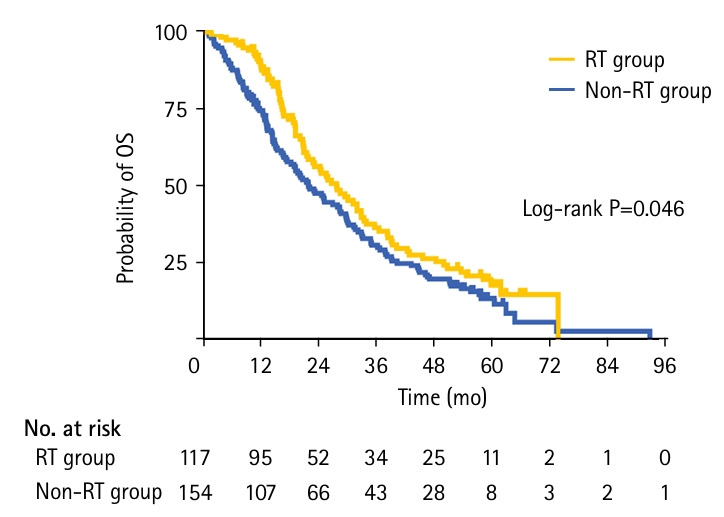
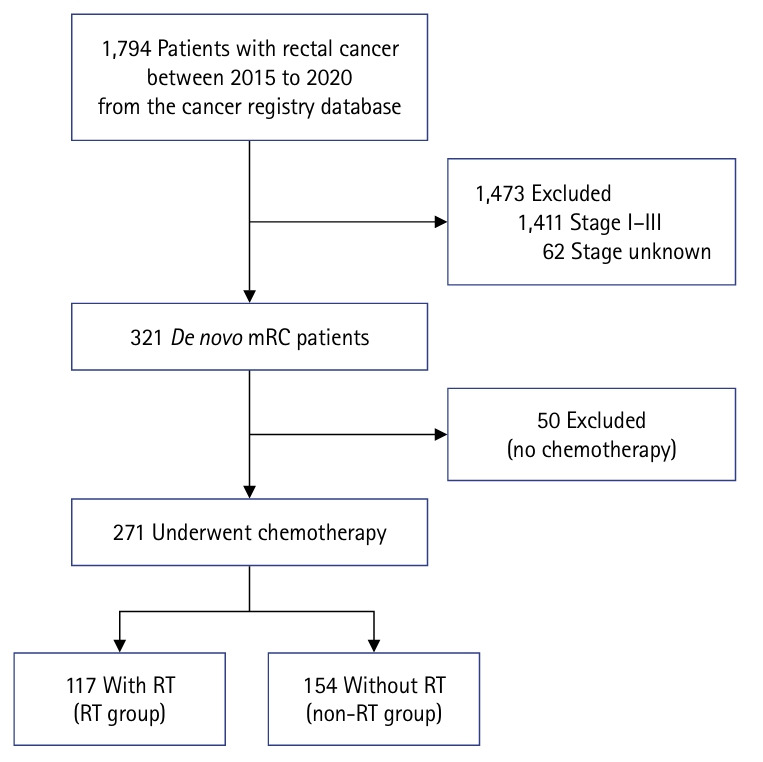
Results: Among 271 patients included in the analysis, 117 received RT and 154 did not. The median OS was significantly longer in the RT group compared with the non-RT group (27.8 months vs. 21.9 months; P=0.046). Multivariate analysis identified several independent predictors of OS: age ≥65 years (hazard ratio [HR], 1.69; 95% confidence interval [CI], 1.26-2.27; P=0.001), primary tumor resection (HR, 2.62; 95% CI, 1.90-3.61; P<0.001), M1b or M1c disease (HR, 1.97; 95% CI, 1.44-2.69; P<0.001), and receipt of RT (HR, 1.41; 95% CI, 1.02-1.94; P=0.036).
Conclusion: RT significantly improves OS in patients with mRC, underscoring its role in treatment strategies. These findings support its inclusion in therapeutic protocols and highlight the need for larger, multicenter trials to confirm and extend these results.



 求助内容:
求助内容: 应助结果提醒方式:

 京公网安备 11010802042870号


