Structural, electronic, and energetic modifications in alkali metal-doped Ge₁₂C₁₂ nanocages for tuning nonlinear optical response, energetic offsets, and charge transfer dynamics: computational insights for advanced photonic materials
Maria Saif, Junaid Yaqoob, Ali Hussain, Muhammad Usman Khan, Sarah Alharthi, Mohammed A. Amin, Mazhar Amjad Gilani, Riaz Hussain
{"title":"Structural, electronic, and energetic modifications in alkali metal-doped Ge₁₂C₁₂ nanocages for tuning nonlinear optical response, energetic offsets, and charge transfer dynamics: computational insights for advanced photonic materials","authors":"Maria Saif, Junaid Yaqoob, Ali Hussain, Muhammad Usman Khan, Sarah Alharthi, Mohammed A. Amin, Mazhar Amjad Gilani, Riaz Hussain","doi":"10.1007/s11224-025-02551-1","DOIUrl":null,"url":null,"abstract":"<div><p>The development of next-generation optoelectronic and photonic devices requires advanced materials with superior nonlinear optical (NLO) properties. Despite significant efforts, the design of stable, efficient, and tunable NLO materials at the nanoscale remains a key challenge. In this context, exploring novel materials with extraordinarily large NLO responses is an intriguing field of study. Density functional theory (DFT) calculations were carried out for exohedral alkali metal-doped Ge<sub>12</sub>C<sub>12</sub> nanocage in order to examine their geometric, electronic, and nonlinear optical properties. Interaction energy (E<sub>int</sub>) computations were employed to study the thermal stability of the complexes under consideration, with the highest interaction energy being − 50.72 kcal/mol. After doping with Li, Na, and K, the E<sub>HL</sub> gap decreased, with the lowest E<sub>HL</sub> gap being measured at 1.66 eV for Na@r<sub>4</sub>-GeC. The TD-DFT computations illustrate that the complexes of Ge<sub>12</sub>C<sub>12</sub> are transparent in the UV region. The natural bond orbital (NBO) and total density of state (TDOS) and partial density of state (PDOS) studies were used to investigate the participation of various segments and confirm charge transfer, respectively. The type of interaction was examined through IRI and QTAIM analyses, which assured the existence of non-covalent interactions between alkali metals and nanocages. The complex of Na@r<sub>4</sub> displays a first hyperpolarizability value of 3.4 × 10<sup>4</sup> au. Therefore, the results demonstrate that the doped complexes of Ge<sub>12</sub>C<sub>12</sub> nanocage with alkali metals are promising candidates for nanoscale materials because of their enhanced NLO responsiveness and excellent stability. This study addresses the rational design strategy for creating high NLO response materials for novel optoelectronic applications.</p></div>","PeriodicalId":780,"journal":{"name":"Structural Chemistry","volume":"37 2","pages":"541 - 569"},"PeriodicalIF":2.2000,"publicationDate":"2025-07-08","publicationTypes":"Journal Article","fieldsOfStudy":null,"isOpenAccess":false,"openAccessPdf":"","citationCount":"0","resultStr":null,"platform":"Semanticscholar","paperid":null,"PeriodicalName":"Structural Chemistry","FirstCategoryId":"92","ListUrlMain":"https://link.springer.com/article/10.1007/s11224-025-02551-1","RegionNum":4,"RegionCategory":"化学","ArticlePicture":[],"TitleCN":null,"AbstractTextCN":null,"PMCID":null,"EPubDate":"","PubModel":"","JCR":"Q3","JCRName":"CHEMISTRY, MULTIDISCIPLINARY","Score":null,"Total":0}
引用次数: 0
Abstract
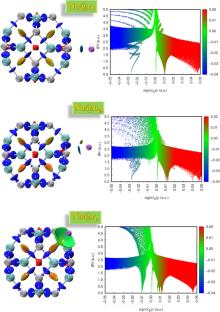
The development of next-generation optoelectronic and photonic devices requires advanced materials with superior nonlinear optical (NLO) properties. Despite significant efforts, the design of stable, efficient, and tunable NLO materials at the nanoscale remains a key challenge. In this context, exploring novel materials with extraordinarily large NLO responses is an intriguing field of study. Density functional theory (DFT) calculations were carried out for exohedral alkali metal-doped Ge12C12 nanocage in order to examine their geometric, electronic, and nonlinear optical properties. Interaction energy (Eint) computations were employed to study the thermal stability of the complexes under consideration, with the highest interaction energy being − 50.72 kcal/mol. After doping with Li, Na, and K, the EHL gap decreased, with the lowest EHL gap being measured at 1.66 eV for Na@r4-GeC. The TD-DFT computations illustrate that the complexes of Ge12C12 are transparent in the UV region. The natural bond orbital (NBO) and total density of state (TDOS) and partial density of state (PDOS) studies were used to investigate the participation of various segments and confirm charge transfer, respectively. The type of interaction was examined through IRI and QTAIM analyses, which assured the existence of non-covalent interactions between alkali metals and nanocages. The complex of Na@r4 displays a first hyperpolarizability value of 3.4 × 10⁴ au. Therefore, the results demonstrate that the doped complexes of Ge12C12 nanocage with alkali metals are promising candidates for nanoscale materials because of their enhanced NLO responsiveness and excellent stability. This study addresses the rational design strategy for creating high NLO response materials for novel optoelectronic applications.
期刊介绍:
Structural Chemistry is an international forum for the publication of peer-reviewed original research papers that cover the condensed and gaseous states of matter and involve numerous techniques for the determination of structure and energetics, their results, and the conclusions derived from these studies. The journal overcomes the unnatural separation in the current literature among the areas of structure determination, energetics, and applications, as well as builds a bridge to other chemical disciplines. Ist comprehensive coverage encompasses broad discussion of results, observation of relationships among various properties, and the description and application of structure and energy information in all domains of chemistry.
We welcome the broadest range of accounts of research in structural chemistry involving the discussion of methodologies and structures,experimental, theoretical, and computational, and their combinations. We encourage discussions of structural information collected for their chemicaland biological significance.

 求助内容:
求助内容: 应助结果提醒方式:

 京公网安备 11010802042870号


