{"title":"A new series of pyrazoles-based compounds: synthesis, HOMO–LUMO analysis, MEP, quantum reactivity, and in silico covid-19 activity","authors":"Nazenin Akın, Yasemin Sunucu-Karafakıoğlu, Senem Akkoc, Mehran Feizi-Dehnayebi, Eyüp Başaran, Ilhan Ozer Ilhan","doi":"10.1007/s11224-025-02602-7","DOIUrl":null,"url":null,"abstract":"<div><p>In the present study, we synthesized four new pyrazole-based compounds with yields of 80%, 70%, 56% and 60% for compounds <b>2–5</b>, respectively. All compounds were characterized by spectroscopic methods. Density functional theory (DFT) calculations were performed to investigate the electronic and quantum chemical properties of the newly synthesized compounds. The optimized geometries obtained from DFT analysis were used to examine the active sites of the compounds through MEP diagrams. Furthermore, the differences in the HOMO–LUMO energy levels were analyzed to assess the biological activity, chemical reactivity, and stability of the molecules. Additional quantum reactivity descriptors were evaluated based on the molecular orbital energies. In parallel, an <i>in silico</i> docking study was conducted to explore the biological activity of the synthesized compounds against the COVID-19 receptor. Among the synthesized compounds, compound <b>3</b> not only showed the most favorable electronic properties (smallest energy gap: 1.17 eV and highest ω: 23.31 eV) but also exhibited the lowest binding energy (–4.43 kcal/mol) in docking studies, indicating strong and stable binding to the 6LU7 protease active site. The combined results from DFT calculations, docking studies and ADME-Tox profiling provide valuable insights into the electronic properties, reactivity, and potential biological applications of the synthesized compounds.</p></div>","PeriodicalId":780,"journal":{"name":"Structural Chemistry","volume":"37 2","pages":"841 - 857"},"PeriodicalIF":2.2000,"publicationDate":"2025-08-29","publicationTypes":"Journal Article","fieldsOfStudy":null,"isOpenAccess":false,"openAccessPdf":"","citationCount":"0","resultStr":null,"platform":"Semanticscholar","paperid":null,"PeriodicalName":"Structural Chemistry","FirstCategoryId":"92","ListUrlMain":"https://link.springer.com/article/10.1007/s11224-025-02602-7","RegionNum":4,"RegionCategory":"化学","ArticlePicture":[],"TitleCN":null,"AbstractTextCN":null,"PMCID":null,"EPubDate":"","PubModel":"","JCR":"Q3","JCRName":"CHEMISTRY, MULTIDISCIPLINARY","Score":null,"Total":0}
引用次数: 0
Abstract
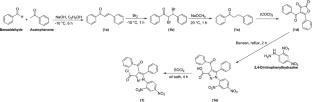
In the present study, we synthesized four new pyrazole-based compounds with yields of 80%, 70%, 56% and 60% for compounds 2–5, respectively. All compounds were characterized by spectroscopic methods. Density functional theory (DFT) calculations were performed to investigate the electronic and quantum chemical properties of the newly synthesized compounds. The optimized geometries obtained from DFT analysis were used to examine the active sites of the compounds through MEP diagrams. Furthermore, the differences in the HOMO–LUMO energy levels were analyzed to assess the biological activity, chemical reactivity, and stability of the molecules. Additional quantum reactivity descriptors were evaluated based on the molecular orbital energies. In parallel, an in silico docking study was conducted to explore the biological activity of the synthesized compounds against the COVID-19 receptor. Among the synthesized compounds, compound 3 not only showed the most favorable electronic properties (smallest energy gap: 1.17 eV and highest ω: 23.31 eV) but also exhibited the lowest binding energy (–4.43 kcal/mol) in docking studies, indicating strong and stable binding to the 6LU7 protease active site. The combined results from DFT calculations, docking studies and ADME-Tox profiling provide valuable insights into the electronic properties, reactivity, and potential biological applications of the synthesized compounds.
期刊介绍:
Structural Chemistry is an international forum for the publication of peer-reviewed original research papers that cover the condensed and gaseous states of matter and involve numerous techniques for the determination of structure and energetics, their results, and the conclusions derived from these studies. The journal overcomes the unnatural separation in the current literature among the areas of structure determination, energetics, and applications, as well as builds a bridge to other chemical disciplines. Ist comprehensive coverage encompasses broad discussion of results, observation of relationships among various properties, and the description and application of structure and energy information in all domains of chemistry.
We welcome the broadest range of accounts of research in structural chemistry involving the discussion of methodologies and structures,experimental, theoretical, and computational, and their combinations. We encourage discussions of structural information collected for their chemicaland biological significance.

 求助内容:
求助内容: 应助结果提醒方式:

 京公网安备 11010802042870号


