V. V. Alisin, I. N. Kravchenko, M. N. Erofeev, I. A. Leshakov, O. S. Bukov
{"title":"Mechanism of Destruction of Friction Surfaces of Ceramic Materials Based on Zirconium Dioxide under Dry Friction","authors":"V. V. Alisin, I. N. Kravchenko, M. N. Erofeev, I. A. Leshakov, O. S. Bukov","doi":"10.1134/S1063784225601231","DOIUrl":null,"url":null,"abstract":"<p>The issues of formation of the third body during dry friction on steel of nanostructured zirconium dioxide crystals partially stabilized by yttrium oxide are considered. The assumption is substantiated that the tribological properties of the friction pair under study are determined by the properties of the films formed on the surface of the crystals. The results of electron microscopic studies of crystal friction surfaces are presented. The elemental composition has been determined, and the phase composition of the transfer films of various areas of the friction surface of crystals have been calculated. It has been established that at high magnifications, the structure of the films on the friction surface of samples with 2–4 mol% Y<sub>2</sub>O<sub>3</sub> is quite uniform with traces of the boundaries of smaller particles of the transferred material. The destruction of the friction surface of the sample with a Y<sub>2</sub>O<sub>3</sub> content of 8 mol% occurs at a deeper level and affects not only the layer of secondary structures, but also the underlying layers of the base material. Recommendations for the selection of friction pairs for high-temperature friction units are formulated.</p>","PeriodicalId":783,"journal":{"name":"Technical Physics","volume":"71 1","pages":"1 - 7"},"PeriodicalIF":0.4000,"publicationDate":"2026-02-18","publicationTypes":"Journal Article","fieldsOfStudy":null,"isOpenAccess":false,"openAccessPdf":"","citationCount":"0","resultStr":null,"platform":"Semanticscholar","paperid":null,"PeriodicalName":"Technical Physics","FirstCategoryId":"101","ListUrlMain":"https://link.springer.com/article/10.1134/S1063784225601231","RegionNum":4,"RegionCategory":"物理与天体物理","ArticlePicture":[],"TitleCN":null,"AbstractTextCN":null,"PMCID":null,"EPubDate":"","PubModel":"","JCR":"Q4","JCRName":"PHYSICS, APPLIED","Score":null,"Total":0}
引用次数: 0
Abstract
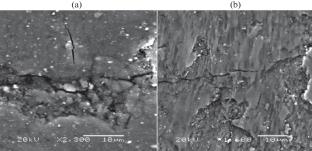
The issues of formation of the third body during dry friction on steel of nanostructured zirconium dioxide crystals partially stabilized by yttrium oxide are considered. The assumption is substantiated that the tribological properties of the friction pair under study are determined by the properties of the films formed on the surface of the crystals. The results of electron microscopic studies of crystal friction surfaces are presented. The elemental composition has been determined, and the phase composition of the transfer films of various areas of the friction surface of crystals have been calculated. It has been established that at high magnifications, the structure of the films on the friction surface of samples with 2–4 mol% Y2O3 is quite uniform with traces of the boundaries of smaller particles of the transferred material. The destruction of the friction surface of the sample with a Y2O3 content of 8 mol% occurs at a deeper level and affects not only the layer of secondary structures, but also the underlying layers of the base material. Recommendations for the selection of friction pairs for high-temperature friction units are formulated.
期刊介绍:
Technical Physics is a journal that contains practical information on all aspects of applied physics, especially instrumentation and measurement techniques. Particular emphasis is put on plasma physics and related fields such as studies of charged particles in electromagnetic fields, synchrotron radiation, electron and ion beams, gas lasers and discharges. Other journal topics are the properties of condensed matter, including semiconductors, superconductors, gases, liquids, and different materials.

 求助内容:
求助内容: 应助结果提醒方式:

 京公网安备 11010802042870号


