
Copilot: A framework for integrating LLM and BMI to enhance human–robot interaction
IF 12.3
1区 计算机科学
Q1 COMPUTER SCIENCE, INTERDISCIPLINARY APPLICATIONS
Robotics and Computer-integrated Manufacturing
Pub Date : 2026-10-01
Epub Date: 2026-03-09
DOI:10.1016/j.rcim.2026.103291
引用次数: 0
Abstract
This paper proposes an innovative human–robot interaction (HRI) framework called Copilot, which aims to bridge the gap between human intent and robot intelligence. Currently, existing HRI systems struggle to infer human intentions and rely heavily on predefined rules, a limitation that significantly hinders the advancement of the field. To address this issue, the Copilot framework, for the first time, integrates the environmental understanding capabilities of large language models (LLMs) with the intention recognition advantages of brain-machine interface (BMI). It constructs three core modules: (1) a LLM-based visual evoked potential (LLM-VEP) paradigm module utilizing LLM for scene understanding and dynamic marking; (2) a BMI module employing the blink-triggered multivariate variational mode decomposition with canonical correlation analysis (BT-MVMD-CCA) algorithm; and (3) an intelligent agent flexibly adapting to different task requirements. Through online experimental validation with 12 participants, the system performed optimally when using the EEG-based double blink triggering (EEG-DBT) method: 0% false trigger rate, 94.09% blink detection rate, and 84.00% task completion rate. In offline experiments, the proposed BT-MVMD-CCA algorithm achieved 92.3% classification accuracy and a peak information transfer rate (ITR) of 71.1 bits/min at DTW = 1.5 s. This research not only provides theoretical support for the HRI field, but also offers promising solutions for assistive robotics and manufacturing scenarios.
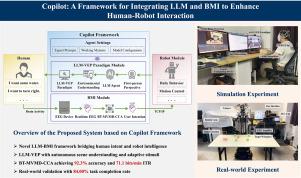
Copilot:一个整合LLM和BMI以增强人机交互的框架
本文提出了一种名为Copilot的创新人机交互(HRI)框架,旨在弥合人类意图和机器人智能之间的差距。目前,现有的HRI系统很难推断人类的意图,并且严重依赖于预定义的规则,这一限制极大地阻碍了该领域的发展。为了解决这一问题,Copilot框架首次将大型语言模型(llm)的环境理解能力与脑机接口(BMI)的意图识别优势相结合。构建了三个核心模块:(1)基于LLM的视觉诱发电位(LLM- vep)范式模块,利用LLM进行场景理解和动态标记;(2)采用眨眼触发多变量变分模态分解与典型相关分析(BT-MVMD-CCA)算法的BMI模块;(3)灵活适应不同任务要求的智能代理。通过对12名参与者的在线实验验证,采用基于脑电图的双闪触发(EEG-DBT)方法时,系统表现最佳:误触发率为0%,眨眼检测率为94.09%,任务完成率为84.00%。在离线实验中,提出的BT-MVMD-CCA算法在DTW = 1.5 s时的分类准确率达到92.3%,峰值信息传输速率(ITR)达到71.1 bits/min。本研究不仅为HRI领域提供了理论支持,也为辅助机器人和制造场景提供了有希望的解决方案。
本文章由计算机程序翻译,如有差异,请以英文原文为准。
求助全文
约1分钟内获得全文
求助全文
来源期刊
CiteScore
24.10
自引率
13.50%
发文量
160
审稿时长
50 days
期刊介绍:
The journal, Robotics and Computer-Integrated Manufacturing, focuses on sharing research applications that contribute to the development of new or enhanced robotics, manufacturing technologies, and innovative manufacturing strategies that are relevant to industry. Papers that combine theory and experimental validation are preferred, while review papers on current robotics and manufacturing issues are also considered. However, papers on traditional machining processes, modeling and simulation, supply chain management, and resource optimization are generally not within the scope of the journal, as there are more appropriate journals for these topics. Similarly, papers that are overly theoretical or mathematical will be directed to other suitable journals. The journal welcomes original papers in areas such as industrial robotics, human-robot collaboration in manufacturing, cloud-based manufacturing, cyber-physical production systems, big data analytics in manufacturing, smart mechatronics, machine learning, adaptive and sustainable manufacturing, and other fields involving unique manufacturing technologies.
 求助内容:
求助内容: 应助结果提醒方式:

 京公网安备 11010802042870号


