
Molecular and functional characterization of Enterococcus faecalis OB15: A hypoallergenic and antimicrobial starter from Tunisian Rigouta cheese
IF 3.4
3区 农林科学
Q2 FOOD SCIENCE & TECHNOLOGY
International Dairy Journal
Pub Date : 2026-06-01
Epub Date: 2026-02-11
DOI:10.1016/j.idairyj.2026.106585
引用次数: 0
Abstract
Screening lactic acid bacteria from traditional foods is vital for identifying functional strains. Enterococcus faecalis OB15, isolated from Tunisian Rigouta cheese, was characterized for its technological, antimicrobial, and hypoallergenic properties. The strain displayed significant proteolytic activity against bovine α- and β-caseins and β-lactoglobulin, with optimal activity at pH 6.5 and 37–42 °C. Inhibitor assays indicated a metalloprotease mechanism, consistent with gelatinase (GelE) activity. In silico docking analyses confirmed that GelE targets immunodominant β-casein epitopes, generating fragments too short for antibody recognition. This structural degradation correlated with a 61% reduction in IgG immunoreactivity. Antimicrobial activity, assessed by agar diffusion assays, revealed inhibitory effects against both Gram-positive and Gram-negative foodborne pathogens, including Escherichia coli (9.5 ± 0.3 mm), Listeria innocua (8.5 ± 0.2 mm), Staphylococcus aureus (8.2 ± 0.2 mm) and Salmonella Typhimurium (8.0 ± 0.5 mm). In addition, the strain lacked vancomycin resistance (vanA/vanB) and histamine decarboxylase (hdc) genes. These findings highlight the potential of E. faecalis OB15 as a promising starter culture for the development of hypoallergenic fermented dairy products.
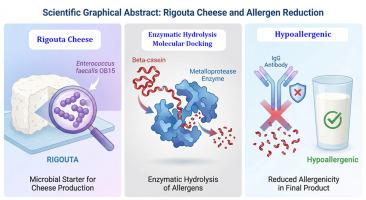
从突尼斯Rigouta奶酪中提取的低致敏性抗菌发酵剂粪肠球菌OB15的分子和功能特征
从传统食品中筛选乳酸菌对鉴定功能性菌株至关重要。从突尼斯Rigouta奶酪中分离得到粪肠球菌OB15,具有抗菌和低致敏性。菌株对牛α-、β-酪蛋白和β-乳球蛋白具有显著的蛋白水解活性,在pH 6.5和37 ~ 42℃条件下具有最佳的水解活性。抑制剂实验表明金属蛋白酶机制,与明胶酶(GelE)活性一致。硅对接分析证实,GelE靶向免疫优势β-酪蛋白表位,产生的片段太短而无法被抗体识别。这种结构降解与IgG免疫反应性降低61%相关。通过琼脂扩散试验评估抗菌活性,发现对革兰氏阳性和革兰氏阴性食源性病原体均有抑制作用,包括大肠杆菌(9.5±0.3 mm)、无害李斯特菌(8.5±0.2 mm)、金黄色葡萄球菌(8.2±0.2 mm)和鼠伤寒沙门菌(8.0±0.5 mm)。此外,该菌株缺乏万古霉素耐药基因(vanA/vanB)和组胺脱羧酶基因(hdc)。这些发现强调了粪芽孢杆菌OB15作为开发低过敏性发酵乳制品的有希望的发酵剂的潜力。
本文章由计算机程序翻译,如有差异,请以英文原文为准。
求助全文
约1分钟内获得全文
求助全文
来源期刊
International Dairy Journal
工程技术-食品科技
CiteScore
6.50
自引率
9.70%
发文量
200
审稿时长
49 days
期刊介绍:
The International Dairy Journal publishes significant advancements in dairy science and technology in the form of research articles and critical reviews that are of relevance to the broader international dairy community. Within this scope, research on the science and technology of milk and dairy products and the nutritional and health aspects of dairy foods are included; the journal pays particular attention to applied research and its interface with the dairy industry.
The journal''s coverage includes the following, where directly applicable to dairy science and technology:
• Chemistry and physico-chemical properties of milk constituents
• Microbiology, food safety, enzymology, biotechnology
• Processing and engineering
• Emulsion science, food structure, and texture
• Raw material quality and effect on relevant products
• Flavour and off-flavour development
• Technological functionality and applications of dairy ingredients
• Sensory and consumer sciences
• Nutrition and substantiation of human health implications of milk components or dairy products
International Dairy Journal does not publish papers related to milk production, animal health and other aspects of on-farm milk production unless there is a clear relationship to dairy technology, human health or final product quality.
 求助内容:
求助内容: 应助结果提醒方式:

 京公网安备 11010802042870号


