
Generative adversarial networks: A comprehensive survey
IF 3.6
Systems and Soft Computing
Pub Date : 2026-06-01
Epub Date: 2026-02-28
DOI:10.1016/j.sasc.2026.200460
引用次数: 0
Abstract
Generative adversarial networks have become a central framework for learning implicit generative models and producing high-fidelity synthetic data, yet their training dynamics remain fragile, and their design space has expanded rapidly. This survey provides a focused, method-oriented synthesis of the field, organizing key advances by architectural families, objective functions, regularization, optimization, stabilization techniques, and evaluation practice. We summarize representative models from the early formulation to recent large-scale and transformer-based variants, highlight how design choices influence stability, fidelity, diversity, and computational cost, and connect methodological developments to major application areas. We also discuss current limitations and open research directions, including data efficiency, reproducibility, safety, and misuse risks, and the emerging interaction between adversarial learning and other modern generative paradigms.
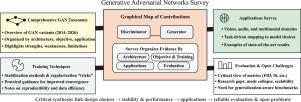
生成对抗网络:综合调查
生成对抗网络已成为学习隐式生成模型和生成高保真合成数据的核心框架,但其训练动态仍然脆弱,其设计空间迅速扩大。该调查提供了一个集中的、面向方法的领域综合,通过架构家族、目标函数、正则化、优化、稳定技术和评估实践组织了关键进展。我们总结了从早期制定到最近大规模和基于变压器的变体的代表性模型,强调了设计选择如何影响稳定性,保真度,多样性和计算成本,并将方法发展与主要应用领域联系起来。我们还讨论了当前的局限性和开放的研究方向,包括数据效率、可重复性、安全性和误用风险,以及对抗学习与其他现代生成范式之间的新兴互动。
本文章由计算机程序翻译,如有差异,请以英文原文为准。
求助全文
约1分钟内获得全文
求助全文

 求助内容:
求助内容: 应助结果提醒方式:

 京公网安备 11010802042870号


