
Riparian bats temporally partition foraging at the cold edge of an upslope climate-driven range expansion

IF 3.7 2区 环境科学与生态学 Q1 BIODIVERSITY CONSERVATION
Global Ecology and Conservation Pub Date : 2026-04-01 Epub Date: 2026-02-23 DOI:10.1016/j.gecco.2026.e04129
Chiara Belli , Luca Cistrone , Mirjam Knörnschild , Belma Sestovic , Ioannis Ekklisiarchos , Miren Aldasoro , Chiara Borgonovo , Ilaria Migliaresi , Mariella Di Domenico , John Ratcliffe , Danilo Russo
{"title":"Riparian bats temporally partition foraging at the cold edge of an upslope climate-driven range expansion","authors":"Chiara Belli ,&nbsp;Luca Cistrone ,&nbsp;Mirjam Knörnschild ,&nbsp;Belma Sestovic ,&nbsp;Ioannis Ekklisiarchos ,&nbsp;Miren Aldasoro ,&nbsp;Chiara Borgonovo ,&nbsp;Ilaria Migliaresi ,&nbsp;Mariella Di Domenico ,&nbsp;John Ratcliffe ,&nbsp;Danilo Russo","doi":"10.1016/j.gecco.2026.e04129","DOIUrl":null,"url":null,"abstract":"<div><div>Climate change is driving many species to shift their distributions polewards and upslope, exposing populations to the challenging abiotic and biotic conditions of the range’s cold edges. At these limits, resources are often scarce and competition, including among conspecifics, can be intense. Long-term monitoring of the riparian bat <em>Myotis daubentonii</em>, a species that shows altitudinal sexual segregation, has revealed an upslope shift of reproductive females within a central Italian river system, from a historical limit of about 850 m a.s.l. to about 1050 m a.s.l. Here, we investigated whether females colonising these newly suitable high-elevation habitats adjust their foraging behaviour in ways that reduce competition. We radio-tracked 14 reproductive females sharing maternity roosts in the cold-edge zone and analysed the spatial and temporal distribution of their foraging activity. All females showed pronounced temporal segregation in their use of foraging areas and regardless of roost membership. Spatial overlap tended to be greater among tracked roost mates, but this trend was not statistically significant. These findings suggest that fine-scale temporal niche partitioning limits interference and promotes efficient use of limited resources at the cold edge. Strong fidelity to individual foraging sites further indicates that site familiarity may buffer competition and reduce foraging costs. Variation in commuting distances among individuals suggests diverse foraging strategies, plausibly reflecting differences in competitive ability or reproductive state. Our results show that at newly colonised cold edges, female <em>M. daubentonii</em> exhibit behavioural plasticity facilitating coexistence among conspecifics and enhancing persistence in suboptimal habitats under climate change.</div></div>","PeriodicalId":54264,"journal":{"name":"Global Ecology and Conservation","volume":"66 ","pages":"Article e04129"},"PeriodicalIF":3.7000,"publicationDate":"2026-04-01","publicationTypes":"Journal Article","fieldsOfStudy":null,"isOpenAccess":false,"openAccessPdf":"","citationCount":"0","resultStr":null,"platform":"Semanticscholar","paperid":null,"PeriodicalName":"Global Ecology and Conservation","FirstCategoryId":"93","ListUrlMain":"https://www.sciencedirect.com/science/article/pii/S2351989426000788","RegionNum":2,"RegionCategory":"环境科学与生态学","ArticlePicture":[],"TitleCN":null,"AbstractTextCN":null,"PMCID":null,"EPubDate":"2026/2/23 0:00:00","PubModel":"Epub","JCR":"Q1","JCRName":"BIODIVERSITY CONSERVATION","Score":null,"Total":0}
引用次数: 0

Abstract

Climate change is driving many species to shift their distributions polewards and upslope, exposing populations to the challenging abiotic and biotic conditions of the range’s cold edges. At these limits, resources are often scarce and competition, including among conspecifics, can be intense. Long-term monitoring of the riparian bat Myotis daubentonii, a species that shows altitudinal sexual segregation, has revealed an upslope shift of reproductive females within a central Italian river system, from a historical limit of about 850 m a.s.l. to about 1050 m a.s.l. Here, we investigated whether females colonising these newly suitable high-elevation habitats adjust their foraging behaviour in ways that reduce competition. We radio-tracked 14 reproductive females sharing maternity roosts in the cold-edge zone and analysed the spatial and temporal distribution of their foraging activity. All females showed pronounced temporal segregation in their use of foraging areas and regardless of roost membership. Spatial overlap tended to be greater among tracked roost mates, but this trend was not statistically significant. These findings suggest that fine-scale temporal niche partitioning limits interference and promotes efficient use of limited resources at the cold edge. Strong fidelity to individual foraging sites further indicates that site familiarity may buffer competition and reduce foraging costs. Variation in commuting distances among individuals suggests diverse foraging strategies, plausibly reflecting differences in competitive ability or reproductive state. Our results show that at newly colonised cold edges, female M. daubentonii exhibit behavioural plasticity facilitating coexistence among conspecifics and enhancing persistence in suboptimal habitats under climate change.
河岸蝙蝠暂时在上坡气候驱动的范围扩张的寒冷边缘觅食
气候变化正在推动许多物种将其分布向两极和上坡转移,使种群暴露在具有挑战性的非生物和生物条件的范围的寒冷边缘。在这些限制下,资源往往是稀缺的,竞争,包括同种动物之间的竞争,可能是激烈的。对河岸蝙蝠Myotis daubentonii(一种表现出高度性别隔离的物种)的长期监测显示,在意大利中部河流系统中,生殖雌性的数量从850 米a.s.l.的历史上限上升到1050 米a.s.l.。在这里,我们研究了在这些新适宜的高海拔栖息地定居的雌性是否会以减少竞争的方式调整觅食行为。对14只在寒带共用母巢的生殖雌性进行了无线电跟踪,分析了其觅食活动的时空分布。所有的雌性在觅食区域的使用上都表现出明显的时间隔离,而不管它们是否属于巢穴成员。空间重叠倾向于在被跟踪的配偶中更大,但这种趋势在统计上并不显著。这些发现表明,精细尺度的时间生态位划分限制了干扰,促进了冷边缘有限资源的有效利用。对单个觅食地点的高保真度进一步表明,对地点的熟悉可以缓冲竞争,降低觅食成本。个体之间通勤距离的差异表明了不同的觅食策略,这似乎反映了竞争能力或繁殖状态的差异。研究结果表明,在新殖民的冷边缘,雌性M. daubentonii表现出行为可塑性,促进了同种生物之间的共存,并增强了气候变化下在次优栖息地的持久性。
本文章由计算机程序翻译,如有差异,请以英文原文为准。
求助全文
约1分钟内获得全文 求助全文
来源期刊
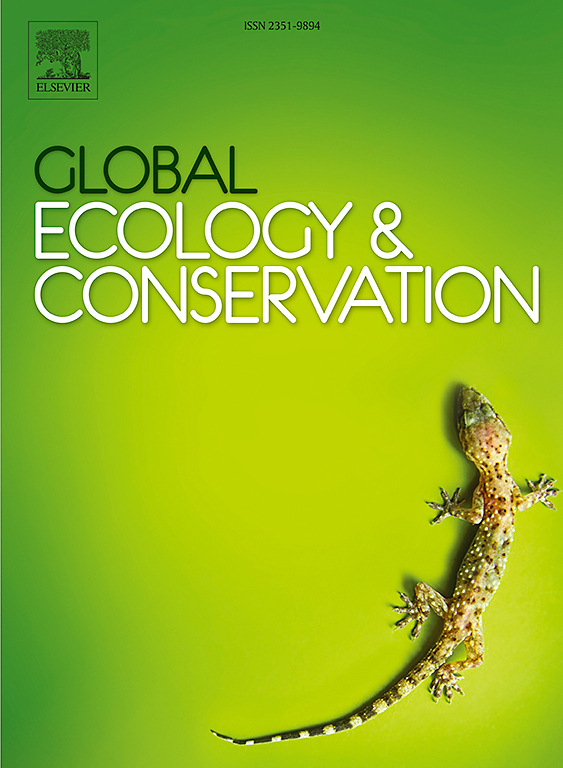
Global Ecology and Conservation
Global Ecology and Conservation Agricultural and Biological Sciences-Ecology, Evolution, Behavior and Systematics
CiteScore
8.10
自引率
5.00%
发文量
346
审稿时长
83 days
期刊介绍: Global Ecology and Conservation is a peer-reviewed, open-access journal covering all sub-disciplines of ecological and conservation science: from theory to practice, from molecules to ecosystems, from regional to global. The fields covered include: organismal, population, community, and ecosystem ecology; physiological, evolutionary, and behavioral ecology; and conservation science.

×
引用
GB/T 7714-2015
复制
MLA
复制
APA
复制
导出至
BibTeX EndNote RefMan NoteFirst NoteExpress
×
提示
您的信息不完整,为了账户安全,请先补充。
现在去补充
×
提示
您因"违规操作"
具体请查看互助需知
我知道了
×
提示
确定
请完成安全验证×
copy
已复制链接
快去分享给好友吧!
我知道了
右上角分享
点击右上角分享
0
联系我们:info@booksci.cn Book学术提供免费学术资源搜索服务,方便国内外学者检索中英文文献。致力于提供最便捷和优质的服务体验。 Copyright © 2023 布克学术 All rights reserved.
京ICP备2023020795号-1
ghs 京公网安备 11010802042870号
Book学术文献互助
Book学术文献互助群
群 号:604180095
Book学术官方微信
小红书


