PD-1 inhibitor-induced rheumatic, endocrine, and sarcoidosis-like immune-related adverse events in metastatic melanoma are associated with improved survival and lower corticosteroid exposure.
Maria Lindén, Hifaa Al Remawi, Anna Fager, Levent M Akyürek, Anna Rudin, Lars Ny, Sara Bjursten, Ankur Pandita, Max Levin
{"title":"PD-1 inhibitor-induced rheumatic, endocrine, and sarcoidosis-like immune-related adverse events in metastatic melanoma are associated with improved survival and lower corticosteroid exposure.","authors":"Maria Lindén, Hifaa Al Remawi, Anna Fager, Levent M Akyürek, Anna Rudin, Lars Ny, Sara Bjursten, Ankur Pandita, Max Levin","doi":"10.1093/immadv/ltag004","DOIUrl":null,"url":null,"abstract":"<p><strong>Introduction: </strong>Programmed cell death protein 1 (PD-1) inhibitors improve survival in advanced melanoma but can induce immune-related adverse events (irAEs). IrAEs have been linked to better outcomes. However, it remains unclear whether specific irAE types drive this effect and how corticosteroid treatment of irAEs influences survival.</p><p><strong>Materials and methods: </strong>A seven-year retrospective cohort study of 301 patients with advanced cutaneous melanoma treated with single-agent PD-1 inhibition at Sahlgrenska University Hospital. irAEs were identified using CTCAE v4.0/v5.0, and irAEs requiring systemic corticosteroids or endocrine replacement therapy were included. Corticosteroid therapy was categorized as low dose (≤0.5 mg/kg prednisolone equivalent) or high dose (>0.5 mg/kg). Overall survival (OS) was assessed using Kaplan-Meier and Cox models, including time-dependent analyses to address immortal time bias.</p><p><strong>Results: </strong>Patients with irAE (109 of 301 patients) had longer OS than those without irAEs. Of the eight most common irAEs, four were associated with superior survival, one was borderline significant, and three were non-significant. Rheumatic irAEs and late-onset thyroid irAEs remained associated with improved OS after adjustment for negative prognostic factors and immoral time bias. Colitis irAE were borderline significant in univariate analysis. Sarcoidosis-like and hypophysitis irAEs were rare but conferred excellent outcomes. Hepatitis, nephritis, and pneumonitis were not associated with better survival. Most survival-associated irAEs were treated with a lower start dose of corticosteroids but duration and time to onset were similar to non-survival-associated irAEs.</p><p><strong>Conclusion: </strong>Rheumatic, endocrine, and sarcoidosis-like irAEs are markers of superior survival and suggest that lower initial corticosteroid doses may preserve PD-1 inhibitor efficacy.</p>","PeriodicalId":73353,"journal":{"name":"Immunotherapy advances","volume":"6 1","pages":"ltag004"},"PeriodicalIF":4.9000,"publicationDate":"2026-02-21","publicationTypes":"Journal Article","fieldsOfStudy":null,"isOpenAccess":false,"openAccessPdf":"https://www.ncbi.nlm.nih.gov/pmc/articles/PMC12965203/pdf/","citationCount":"0","resultStr":null,"platform":"Semanticscholar","paperid":null,"PeriodicalName":"Immunotherapy advances","FirstCategoryId":"1085","ListUrlMain":"https://doi.org/10.1093/immadv/ltag004","RegionNum":0,"RegionCategory":null,"ArticlePicture":[],"TitleCN":null,"AbstractTextCN":null,"PMCID":null,"EPubDate":"2026/1/1 0:00:00","PubModel":"eCollection","JCR":"Q2","JCRName":"IMMUNOLOGY","Score":null,"Total":0}
引用次数: 0
Abstract
Introduction: Programmed cell death protein 1 (PD-1) inhibitors improve survival in advanced melanoma but can induce immune-related adverse events (irAEs). IrAEs have been linked to better outcomes. However, it remains unclear whether specific irAE types drive this effect and how corticosteroid treatment of irAEs influences survival.
Materials and methods: A seven-year retrospective cohort study of 301 patients with advanced cutaneous melanoma treated with single-agent PD-1 inhibition at Sahlgrenska University Hospital. irAEs were identified using CTCAE v4.0/v5.0, and irAEs requiring systemic corticosteroids or endocrine replacement therapy were included. Corticosteroid therapy was categorized as low dose (≤0.5 mg/kg prednisolone equivalent) or high dose (>0.5 mg/kg). Overall survival (OS) was assessed using Kaplan-Meier and Cox models, including time-dependent analyses to address immortal time bias.
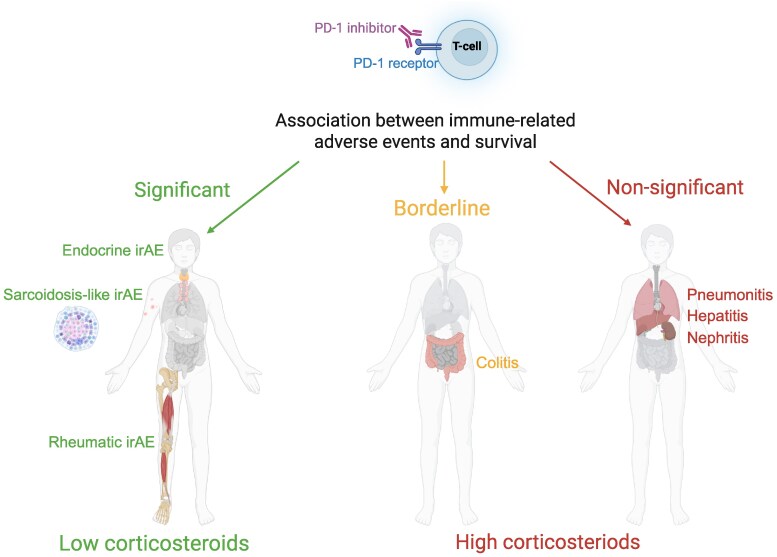
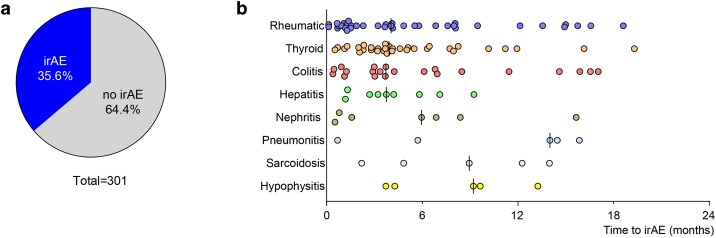
Results: Patients with irAE (109 of 301 patients) had longer OS than those without irAEs. Of the eight most common irAEs, four were associated with superior survival, one was borderline significant, and three were non-significant. Rheumatic irAEs and late-onset thyroid irAEs remained associated with improved OS after adjustment for negative prognostic factors and immoral time bias. Colitis irAE were borderline significant in univariate analysis. Sarcoidosis-like and hypophysitis irAEs were rare but conferred excellent outcomes. Hepatitis, nephritis, and pneumonitis were not associated with better survival. Most survival-associated irAEs were treated with a lower start dose of corticosteroids but duration and time to onset were similar to non-survival-associated irAEs.
Conclusion: Rheumatic, endocrine, and sarcoidosis-like irAEs are markers of superior survival and suggest that lower initial corticosteroid doses may preserve PD-1 inhibitor efficacy.



 求助内容:
求助内容: 应助结果提醒方式:

 京公网安备 11010802042870号


