
Real-world data on uptake and use of digital mental health interventions among waitlisted patients with various mental disorders
IF 4.1
2区 医学
Q1 HEALTH CARE SCIENCES & SERVICES
Internet Interventions-The Application of Information Technology in Mental and Behavioural Health
Pub Date : 2026-06-01
Epub Date: 2026-02-13
DOI:10.1016/j.invent.2026.100915
引用次数: 0
Abstract
Background
Digital mental health interventions (DMHI) have the potential to provide patients awaiting outpatient psychotherapy with a valuable and immediate treatment option to bridge long waiting periods. However, randomized controlled trials concerning these interventions are marred by high attrition rates and low adherence, and research on the implementation of these interventions in real-world settings is scarce. The present study aims to provide real-world data on the uptake and use of prescribed DMHI, as well as the effect of DMHI use on psychological well-being.
Method
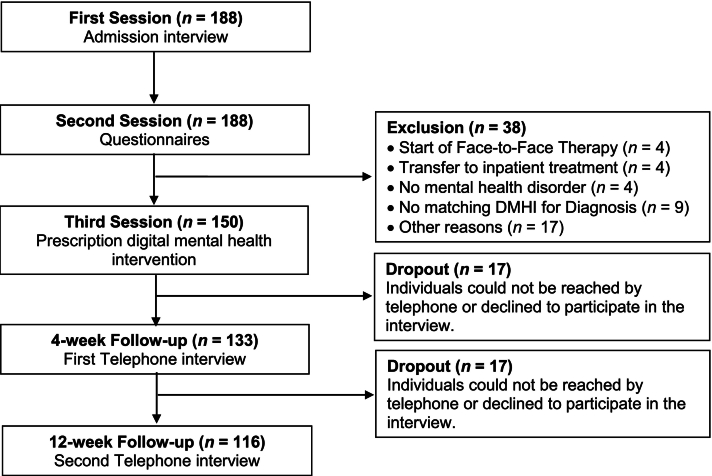
150 patients with various mental disorders awaiting face-to-face psychotherapy were included in this preregistered study. All patients received a prescription for a diagnosis-specific DMHI to bridge the waiting period. Structured telephone interviews were conducted to assess uptake of the prescription, use of the DMHI, and psychological well-being four and 12 weeks after inclusion.
Results
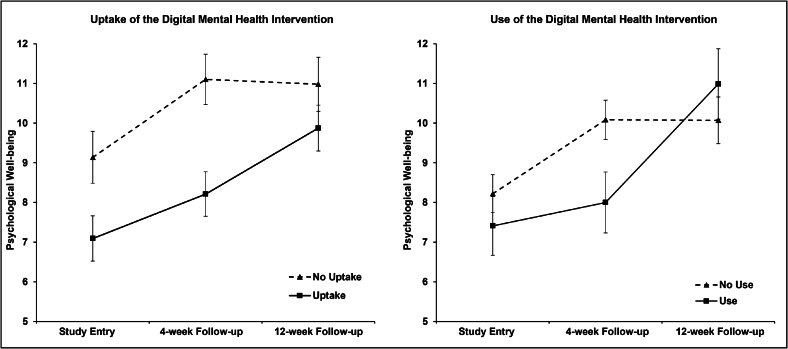
56% of the patients reported an uptake of the DMHI prescription. The percentage of patients who actually used the DMHI was lower than for uptake (29%). Patients who expressed interest in the use of DMHI, higher treatment expectations, and lower psychological well-being were more likely to use the DMHI. A linear mixed model indicated a significant improvement in psychological well-being among DMHI users.
Conclusion
The findings of the present study underscore that the implementation of DMHI in real-world settings is hindered by low uptake rates and even lower utilization. To improve DMHI use, it is essential to incorporate potential mediating factors, such as treatment expectations, into future research.
关于各种精神障碍候诊患者接受和使用数字精神卫生干预措施的真实世界数据。
背景:数字心理健康干预(DMHI)有可能为等待门诊心理治疗的患者提供有价值的即时治疗选择,以缩短漫长的等待期。然而,关于这些干预措施的随机对照试验受到高损耗率和低依从性的影响,并且在现实环境中实施这些干预措施的研究很少。本研究旨在提供实际数据的摄取和使用处方DMHI,以及DMHI使用对心理健康的影响。方法:将150例等待面对面心理治疗的各类精神障碍患者纳入预登记研究。所有患者都收到了诊断特异性DMHI的处方,以缩短等待期。采用结构化电话访谈来评估处方的接受情况、DMHI的使用情况以及纳入后4周和12周的心理健康状况。结果:56%的患者报告服用了DMHI处方。实际使用DMHI的患者比例低于接受DMHI的患者(29%)。对使用DMHI感兴趣、对治疗期望较高、心理健康状况较差的患者更有可能使用DMHI。线性混合模型显示DMHI使用者的心理健康有显著改善。结论:本研究的发现强调了DMHI在现实环境中的实施受到低吸收率和更低利用率的阻碍。为了改善DMHI的使用,有必要将潜在的中介因素,如治疗预期,纳入未来的研究。
本文章由计算机程序翻译,如有差异,请以英文原文为准。
求助全文
约1分钟内获得全文
求助全文
来源期刊
Internet Interventions-The Application of Information Technology in Mental and Behavioural Health
Medicine-Health Informatics
CiteScore
6.50
自引率
9.30%
发文量
94
审稿时长
6 weeks
期刊介绍:
Official Journal of the European Society for Research on Internet Interventions (ESRII) and the International Society for Research on Internet Interventions (ISRII).
The aim of Internet Interventions is to publish scientific, peer-reviewed, high-impact research on Internet interventions and related areas.
Internet Interventions welcomes papers on the following subjects:
• Intervention studies targeting the promotion of mental health and featuring the Internet and/or technologies using the Internet as an underlying technology, e.g. computers, smartphone devices, tablets, sensors
• Implementation and dissemination of Internet interventions
• Integration of Internet interventions into existing systems of care
• Descriptions of development and deployment infrastructures
• Internet intervention methodology and theory papers
• Internet-based epidemiology
• Descriptions of new Internet-based technologies and experiments with clinical applications
• Economics of internet interventions (cost-effectiveness)
• Health care policy and Internet interventions
• The role of culture in Internet intervention
• Internet psychometrics
• Ethical issues pertaining to Internet interventions and measurements
• Human-computer interaction and usability research with clinical implications
• Systematic reviews and meta-analysis on Internet interventions
 求助内容:
求助内容: 应助结果提醒方式:

 京公网安备 11010802042870号


