Jessica de Sousa Meneses, Fabrício Augusto Menegon, Lizandra da Silva Menegon
{"title":"Sickness absenteeism among public servants in the Amazon region during the COVID-19 pandemic: a longitudinal study (2019-2022).","authors":"Jessica de Sousa Meneses, Fabrício Augusto Menegon, Lizandra da Silva Menegon","doi":"10.47626/1679-4435-2026-1522","DOIUrl":null,"url":null,"abstract":"<p><strong>Introduction: </strong>Characterizing sickness absenteeism is essential for understanding the health-disease process within the public sector.</p><p><strong>Objectives: </strong>To characterize the profile of sickness absence among civil servants during the COVID-19 pandemic period.</p><p><strong>Methods: </strong>This longitudinal, descriptive study used secondary data from sickness absence records obtained from both the Integrated Civil Servant Health Care Subsystem and the Federal University of Amapá, covering the period from 2019 to 2022. Absences were analyzed according to sex, age group, occupational category, and International Classification of Diseases group.</p><p><strong>Results: </strong>A total of 675 sickness absences were recorded, corresponding to 12,553 lost workdays, of which 444 were associated with an International Classification of Diseases code. The most frequent diagnostic groups were infectious and parasitic diseases (15.09%), mental and behavioral disorders (12.39%), and diseases of the digestive system (11.49%). Absences were more prevalent among women (68.15%) and among employees aged 30-39 years (36.59%). Administrative staff accounted for the highest proportion of absences (59.09%).</p><p><strong>Conclusions: </strong>The profile of sickness absenteeism differed from that observed in other public institutions. The findings underscore concerns regarding underreporting and highlight the need to improve institutional communication and to implement targeted strategies aimed at promoting workers' mental and oral health.</p>","PeriodicalId":38694,"journal":{"name":"Revista Brasileira de Medicina do Trabalho","volume":"24 ","pages":"e20261522"},"PeriodicalIF":0.0000,"publicationDate":"2026-02-27","publicationTypes":"Journal Article","fieldsOfStudy":null,"isOpenAccess":false,"openAccessPdf":"https://www.ncbi.nlm.nih.gov/pmc/articles/PMC12965668/pdf/","citationCount":"0","resultStr":null,"platform":"Semanticscholar","paperid":null,"PeriodicalName":"Revista Brasileira de Medicina do Trabalho","FirstCategoryId":"1085","ListUrlMain":"https://doi.org/10.47626/1679-4435-2026-1522","RegionNum":0,"RegionCategory":null,"ArticlePicture":[],"TitleCN":null,"AbstractTextCN":null,"PMCID":null,"EPubDate":"2026/1/1 0:00:00","PubModel":"eCollection","JCR":"Q4","JCRName":"Medicine","Score":null,"Total":0}
引用次数: 0
Abstract
Introduction: Characterizing sickness absenteeism is essential for understanding the health-disease process within the public sector.
Objectives: To characterize the profile of sickness absence among civil servants during the COVID-19 pandemic period.
Methods: This longitudinal, descriptive study used secondary data from sickness absence records obtained from both the Integrated Civil Servant Health Care Subsystem and the Federal University of Amapá, covering the period from 2019 to 2022. Absences were analyzed according to sex, age group, occupational category, and International Classification of Diseases group.
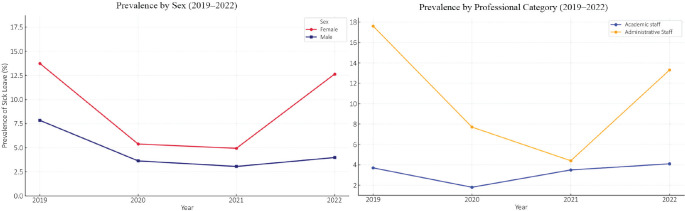
Results: A total of 675 sickness absences were recorded, corresponding to 12,553 lost workdays, of which 444 were associated with an International Classification of Diseases code. The most frequent diagnostic groups were infectious and parasitic diseases (15.09%), mental and behavioral disorders (12.39%), and diseases of the digestive system (11.49%). Absences were more prevalent among women (68.15%) and among employees aged 30-39 years (36.59%). Administrative staff accounted for the highest proportion of absences (59.09%).
Conclusions: The profile of sickness absenteeism differed from that observed in other public institutions. The findings underscore concerns regarding underreporting and highlight the need to improve institutional communication and to implement targeted strategies aimed at promoting workers' mental and oral health.



 求助内容:
求助内容: 应助结果提醒方式:

 京公网安备 11010802042870号


