[Prevalence of Rumination Syndrome: Experience in Three Countries of the Working Group on Brain-Gut Disorders of the Latin American Society of Pediatric Gastroenterology, Hepatology and Nutrition (LASPGHAN)].
Carlos Alberto Velasco-Benítez, Estefanía Rodríguez-López, Daniela Alejandra Velasco-Suárez, Claudia Jimena Ortiz-Rivera, Edgar Játiva-Mariño, Ada Ruth Dionicio Avendaño, Arony Martínez
{"title":"[Prevalence of Rumination Syndrome: Experience in Three Countries of the Working Group on Brain-Gut Disorders of the Latin American Society of Pediatric Gastroenterology, Hepatology and Nutrition (LASPGHAN)].","authors":"Carlos Alberto Velasco-Benítez, Estefanía Rodríguez-López, Daniela Alejandra Velasco-Suárez, Claudia Jimena Ortiz-Rivera, Edgar Játiva-Mariño, Ada Ruth Dionicio Avendaño, Arony Martínez","doi":"10.52787/agl.v55i4.526","DOIUrl":null,"url":null,"abstract":"<p><strong>Introduction: </strong>According to Rome IV diagnostic criteria, the worldwide prevalence of rumination syndrome is 1.0%.</p><p><strong>Objectives: </strong>Identify the prevalence and possible associations of rumination syndrome in preschoolers, school-children, and adolescents from Colombia, Mexico, and Ecuador according to Rome IV criteria.</p><p><strong>Materials and methods: </strong>Prospective, observational, cross-sectional and descriptive study conducted in three Latin American countries. We included children and adolescents between 5 and 18 years of age from the Functional International Digestive Epidemiological Research Survey - FINDERS Group database, who answered the Rome IV Pediatric Digestive Symptom Questionnaire in Spanish. Sociodemographic, family, clinical, and nutritional variables were analyzed. The statistical analysis included measures of central tendency and dispersion for univariate description of the variables. Subsequently, bivariate analyses were performed using the chi-square or Fisher's exact tests, and odds ratios (OR) were calculated with their respective 95% confidence intervals. A p-value of p < 0.05 was considered statistically significant.</p><p><strong>Results: </strong>A total of 10.089 children (mean age 12.7 ± 3.1 years; 55.6% female; 52.1% mixed race) were included in the study. Rumination syndrome was diagnosed in 0.8% of the children. An overlap of rumination with other functional disorders was observed in 3.4% of cases. The following variables were associated with rumination: female gender (OR = 2.10; 95% C: 1.24 - 3.66; p = 0.0032) and overlap with other functional disorders such as constipation and aerophagia (p = 0.000).</p><p><strong>Conclusion: </strong>The prevalence of rumination syndrome among preschoolers, schoolchildren and adolescents in three Latin American countries is similar to that reported worldwide. Bivariate analysis showed an association with female sex and overlap with other functional disorders.</p>","PeriodicalId":35700,"journal":{"name":"Acta Gastroenterologica Latinoamericana","volume":"55 4","pages":"332-340"},"PeriodicalIF":0.0000,"publicationDate":"2025-12-23","publicationTypes":"Journal Article","fieldsOfStudy":null,"isOpenAccess":false,"openAccessPdf":"https://www.ncbi.nlm.nih.gov/pmc/articles/PMC12965162/pdf/","citationCount":"0","resultStr":null,"platform":"Semanticscholar","paperid":null,"PeriodicalName":"Acta Gastroenterologica Latinoamericana","FirstCategoryId":"1085","ListUrlMain":"https://doi.org/10.52787/agl.v55i4.526","RegionNum":0,"RegionCategory":null,"ArticlePicture":[],"TitleCN":null,"AbstractTextCN":null,"PMCID":null,"EPubDate":"2025/9/1 0:00:00","PubModel":"eCollection","JCR":"Q4","JCRName":"Medicine","Score":null,"Total":0}
引用次数: 0
Abstract
Introduction: According to Rome IV diagnostic criteria, the worldwide prevalence of rumination syndrome is 1.0%.
Objectives: Identify the prevalence and possible associations of rumination syndrome in preschoolers, school-children, and adolescents from Colombia, Mexico, and Ecuador according to Rome IV criteria.
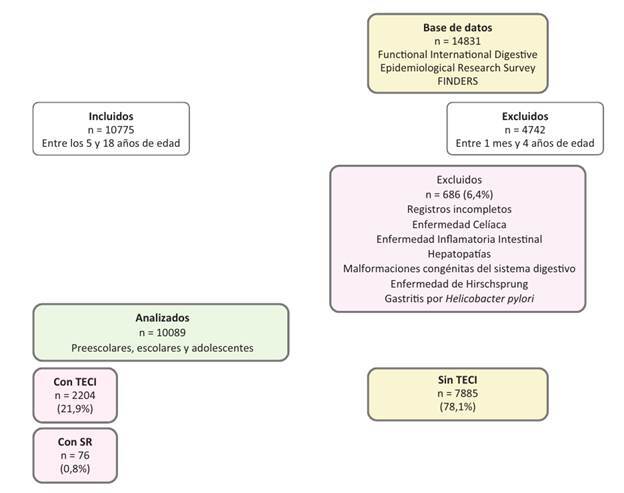
Materials and methods: Prospective, observational, cross-sectional and descriptive study conducted in three Latin American countries. We included children and adolescents between 5 and 18 years of age from the Functional International Digestive Epidemiological Research Survey - FINDERS Group database, who answered the Rome IV Pediatric Digestive Symptom Questionnaire in Spanish. Sociodemographic, family, clinical, and nutritional variables were analyzed. The statistical analysis included measures of central tendency and dispersion for univariate description of the variables. Subsequently, bivariate analyses were performed using the chi-square or Fisher's exact tests, and odds ratios (OR) were calculated with their respective 95% confidence intervals. A p-value of p < 0.05 was considered statistically significant.
Results: A total of 10.089 children (mean age 12.7 ± 3.1 years; 55.6% female; 52.1% mixed race) were included in the study. Rumination syndrome was diagnosed in 0.8% of the children. An overlap of rumination with other functional disorders was observed in 3.4% of cases. The following variables were associated with rumination: female gender (OR = 2.10; 95% C: 1.24 - 3.66; p = 0.0032) and overlap with other functional disorders such as constipation and aerophagia (p = 0.000).
Conclusion: The prevalence of rumination syndrome among preschoolers, schoolchildren and adolescents in three Latin American countries is similar to that reported worldwide. Bivariate analysis showed an association with female sex and overlap with other functional disorders.
期刊介绍:
Está dedicada a la investigación clínica y básica sobre todos los aspectos del aparato digestivo, incluídos el hígado, el páncreas y la nutrición, en seres humanos adultos y niños, animales de experimentación o sistemas celulares.


 求助内容:
求助内容: 应助结果提醒方式:

 京公网安备 11010802042870号


