Anahí Ayelén de Los Rios, Juan Ignacio Olmos, José María Sanguinetti, Andrés Wonaga, Lorena Bortot, Esteban González Ballerga
{"title":"[Use of Los Angeles Classification in Erosive Esophagitis: analysis of inter-observer and intra-observer agreement].","authors":"Anahí Ayelén de Los Rios, Juan Ignacio Olmos, José María Sanguinetti, Andrés Wonaga, Lorena Bortot, Esteban González Ballerga","doi":"10.52787/agl.v55i4.559","DOIUrl":null,"url":null,"abstract":"<p><strong>Introduction: </strong>Gastroesophageal reflux disease is a com-mon condition with a prevalence of 10 to 20% in Western countries. The Los Angeles Classification is the standard endoscopic system for categorizing erosive esophagitis.</p><p><strong>Objectives: </strong>To evaluate intra- and inter-observer agreement among resident physicians and gastroenterology specialists in classifying the severity of reflux-related erosive esopha-gitis using the Los Angeles Classification.</p><p><strong>Materials and methods: </strong>A cross-sectional study was conducted with 59 participants (25 specialists and 34 residents) who clas-sified 40 endoscopic images according to the Los Angeles Classification (10 images were duplicated). Inter-observ-er agreement was analyzed using Fleiss's kappa index and intra-observer agreement using Cohen's kappa.</p><p><strong>Results: </strong>Inter-observer agreement was moderate among specialists (κ = 0.425, IC95% 0.39 - 0.46) and acceptable among residents (κ = 0.297, IC95% 0.26-0.33), and the dif-ference was statistically significant (p < 0.001). Over-all intra-observer agreement was moderate (κ = 0.525, IC95% 0.47 - 0.58).</p><p><strong>Conclusion: </strong>Low inter- and intra-observer agreement was observed when using the Los Angeles Classification for esophagitis, with signifi-cant differences when comparing groups with different levels of experience. The development and application of local clinical-endoscopic protocols is recommended to standardize diagnostic and therapeutic criteria, optimize resources, and contribute to the training of gastroenter-ology specialists.</p>","PeriodicalId":35700,"journal":{"name":"Acta Gastroenterologica Latinoamericana","volume":"55 4","pages":"350-357"},"PeriodicalIF":0.0000,"publicationDate":"2025-12-23","publicationTypes":"Journal Article","fieldsOfStudy":null,"isOpenAccess":false,"openAccessPdf":"https://www.ncbi.nlm.nih.gov/pmc/articles/PMC12965164/pdf/","citationCount":"0","resultStr":null,"platform":"Semanticscholar","paperid":null,"PeriodicalName":"Acta Gastroenterologica Latinoamericana","FirstCategoryId":"1085","ListUrlMain":"https://doi.org/10.52787/agl.v55i4.559","RegionNum":0,"RegionCategory":null,"ArticlePicture":[],"TitleCN":null,"AbstractTextCN":null,"PMCID":null,"EPubDate":"2025/9/1 0:00:00","PubModel":"eCollection","JCR":"Q4","JCRName":"Medicine","Score":null,"Total":0}
引用次数: 0
Abstract
Introduction: Gastroesophageal reflux disease is a com-mon condition with a prevalence of 10 to 20% in Western countries. The Los Angeles Classification is the standard endoscopic system for categorizing erosive esophagitis.
Objectives: To evaluate intra- and inter-observer agreement among resident physicians and gastroenterology specialists in classifying the severity of reflux-related erosive esopha-gitis using the Los Angeles Classification.
Materials and methods: A cross-sectional study was conducted with 59 participants (25 specialists and 34 residents) who clas-sified 40 endoscopic images according to the Los Angeles Classification (10 images were duplicated). Inter-observ-er agreement was analyzed using Fleiss's kappa index and intra-observer agreement using Cohen's kappa.
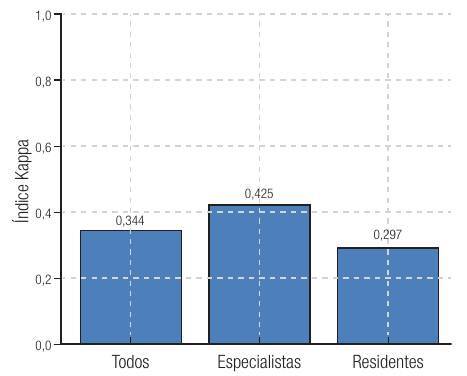
Results: Inter-observer agreement was moderate among specialists (κ = 0.425, IC95% 0.39 - 0.46) and acceptable among residents (κ = 0.297, IC95% 0.26-0.33), and the dif-ference was statistically significant (p < 0.001). Over-all intra-observer agreement was moderate (κ = 0.525, IC95% 0.47 - 0.58).
Conclusion: Low inter- and intra-observer agreement was observed when using the Los Angeles Classification for esophagitis, with signifi-cant differences when comparing groups with different levels of experience. The development and application of local clinical-endoscopic protocols is recommended to standardize diagnostic and therapeutic criteria, optimize resources, and contribute to the training of gastroenter-ology specialists.
期刊介绍:
Está dedicada a la investigación clínica y básica sobre todos los aspectos del aparato digestivo, incluídos el hígado, el páncreas y la nutrición, en seres humanos adultos y niños, animales de experimentación o sistemas celulares.



 求助内容:
求助内容: 应助结果提醒方式:

 京公网安备 11010802042870号


