Lourdes Mollard, Rodrigo A Gasque, Magalí Chahdi-Beltrame, Marcelo E Lenz, Francisco J Mattera, Emilio G Quiñonez
{"title":"[Transaminases on the First Day After Hepatectomy and Prediction of Out-comes in Malignant Disease].","authors":"Lourdes Mollard, Rodrigo A Gasque, Magalí Chahdi-Beltrame, Marcelo E Lenz, Francisco J Mattera, Emilio G Quiñonez","doi":"10.52787/agl.v55i4.547","DOIUrl":null,"url":null,"abstract":"<p><strong>Introduction: </strong>Advances in oncological liver surgery have improved the radicality of procedures and broadened the criteria for resectability. Transaminases can be indicators of postoperative hepatocellular injury.</p><p><strong>Objectives: </strong>Evaluate the relationship between transaminase levels on the first postoperative day and morbidity and mortality in hepatectomies for malignant disease.</p><p><strong>Materials and methods: </strong>A retrospective analysis was conducted on hepatectomies for malignant disease between March 2015 and February 2023. Demographic, intraoperative, and postoperative variables were evaluated. Optimal transaminase cutoff values and their relationship with complications and mortality were determined using ROC curves and sensitivity and specificity calculations.</p><p><strong>Results: </strong>We performed 273 hepatectomies at our institution, 118 of which were for malignant pathology. We found a statistically significant relationship between elevated transaminase levels on the first postoperative day and the development of morbidity and mortality. The cutoff points for predicting mortality were 856 IU/L for glutamic-oxaloacetic transaminase and 1341 IU/L for glutamic-pyruvic transaminase (AUC: 0,714 and 0,579, respectively), and 530 IU/L and 257 IU/L for predicting the occurrence of complications (AUC: 0,700 and 0,663, respectively). Elevated glutamic-pyruvic transaminase values were associated with postoperative liver failure, with a cutoff point > 856 IU/L (AUC: 0,834).</p><p><strong>Conclusion: </strong>Elevated transaminase values on the first postoperative day are associaed with a higher occurrence of complications, the need for blood products and the use of vasoactive drugs. Elevated glutamic-pyruvic transaminase indicates a higher risk of postoperative liver failure and 90-day mortality. Transaminases are useful prognostic markers in hepatectomies for malignant pathology.</p>","PeriodicalId":35700,"journal":{"name":"Acta Gastroenterologica Latinoamericana","volume":"55 4","pages":"358-370"},"PeriodicalIF":0.0000,"publicationDate":"2025-12-23","publicationTypes":"Journal Article","fieldsOfStudy":null,"isOpenAccess":false,"openAccessPdf":"https://www.ncbi.nlm.nih.gov/pmc/articles/PMC12965157/pdf/","citationCount":"0","resultStr":null,"platform":"Semanticscholar","paperid":null,"PeriodicalName":"Acta Gastroenterologica Latinoamericana","FirstCategoryId":"1085","ListUrlMain":"https://doi.org/10.52787/agl.v55i4.547","RegionNum":0,"RegionCategory":null,"ArticlePicture":[],"TitleCN":null,"AbstractTextCN":null,"PMCID":null,"EPubDate":"2025/9/1 0:00:00","PubModel":"eCollection","JCR":"Q4","JCRName":"Medicine","Score":null,"Total":0}
引用次数: 0
Abstract
Introduction: Advances in oncological liver surgery have improved the radicality of procedures and broadened the criteria for resectability. Transaminases can be indicators of postoperative hepatocellular injury.
Objectives: Evaluate the relationship between transaminase levels on the first postoperative day and morbidity and mortality in hepatectomies for malignant disease.
Materials and methods: A retrospective analysis was conducted on hepatectomies for malignant disease between March 2015 and February 2023. Demographic, intraoperative, and postoperative variables were evaluated. Optimal transaminase cutoff values and their relationship with complications and mortality were determined using ROC curves and sensitivity and specificity calculations.
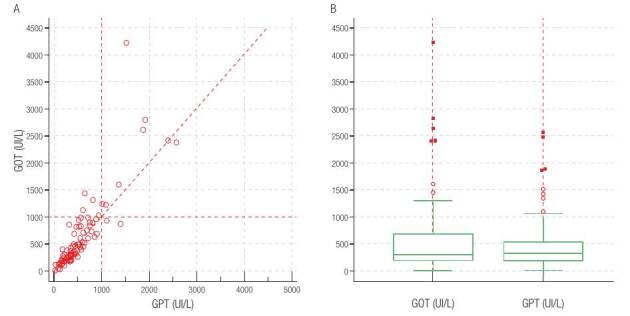
Results: We performed 273 hepatectomies at our institution, 118 of which were for malignant pathology. We found a statistically significant relationship between elevated transaminase levels on the first postoperative day and the development of morbidity and mortality. The cutoff points for predicting mortality were 856 IU/L for glutamic-oxaloacetic transaminase and 1341 IU/L for glutamic-pyruvic transaminase (AUC: 0,714 and 0,579, respectively), and 530 IU/L and 257 IU/L for predicting the occurrence of complications (AUC: 0,700 and 0,663, respectively). Elevated glutamic-pyruvic transaminase values were associated with postoperative liver failure, with a cutoff point > 856 IU/L (AUC: 0,834).
Conclusion: Elevated transaminase values on the first postoperative day are associaed with a higher occurrence of complications, the need for blood products and the use of vasoactive drugs. Elevated glutamic-pyruvic transaminase indicates a higher risk of postoperative liver failure and 90-day mortality. Transaminases are useful prognostic markers in hepatectomies for malignant pathology.
期刊介绍:
Está dedicada a la investigación clínica y básica sobre todos los aspectos del aparato digestivo, incluídos el hígado, el páncreas y la nutrición, en seres humanos adultos y niños, animales de experimentación o sistemas celulares.




 求助内容:
求助内容: 应助结果提醒方式:

 京公网安备 11010802042870号


