Jonas R Schaarup, Lasse Bjerg, Christian Stevns Hansen, Signe Toft Andersen, Marleen Mj van Greevenbroek, Miranda T Schram, Bastiaan E De Galan, Coen Stehouwer, Daniel R Witte
{"title":"Cardiovascular autonomic dysfunction is linked with arterial stiffness across glucose metabolism: the Maastricht study.","authors":"Jonas R Schaarup, Lasse Bjerg, Christian Stevns Hansen, Signe Toft Andersen, Marleen Mj van Greevenbroek, Miranda T Schram, Bastiaan E De Galan, Coen Stehouwer, Daniel R Witte","doi":"10.1136/bmjdrc-2025-004995","DOIUrl":null,"url":null,"abstract":"<p><strong>Objective: </strong>To ascertain the cross-sectional association between cardiovascular autonomic dysfunction and arterial stiffness across glucose metabolism status.</p><p><strong>Research design and methods: </strong>We performed a cross-sectional analysis of participants of the Maastricht study. Cardiovascular autonomic function was based on heart rate variability (HRV) indices from 24-hour ECG recordings and summarized in z-scores for time and frequency domains. Aortic and carotid stiffness were assessed by carotid-femoral pulse wave velocity (PWV) and carotid artery distensibility (CD), respectively. We used multiple linear regression to study the associations and adjusted for demographic and lifestyle factors and a range of cardiovascular risk factors. We tested for effect modification of the associations by glucose metabolism status.</p><p><strong>Results: </strong>PWV and CD measures were available in 3673 and 1802 participants, respectively (median (25th; 75th percentile) age: 60 years (53; 66), 51% women, 20% type 2 diabetes by design. Participants with lower HRV had higher aortic stiffness. Per SD lower time-domain and frequency-domain HRV z-scores were associated with 2.8% (95% CI 2.1% to 3.4%) and 2.8% (95% CI 2.1% to 3.5%) higher PWV, respectively. Similar trends were observed for carotid stiffness, with 3.2% (95% CI 1.4% to 5.0%) and 3.1% (95% CI 1.2% to 5.0%) lower CD per SD lower time-domain and frequency-domain HRV, respectively. The magnitude of these associations was higher in groups with prediabetes and type 2 diabetes compared with those with normal glucose metabolism, with evidence of effect modification by glucose metabolism status (p value for interaction: <0.01 for prediabetes and <0.05 to <0.10 for type 2 diabetes, both compared with normal glucose metabolism).</p><p><strong>Conclusion: </strong>Cardiovascular autonomic dysfunction is associated with higher aortic and carotid stiffness, especially in people with dysglycemia.</p>","PeriodicalId":9151,"journal":{"name":"BMJ Open Diabetes Research & Care","volume":"14 2","pages":""},"PeriodicalIF":4.1000,"publicationDate":"2026-03-06","publicationTypes":"Journal Article","fieldsOfStudy":null,"isOpenAccess":false,"openAccessPdf":"https://www.ncbi.nlm.nih.gov/pmc/articles/PMC12970051/pdf/","citationCount":"0","resultStr":null,"platform":"Semanticscholar","paperid":null,"PeriodicalName":"BMJ Open Diabetes Research & Care","FirstCategoryId":"3","ListUrlMain":"https://doi.org/10.1136/bmjdrc-2025-004995","RegionNum":2,"RegionCategory":"医学","ArticlePicture":[],"TitleCN":null,"AbstractTextCN":null,"PMCID":null,"EPubDate":"","PubModel":"","JCR":"Q2","JCRName":"ENDOCRINOLOGY & METABOLISM","Score":null,"Total":0}
引用次数: 0
Abstract
Objective: To ascertain the cross-sectional association between cardiovascular autonomic dysfunction and arterial stiffness across glucose metabolism status.
Research design and methods: We performed a cross-sectional analysis of participants of the Maastricht study. Cardiovascular autonomic function was based on heart rate variability (HRV) indices from 24-hour ECG recordings and summarized in z-scores for time and frequency domains. Aortic and carotid stiffness were assessed by carotid-femoral pulse wave velocity (PWV) and carotid artery distensibility (CD), respectively. We used multiple linear regression to study the associations and adjusted for demographic and lifestyle factors and a range of cardiovascular risk factors. We tested for effect modification of the associations by glucose metabolism status.
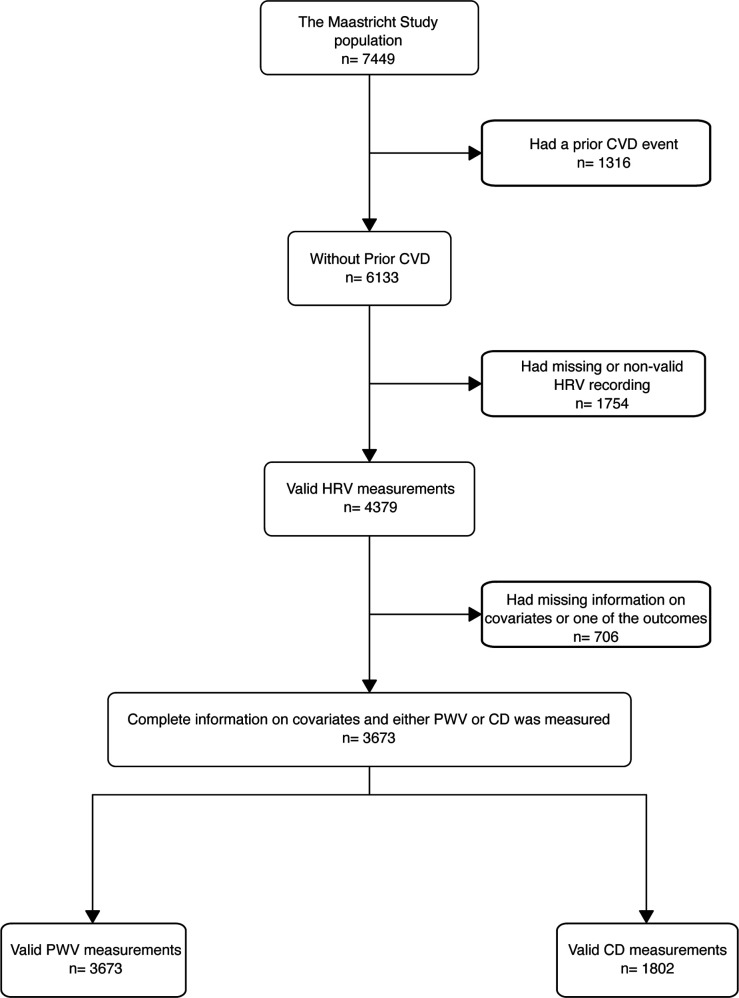
Results: PWV and CD measures were available in 3673 and 1802 participants, respectively (median (25th; 75th percentile) age: 60 years (53; 66), 51% women, 20% type 2 diabetes by design. Participants with lower HRV had higher aortic stiffness. Per SD lower time-domain and frequency-domain HRV z-scores were associated with 2.8% (95% CI 2.1% to 3.4%) and 2.8% (95% CI 2.1% to 3.5%) higher PWV, respectively. Similar trends were observed for carotid stiffness, with 3.2% (95% CI 1.4% to 5.0%) and 3.1% (95% CI 1.2% to 5.0%) lower CD per SD lower time-domain and frequency-domain HRV, respectively. The magnitude of these associations was higher in groups with prediabetes and type 2 diabetes compared with those with normal glucose metabolism, with evidence of effect modification by glucose metabolism status (p value for interaction: <0.01 for prediabetes and <0.05 to <0.10 for type 2 diabetes, both compared with normal glucose metabolism).
Conclusion: Cardiovascular autonomic dysfunction is associated with higher aortic and carotid stiffness, especially in people with dysglycemia.
目的:探讨糖代谢状态下心血管自主神经功能障碍与动脉僵硬的横断面相关性。研究设计和方法:我们对马斯特里赫特研究的参与者进行了横断面分析。心血管自主功能基于24小时心电图记录的心率变异性(HRV)指数,并在时域和频域总结为z分数。分别用颈动脉-股动脉脉波速度(PWV)和颈动脉扩张性(CD)评估主动脉和颈动脉僵硬度。我们使用多元线性回归来研究相关性,并调整了人口统计学和生活方式因素以及一系列心血管危险因素。我们测试了葡萄糖代谢状态对相关性的影响。结果:分别有3673名和1802名参与者进行了PWV和CD测量(中位(25;75百分位)年龄:60岁(53;66),51%为女性,20%为2型糖尿病患者)。HRV较低的参与者主动脉僵硬度较高。每SD较低的时域和频域HRV z得分分别与2.8% (95% CI 2.1%至3.4%)和2.8% (95% CI 2.1%至3.5%)的PWV升高相关。在颈动脉僵硬度方面也观察到类似的趋势,每SD的CD分别降低3.2% (95% CI 1.4%至5.0%)和3.1% (95% CI 1.2%至5.0%),时域和频域HRV分别降低。与糖代谢正常的患者相比,糖尿病前期和2型糖尿病患者的相关程度更高,有证据表明糖代谢状态会改变效果(相互作用的p值)。结论:心血管自主神经功能障碍与主动脉和颈动脉僵硬度升高有关,尤其是在血糖异常的人群中。
期刊介绍:
BMJ Open Diabetes Research & Care is an open access journal committed to publishing high-quality, basic and clinical research articles regarding type 1 and type 2 diabetes, and associated complications. Only original content will be accepted, and submissions are subject to rigorous peer review to ensure the publication of
high-quality — and evidence-based — original research articles.



 求助内容:
求助内容: 应助结果提醒方式:

 京公网安备 11010802042870号


