Jennyfher R Toro-Vera, Jerry K Benites-Meza, Christopher J Alarcón-Toro, Andrea A Aldea-García, Liseth Pinedo-Castillo, Carlos J Zumaran-Nuñez, Percy Herrera-Añazco, Vicente A Benites-Zapata
{"title":"Intimate Partner Violence and Early Initiation of Breastfeeding: Evidence from the Peruvian Demographic and Family Health Survey.","authors":"Jennyfher R Toro-Vera, Jerry K Benites-Meza, Christopher J Alarcón-Toro, Andrea A Aldea-García, Liseth Pinedo-Castillo, Carlos J Zumaran-Nuñez, Percy Herrera-Añazco, Vicente A Benites-Zapata","doi":"10.1177/17455057261424821","DOIUrl":null,"url":null,"abstract":"<p><strong>Background: </strong>Violence against women is a serious human rights violation and a public health problem. In Peru, more than 55% of women have suffered intimate partner violence (IPV), which has a negative impact on their health and breastfeeding.</p><p><strong>Objective: </strong>To evaluate the association of IPV and early initiation of breastfeeding (EIBF) in Peruvian women.</p><p><strong>Design: </strong>Cross-sectional study.</p><p><strong>Methods: </strong>A secondary analysis was conducted using data from the Demographic and Family Health Survey (ENDES) of the period 2018-2022. The population included women of reproductive age (15-49 years). The outcome variable was the EIBF, and the main predictor variable was IPV. Crude prevalence ratios and adjusted prevalence ratios were estimated as a measure of association.</p><p><strong>Results: </strong>We analyzed a final sample of 30,482 women. The prevalence of IPV was 16.25%, while the prevalence of mothers who did not initiate early breastfeeding was 33.37%. It was found that partner violence was associated with a lower likelihood of complying with EIBF.</p><p><strong>Conclusion: </strong>We identified that women who experienced IPV were less likely to initiate early breastfeeding.</p>","PeriodicalId":75327,"journal":{"name":"Women's health (London, England)","volume":"22 ","pages":"17455057261424821"},"PeriodicalIF":2.9000,"publicationDate":"2026-01-01","publicationTypes":"Journal Article","fieldsOfStudy":null,"isOpenAccess":false,"openAccessPdf":"https://www.ncbi.nlm.nih.gov/pmc/articles/PMC12966586/pdf/","citationCount":"0","resultStr":null,"platform":"Semanticscholar","paperid":null,"PeriodicalName":"Women's health (London, England)","FirstCategoryId":"1085","ListUrlMain":"https://doi.org/10.1177/17455057261424821","RegionNum":0,"RegionCategory":null,"ArticlePicture":[],"TitleCN":null,"AbstractTextCN":null,"PMCID":null,"EPubDate":"2026/3/6 0:00:00","PubModel":"Epub","JCR":"","JCRName":"","Score":null,"Total":0}
引用次数: 0
Abstract
Background: Violence against women is a serious human rights violation and a public health problem. In Peru, more than 55% of women have suffered intimate partner violence (IPV), which has a negative impact on their health and breastfeeding.
Objective: To evaluate the association of IPV and early initiation of breastfeeding (EIBF) in Peruvian women.
Design: Cross-sectional study.
Methods: A secondary analysis was conducted using data from the Demographic and Family Health Survey (ENDES) of the period 2018-2022. The population included women of reproductive age (15-49 years). The outcome variable was the EIBF, and the main predictor variable was IPV. Crude prevalence ratios and adjusted prevalence ratios were estimated as a measure of association.
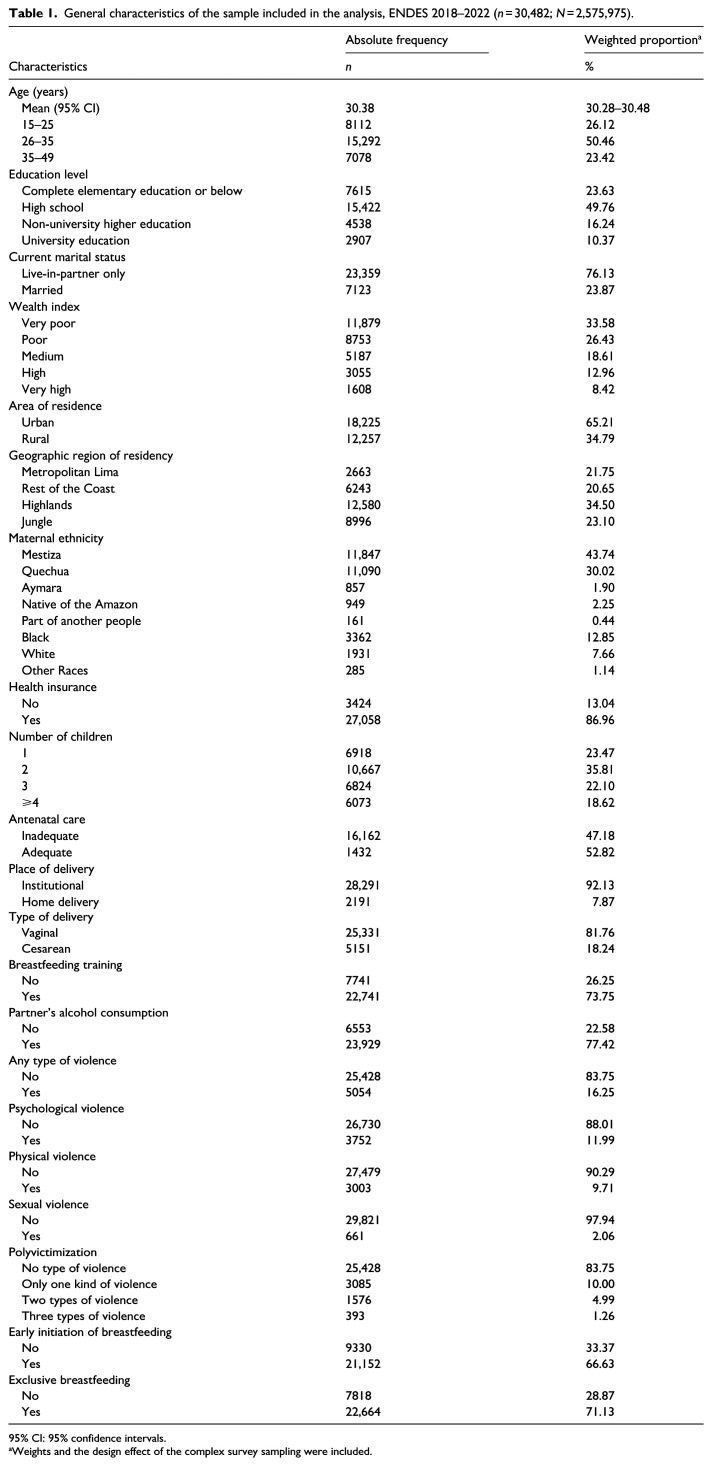
Results: We analyzed a final sample of 30,482 women. The prevalence of IPV was 16.25%, while the prevalence of mothers who did not initiate early breastfeeding was 33.37%. It was found that partner violence was associated with a lower likelihood of complying with EIBF.
Conclusion: We identified that women who experienced IPV were less likely to initiate early breastfeeding.



 求助内容:
求助内容: 应助结果提醒方式:

 京公网安备 11010802042870号


