
Exploring the effect of ethanol-water structuring on the transport properties of ethanol in porous silicas

IF 1.7
Magnetic Resonance Letters Pub Date : 2026-02-01 Epub Date: 2025-07-17 DOI:10.1016/j.mrl.2025.200227
Jordan Ward-Williams , Andrew Sederman , Michael Mantle , Matthias Appel , Lynn Gladden
{"title":"Exploring the effect of ethanol-water structuring on the transport properties of ethanol in porous silicas","authors":"Jordan Ward-Williams ,&nbsp;Andrew Sederman ,&nbsp;Michael Mantle ,&nbsp;Matthias Appel ,&nbsp;Lynn Gladden","doi":"10.1016/j.mrl.2025.200227","DOIUrl":null,"url":null,"abstract":"<div><div>The transport properties of liquid mixtures confined within porous media can change significantly from those observed for bulk mixtures due to changes in the liquid structuring within the pore space. Here, pulsed field gradient NMR was used to measure the diffusion coefficient of ethanol in ethanol-water liquid mixtures confined within silicas with pore diameters of 6 nm and 3 nm as a function of composition. For liquids imbibed within the 6 nm pores, the composition dependence of the ethanol diffusion coefficient closely followed that of the bulk liquid mixture and the absolute diffusion coefficients were reduced by a tortuosity factor of 3, with a minor contribution due to liquid-surface interactions. For liquids imbibed within the 3 nm pores, the diffusion coefficient of ethanol decreased as the composition of ethanol within the pore space increased, and for single-component ethanol imbibition the effective tortuosity was 63. Fast field cycling NMR experiments showed that the diffusion behaviour was not controlled by an increase in ethanol adsorption strength. A geometric analysis of the pore space was consistent with a highly confined system in which most molecules interacted with the pore walls. Under such confinement, the liquid structuring within the bulk pore space did not reflect that of the bulk liquid mixtures, and the observed decrease in diffusion coefficient as ethanol composition increased was consistent with an increase in confinement due to the larger size of the ethanol molecule.</div></div>","PeriodicalId":93594,"journal":{"name":"Magnetic Resonance Letters","volume":"6 1","pages":"Article 200227"},"PeriodicalIF":1.7000,"publicationDate":"2026-02-01","publicationTypes":"Journal Article","fieldsOfStudy":null,"isOpenAccess":false,"openAccessPdf":"","citationCount":"0","resultStr":null,"platform":"Semanticscholar","paperid":null,"PeriodicalName":"Magnetic Resonance Letters","FirstCategoryId":"1085","ListUrlMain":"https://www.sciencedirect.com/science/article/pii/S277251622500052X","RegionNum":0,"RegionCategory":null,"ArticlePicture":[],"TitleCN":null,"AbstractTextCN":null,"PMCID":null,"EPubDate":"2025/7/17 0:00:00","PubModel":"Epub","JCR":"","JCRName":"","Score":null,"Total":0}
引用次数: 0

Abstract

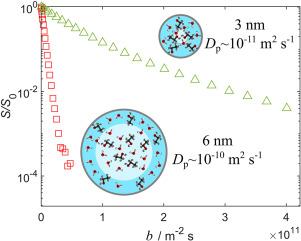
The transport properties of liquid mixtures confined within porous media can change significantly from those observed for bulk mixtures due to changes in the liquid structuring within the pore space. Here, pulsed field gradient NMR was used to measure the diffusion coefficient of ethanol in ethanol-water liquid mixtures confined within silicas with pore diameters of 6 nm and 3 nm as a function of composition. For liquids imbibed within the 6 nm pores, the composition dependence of the ethanol diffusion coefficient closely followed that of the bulk liquid mixture and the absolute diffusion coefficients were reduced by a tortuosity factor of 3, with a minor contribution due to liquid-surface interactions. For liquids imbibed within the 3 nm pores, the diffusion coefficient of ethanol decreased as the composition of ethanol within the pore space increased, and for single-component ethanol imbibition the effective tortuosity was 63. Fast field cycling NMR experiments showed that the diffusion behaviour was not controlled by an increase in ethanol adsorption strength. A geometric analysis of the pore space was consistent with a highly confined system in which most molecules interacted with the pore walls. Under such confinement, the liquid structuring within the bulk pore space did not reflect that of the bulk liquid mixtures, and the observed decrease in diffusion coefficient as ethanol composition increased was consistent with an increase in confinement due to the larger size of the ethanol molecule.
Abstract Image

探讨乙醇-水结构对乙醇在多孔二氧化硅中输运性质的影响。
由于孔隙空间内液体结构的变化,限制在多孔介质内的液体混合物的输运性质与在散装混合物中观察到的输运性质有显著变化。本文采用脉冲场梯度核磁共振测量了乙醇-水-液体混合物中乙醇的扩散系数,该扩散系数被限制在孔径为6 nm和3 nm的二氧化硅中,作为组分的函数。对于在6 nm孔内吸收的液体,乙醇扩散系数的组分依赖关系与体积液体混合物密切相关,绝对扩散系数降低了3倍,液面相互作用的贡献较小。对于在3nm孔内吸吸的液体,乙醇的扩散系数随着孔内乙醇组分的增加而减小,单组分乙醇吸吸的有效扭曲度为63。快速场循环核磁共振实验表明,扩散行为不受乙醇吸附强度的增加的控制。孔空间的几何分析与高度受限系统一致,其中大多数分子与孔壁相互作用。在这种约束下,体积孔空间内的液体结构并不能反映体积液混合物的结构,随着乙醇成分的增加,所观察到的扩散系数的降低与乙醇分子尺寸增大导致的约束增加是一致的。
本文章由计算机程序翻译,如有差异,请以英文原文为准。
求助全文
约1分钟内获得全文 求助全文
来源期刊
Magnetic Resonance Letters
Magnetic Resonance Letters Analytical Chemistry, Spectroscopy, Radiology and Imaging, Biochemistry, Genetics and Molecular Biology (General)
自引率
0.00%
发文量
0

×
引用
GB/T 7714-2015
复制
MLA
复制
APA
复制
导出至
BibTeX EndNote RefMan NoteFirst NoteExpress
×
提示
您的信息不完整,为了账户安全,请先补充。
现在去补充
×
提示
您因"违规操作"
具体请查看互助需知
我知道了
×
提示
确定
请完成安全验证×
copy
已复制链接
快去分享给好友吧!
我知道了
右上角分享
点击右上角分享
0
联系我们:info@booksci.cn Book学术提供免费学术资源搜索服务,方便国内外学者检索中英文文献。致力于提供最便捷和优质的服务体验。 Copyright © 2023 布克学术 All rights reserved.
京ICP备2023020795号-1
ghs 京公网安备 11010802042870号
Book学术文献互助
Book学术文献互助群
群 号:604180095
Book学术官方微信
小红书


