
SNMR with short pulses: Optimizing the kernel calculation by considering the influence of pulse shape and phase
IF 1.7
Magnetic Resonance Letters
Pub Date : 2026-02-01
Epub Date: 2025-07-03
DOI:10.1016/j.mrl.2025.200223
引用次数: 0
Abstract
In the past few years, efforts have been made to extend the sensitivity of surface nuclear magnetic resonance (SNMR) to short relaxation times, typical for strongly bound water, which, for example, occurs in partially saturated soils. The two limiting factors for the sensitivity are the dead time after the excitation pulse and the duration of the pulse itself. To enable short pulses, while also achieving proper depths of investigation, high pulse amplitudes are needed. This makes it necessary to consider the Bloch-Siegert effect, i.e. the counter-rotating component and the parallel component of the excitation field have significant influence on the excitation. If an untuned transmitter circuit is used, the pulse shape will also be non-sinusoidal. In this paper, we demonstrate that this influences SNMR measurements with short pulses in two ways: On one hand, the pulse shape influences the phase of the fundamental frequency oscillation. On the other, at very high pulse amplitudes, other frequency components of the excitation field start to influence the excitation. The behavior of the macroscopic magnetizations in the subsurface during the pulse is simulated by solving the Bloch equations, using the pulse shape as an input. Since these calculations are computational expensive, we propose a lookup scheme that allows a time efficient modeling of the obtained SNMR data.
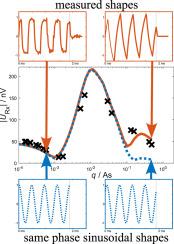
短脉冲SNMR:考虑脉冲形状和相位的影响,优化核计算。
在过去的几年里,人们已经努力将表面核磁共振(SNMR)的灵敏度扩展到短松弛时间,这是典型的强结合水,例如,在部分饱和土壤中发生。灵敏度的两个限制因素是激励脉冲后的死区时间和脉冲本身的持续时间。为了实现短脉冲,同时达到适当的探测深度,需要高脉冲幅度。这就需要考虑Bloch-Siegert效应,即激励场的反向旋转分量和平行分量对激励有显著的影响。如果使用未调谐的发射机电路,脉冲形状也将是非正弦的。在本文中,我们从两个方面证明了这对短脉冲SNMR测量的影响:一方面,脉冲形状影响基频振荡的相位。另一方面,在非常高的脉冲幅值时,激励场的其他频率分量开始影响激励。通过求解布洛赫方程,以脉冲形状作为输入,模拟了脉冲期间地下宏观磁化的行为。由于这些计算的计算成本很高,因此我们提出了一种查找方案,该方案允许对获得的SNMR数据进行高效的建模。
本文章由计算机程序翻译,如有差异,请以英文原文为准。
求助全文
约1分钟内获得全文
求助全文
来源期刊

Magnetic Resonance Letters
Analytical Chemistry, Spectroscopy, Radiology and Imaging, Biochemistry, Genetics and Molecular Biology (General)
自引率
0.00%
发文量
0
 求助内容:
求助内容: 应助结果提醒方式:

 京公网安备 11010802042870号


