Himanshi Jangir, Leandro H Gallo, Russell Emmons, James J Hickman
{"title":"Development of a functional sarcopenia model utilizing a microcantilever microphysiological system as a phenotypic disease model.","authors":"Himanshi Jangir, Leandro H Gallo, Russell Emmons, James J Hickman","doi":"10.1007/s44164-025-00092-9","DOIUrl":null,"url":null,"abstract":"<p><strong>Purpose: </strong>Sarcopenia is a skeletal muscle (SKM) condition marked by reduced muscle mass and function and is often observed as a comorbidity with inflammatory conditions.</p><p><strong>Methods: </strong>We have developed a defined in vitro functional model to study sarcopenia by incubating human-induced pluripotent stem cell-derived SKM cells with 3 nM TNF-alpha (TNFα) for 96 h. The long-term effects of this treatment were studied for up to 32 days in culture. Muscle function was evaluated by measuring myotube width as well as microcantilever contraction amplitude, force, and fatigue index.</p><p><strong>Results: </strong>This model revealed the maintenance of a significant reduction in myotube width for 32 days after TNF-α treatment; moreover, a decrease in myotube contraction amplitude and an increase in fatigue indices were recorded for 32 days. In addition, disease progression and tissue degradation of the sarcopenic conditions were monitored for higher reactive oxygen species production for both acute (day 4) and chronic (day 40) timelines.</p><p><strong>Conclusion: </strong>This is the first microphysiological system for sarcopenia evaluation that can be used to evaluate therapeutics. This device can now be combined in a multi-organ microphysiological system to study sarcopenia induced by an inflammatory response from other organs or as a comorbidity in the platform.</p><p><strong>Graphical abstract: </strong>Development of the first defined in vitro functional model of sarcopenia on a microcantilever platform. This study recapitulates physiological signatures of disease progression characterized by loss of muscle mass and function and an increase in reactive oxygen species.</p>","PeriodicalId":73357,"journal":{"name":"In vitro models","volume":"5 1","pages":"63-78"},"PeriodicalIF":2.4000,"publicationDate":"2025-09-22","publicationTypes":"Journal Article","fieldsOfStudy":null,"isOpenAccess":false,"openAccessPdf":"https://www.ncbi.nlm.nih.gov/pmc/articles/PMC12957697/pdf/","citationCount":"0","resultStr":null,"platform":"Semanticscholar","paperid":null,"PeriodicalName":"In vitro models","FirstCategoryId":"1085","ListUrlMain":"https://doi.org/10.1007/s44164-025-00092-9","RegionNum":0,"RegionCategory":null,"ArticlePicture":[],"TitleCN":null,"AbstractTextCN":null,"PMCID":null,"EPubDate":"2026/2/1 0:00:00","PubModel":"eCollection","JCR":"","JCRName":"","Score":null,"Total":0}
引用次数: 0
Abstract
Purpose: Sarcopenia is a skeletal muscle (SKM) condition marked by reduced muscle mass and function and is often observed as a comorbidity with inflammatory conditions.
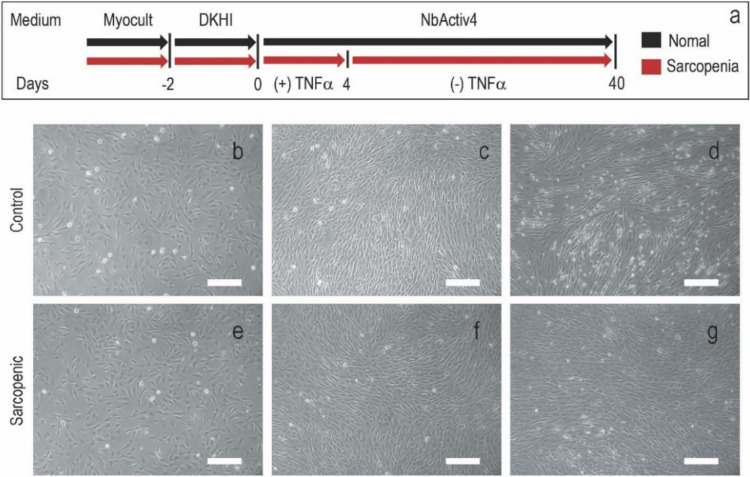
Methods: We have developed a defined in vitro functional model to study sarcopenia by incubating human-induced pluripotent stem cell-derived SKM cells with 3 nM TNF-alpha (TNFα) for 96 h. The long-term effects of this treatment were studied for up to 32 days in culture. Muscle function was evaluated by measuring myotube width as well as microcantilever contraction amplitude, force, and fatigue index.
Results: This model revealed the maintenance of a significant reduction in myotube width for 32 days after TNF-α treatment; moreover, a decrease in myotube contraction amplitude and an increase in fatigue indices were recorded for 32 days. In addition, disease progression and tissue degradation of the sarcopenic conditions were monitored for higher reactive oxygen species production for both acute (day 4) and chronic (day 40) timelines.
Conclusion: This is the first microphysiological system for sarcopenia evaluation that can be used to evaluate therapeutics. This device can now be combined in a multi-organ microphysiological system to study sarcopenia induced by an inflammatory response from other organs or as a comorbidity in the platform.
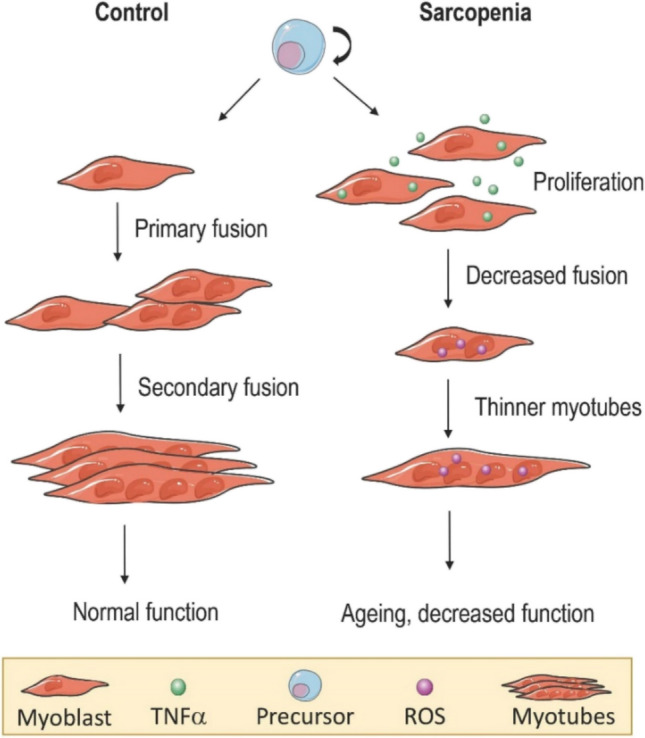
Graphical abstract: Development of the first defined in vitro functional model of sarcopenia on a microcantilever platform. This study recapitulates physiological signatures of disease progression characterized by loss of muscle mass and function and an increase in reactive oxygen species.



 求助内容:
求助内容: 应助结果提醒方式:

 京公网安备 11010802042870号


