Marie Hauge Pedersen, Mathias Lasgaard, Camilla Palmhøj Nielsen, Anders Prior, Polly Duncan, Stine Schramm, Finn Breinholt Larsen
{"title":"Multimorbidity patterns and their associations with patient-perceived treatment burden: A latent class analysis of 14,344 Danish adults.","authors":"Marie Hauge Pedersen, Mathias Lasgaard, Camilla Palmhøj Nielsen, Anders Prior, Polly Duncan, Stine Schramm, Finn Breinholt Larsen","doi":"10.1177/26335565261417433","DOIUrl":null,"url":null,"abstract":"<p><strong>Objectives: </strong>To identify population groups with distinct multimorbidity patterns and to examine their associations with high treatment burden.</p><p><strong>Methods: </strong>Latent class analysis was conducted using cross-sectional, self-reported data on 16 long-term conditions from Danish adults aged 25 years and older in treatment (N = 14,344), drawn from the Danish National Health Survey. Treatment burden was assessed using the Multimorbidity Treatment Burden Questionnaire, and associations between identified multimorbidity patterns and high treatment burden (score ≥22) were examined using a bias-adjusted three-step approach.</p><p><strong>Results: </strong>Eight latent classes were identified: 1 <i>Hypertension</i> (31% of the study population); 2 <i>Mental health disorders</i> (21%); 3 <i>Musculoskeletal disorders</i> (17%); 4 <i>Complex</i> <i>cardiometabolic-</i> <i>musculoskeletal</i> <i>disorders</i> (10%); 5 <i>Complex</i> <i>headache-mental-back-disorders</i> (7%); 6 <i>Asthma-</i> <i>allergy</i> (6%); 7 <i>Cataract-</i> <i>respiratory</i> <i>disorders</i> (5%); and 8 <i>Complex</i> <i>respiratory-</i> <i>musculoskeletal</i> <i>disorders</i> (3%). Overall, 13% experienced a high treatment burden. This proportion varied from 0.5% in Class 3 to 48% in Class 5, with the highest proportions associated with Classes 4 (27%), 5 (48%), and 8 (26%). The three complex multimorbidity groups averaged more than four conditions per individual and, compared to Class 1, were associated with a non-Danish background, being temporarily or permanently out of work, low social support, and difficulties engaging with healthcare providers. The prevalence of high treatment burden and the strength of its association with disease patterns decreased with age, while no substantial differences were observed across sexes.</p><p><strong>Conclusion: </strong>Specific multimorbidity patterns were strongly associated with high treatment burden. These findings may inform healthcare planning, resource allocation, and tailored interventions to reduce treatment burden.</p>","PeriodicalId":73843,"journal":{"name":"Journal of multimorbidity and comorbidity","volume":"16 ","pages":"26335565261417433"},"PeriodicalIF":3.0000,"publicationDate":"2026-03-03","publicationTypes":"Journal Article","fieldsOfStudy":null,"isOpenAccess":false,"openAccessPdf":"https://www.ncbi.nlm.nih.gov/pmc/articles/PMC12957603/pdf/","citationCount":"0","resultStr":null,"platform":"Semanticscholar","paperid":null,"PeriodicalName":"Journal of multimorbidity and comorbidity","FirstCategoryId":"1085","ListUrlMain":"https://doi.org/10.1177/26335565261417433","RegionNum":0,"RegionCategory":null,"ArticlePicture":[],"TitleCN":null,"AbstractTextCN":null,"PMCID":null,"EPubDate":"2026/1/1 0:00:00","PubModel":"eCollection","JCR":"","JCRName":"","Score":null,"Total":0}
引用次数: 0
Abstract
Objectives: To identify population groups with distinct multimorbidity patterns and to examine their associations with high treatment burden.
Methods: Latent class analysis was conducted using cross-sectional, self-reported data on 16 long-term conditions from Danish adults aged 25 years and older in treatment (N = 14,344), drawn from the Danish National Health Survey. Treatment burden was assessed using the Multimorbidity Treatment Burden Questionnaire, and associations between identified multimorbidity patterns and high treatment burden (score ≥22) were examined using a bias-adjusted three-step approach.
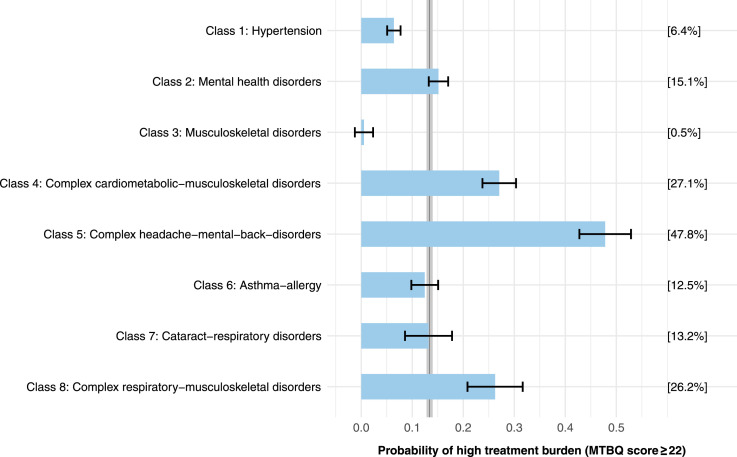
Results: Eight latent classes were identified: 1 Hypertension (31% of the study population); 2 Mental health disorders (21%); 3 Musculoskeletal disorders (17%); 4 Complexcardiometabolic-musculoskeletaldisorders (10%); 5 Complexheadache-mental-back-disorders (7%); 6 Asthma-allergy (6%); 7 Cataract-respiratorydisorders (5%); and 8 Complexrespiratory-musculoskeletaldisorders (3%). Overall, 13% experienced a high treatment burden. This proportion varied from 0.5% in Class 3 to 48% in Class 5, with the highest proportions associated with Classes 4 (27%), 5 (48%), and 8 (26%). The three complex multimorbidity groups averaged more than four conditions per individual and, compared to Class 1, were associated with a non-Danish background, being temporarily or permanently out of work, low social support, and difficulties engaging with healthcare providers. The prevalence of high treatment burden and the strength of its association with disease patterns decreased with age, while no substantial differences were observed across sexes.
Conclusion: Specific multimorbidity patterns were strongly associated with high treatment burden. These findings may inform healthcare planning, resource allocation, and tailored interventions to reduce treatment burden.
目的:确定具有不同多病模式的人群,并研究其与高治疗负担的关系。方法:利用来自丹麦国家健康调查(Danish National Health Survey)的年龄在25岁及以上的丹麦成年人(N = 14,344)的16项长期疾病的横断面自我报告数据进行潜在类别分析。使用多病治疗负担问卷评估治疗负担,并使用偏差校正三步法检查已确定的多病模式与高治疗负担(评分≥22)之间的关联。结果:确定了8个潜在类别:1高血压(占研究人群的31%);2例精神健康障碍(21%);3肌肉骨骼疾病(17%);4复杂的心脏代谢-肌肉骨骼疾病(10%);5例复杂头痛-精神-背部疾病(7%);6哮喘-过敏(6%);白内障-呼吸系统疾病(5%);复杂呼吸-肌肉骨骼疾病8例(3%)。总体而言,13%的人经历了很高的治疗负担。这一比例从第3类的0.5%到第5类的48%不等,其中第4类(27%)、第5类(48%)和第8类(26%)的比例最高。与第一类相比,三个复杂多病组平均每人有四种以上的病症,与非丹麦背景有关,暂时或永久失业,社会支持低,与医疗保健提供者接触困难。高治疗负担的流行率及其与疾病模式的关联强度随着年龄的增长而下降,而在性别之间没有观察到实质性差异。结论:特殊的多病模式与高治疗负担密切相关。这些发现可以为医疗保健计划、资源分配和量身定制的干预措施提供信息,以减轻治疗负担。




 求助内容:
求助内容: 应助结果提醒方式:

 京公网安备 11010802042870号


