Wenjun Song, Nurul Izzah Shari, Mohammad Farris Iman Leong Bin Abdullah, Hasmah Binti Hussin, Ruiling Zhang, Nor Shuhada Mansor
{"title":"Acceptance and commitment therapy improves the quality of life of breast cancer patients by reducing helplessness: a randomized controlled trial.","authors":"Wenjun Song, Nurul Izzah Shari, Mohammad Farris Iman Leong Bin Abdullah, Hasmah Binti Hussin, Ruiling Zhang, Nor Shuhada Mansor","doi":"10.1186/s12904-026-02049-5","DOIUrl":null,"url":null,"abstract":"<p><strong>Background: </strong>Breast cancer imposes substantial psychosocial challenges, with helplessness being a key determinant of reduced quality of life (QoL). Acceptance and Commitment Therapy (ACT) has shown promise in improving psychological flexibility, but its role in targeting helplessness and enhancing QoL in breast cancer patients has not been fully established. This randomized controlled trial (RCT) examined the effects of ACT on helplessness, QoL, and their domains.</p><p><strong>Methods: </strong>This two-arm, parallel, single-blind RCT recruited 80 breast cancer patients from a tertiary care center and randomly assigned them to either ACT (n = 40) or treatment-as-usual (TAU, n = 40). Participants completed the Malay Illness Cognition Questionnaire (ICQ-M) and the Functional Assessment of Cancer Therapy (General and Breast Cancer modules) at baseline (T1), post-intervention at 4 weeks (T2), and follow-up at 12 weeks (T3). ACT was delivered in four weekly sessions between T1 and T2. Data were analyzed using repeated-measures analysis of variance (ANOVA).</p><p><strong>Results: </strong>Sixty-six participants completed all assessments (ACT, n = 32; TAU, n = 34). Compared with TAU, ACT significantly reduced helplessness and improved overall QoL and all QoL domains across time points (all p < 0.05). Effects were maintained at 12-week follow-up.</p><p><strong>Conclusion: </strong>ACT is an effective psychosocial intervention for breast cancer patients, producing sustained improvements in QoL partly by reducing helplessness. Integrating ACT into supportive and palliative care may address critical psychological mechanisms affecting patient well-being.</p><p><strong>Trial registration: </strong>ClinicalTrials.gov, NCT05327153. Registered on April 6, 2022.</p>","PeriodicalId":48945,"journal":{"name":"BMC Palliative Care","volume":" ","pages":""},"PeriodicalIF":2.5000,"publicationDate":"2026-03-05","publicationTypes":"Journal Article","fieldsOfStudy":null,"isOpenAccess":false,"openAccessPdf":"https://www.ncbi.nlm.nih.gov/pmc/articles/PMC13001182/pdf/","citationCount":"0","resultStr":null,"platform":"Semanticscholar","paperid":null,"PeriodicalName":"BMC Palliative Care","FirstCategoryId":"3","ListUrlMain":"https://doi.org/10.1186/s12904-026-02049-5","RegionNum":2,"RegionCategory":"医学","ArticlePicture":[],"TitleCN":null,"AbstractTextCN":null,"PMCID":null,"EPubDate":"","PubModel":"","JCR":"Q2","JCRName":"HEALTH CARE SCIENCES & SERVICES","Score":null,"Total":0}
引用次数: 0
Abstract
Background: Breast cancer imposes substantial psychosocial challenges, with helplessness being a key determinant of reduced quality of life (QoL). Acceptance and Commitment Therapy (ACT) has shown promise in improving psychological flexibility, but its role in targeting helplessness and enhancing QoL in breast cancer patients has not been fully established. This randomized controlled trial (RCT) examined the effects of ACT on helplessness, QoL, and their domains.
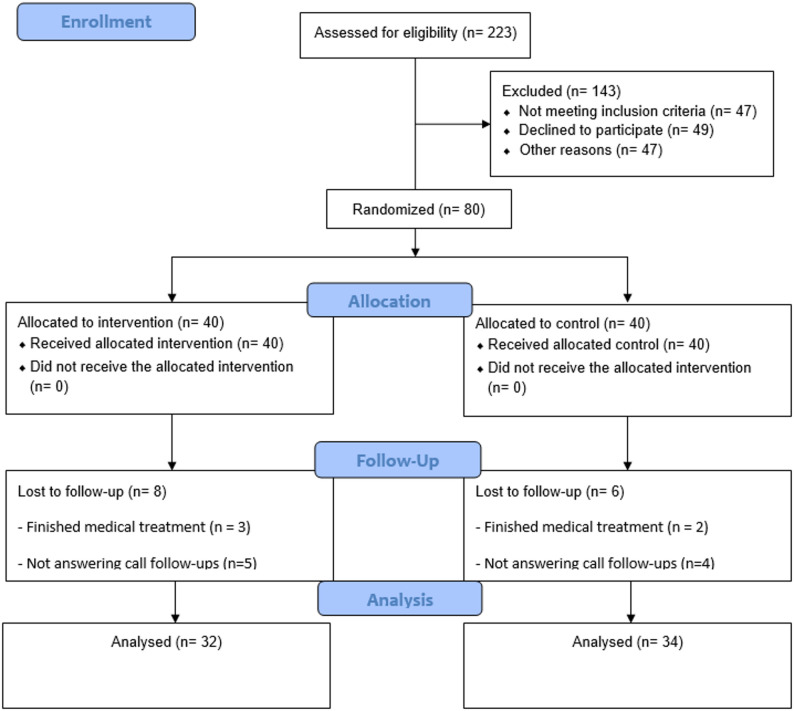
Methods: This two-arm, parallel, single-blind RCT recruited 80 breast cancer patients from a tertiary care center and randomly assigned them to either ACT (n = 40) or treatment-as-usual (TAU, n = 40). Participants completed the Malay Illness Cognition Questionnaire (ICQ-M) and the Functional Assessment of Cancer Therapy (General and Breast Cancer modules) at baseline (T1), post-intervention at 4 weeks (T2), and follow-up at 12 weeks (T3). ACT was delivered in four weekly sessions between T1 and T2. Data were analyzed using repeated-measures analysis of variance (ANOVA).
Results: Sixty-six participants completed all assessments (ACT, n = 32; TAU, n = 34). Compared with TAU, ACT significantly reduced helplessness and improved overall QoL and all QoL domains across time points (all p < 0.05). Effects were maintained at 12-week follow-up.
Conclusion: ACT is an effective psychosocial intervention for breast cancer patients, producing sustained improvements in QoL partly by reducing helplessness. Integrating ACT into supportive and palliative care may address critical psychological mechanisms affecting patient well-being.
Trial registration: ClinicalTrials.gov, NCT05327153. Registered on April 6, 2022.
背景:乳腺癌带来了巨大的社会心理挑战,无助感是生活质量下降的关键决定因素。接受与承诺疗法(ACT)在改善乳腺癌患者心理灵活性方面显示出良好的前景,但其在针对乳腺癌患者无助感和提高患者生活质量方面的作用尚未完全确定。本随机对照试验(RCT)考察了ACT对无助感、生活质量及其域的影响。方法:这项双臂、平行、单盲随机对照试验从三级保健中心招募了80名乳腺癌患者,并将其随机分配到ACT (n = 40)或常规治疗(TAU, n = 40)组。参与者在基线(T1)、干预后4周(T2)和随访12周(T3)时完成马来疾病认知问卷(ICQ-M)和癌症治疗功能评估(一般和乳腺癌模块)。ACT在T1和T2之间进行每周一次的治疗。数据分析采用重复测量方差分析(ANOVA)。结果:66名参与者完成了所有评估(ACT, n = 32; TAU, n = 34)。与TAU相比,ACT显著降低了无助感,改善了总体生活质量和所有生活质量域(均p)结论:ACT是一种有效的乳腺癌患者心理社会干预,部分通过减少无助感来持续改善生活质量。将ACT纳入支持性和姑息性护理可能解决影响患者福祉的关键心理机制。试验注册:ClinicalTrials.gov, NCT05327153。于2022年4月6日注册。
期刊介绍:
BMC Palliative Care is an open access journal publishing original peer-reviewed research articles in the clinical, scientific, ethical and policy issues, local and international, regarding all aspects of hospice and palliative care for the dying and for those with profound suffering related to chronic illness.

 求助内容:
求助内容: 应助结果提醒方式:

 京公网安备 11010802042870号


