Yonghan Zhong, Ying Xu, Kecheng Zhu, Jorge Diaz-Cidoncha Garcia, Miguel Ángel Gómez Ruano, Qing Yi
{"title":"Data-driven classification of playing styles and match outcome prediction in UEFA Champions League teams.","authors":"Yonghan Zhong, Ying Xu, Kecheng Zhu, Jorge Diaz-Cidoncha Garcia, Miguel Ángel Gómez Ruano, Qing Yi","doi":"10.5114/biolsport.2026.154944","DOIUrl":null,"url":null,"abstract":"<p><p>This study proposes a data-driven framework for classifying UEFA Champions League teams into possession-based and counterattacking styles and predicting match outcomes based on key performance indicators (KPIs). Dimensionality reduction via an autoencoder was combined with K-means clustering to identify underlying tactical patterns beyond traditional possession metrics. Feature selection was performed using LASSO, Boruta, and XGBoost to determine the most relevant KPIs. Predictive models, including Support Vector Machine (SVM), K-Nearest Neighbors (KNN), and LightGBM, were evaluated using AUC and F1 Score. SVM achieved the highest performance for possession-based teams, whereas KNN outperformed other models for counterattacking teams. The results revealed distinct style-specific performance profiles. For possession-based teams, higher possession and key passes correlated negatively with winning probability, while crosses and long-range shots were positively associated with success. In counterattacking teams, increased possession and key passes improved match outcomes, whereas crosses and shots from outside the box showed negative associations. Defensive actions, particularly clearances, were strongly associated with improved defensive stability and match success, especially among counterattacking teams. This framework improves the accuracy of tactical classification and provides interpretable associations between KPIs and match outcomes. The findings can inform style-specific tactical planning and performance monitoring, enabling coaches to adjust offensive or defensive training priorities according to team strategy.</p>","PeriodicalId":55365,"journal":{"name":"Biology of Sport","volume":"43 ","pages":"575-586"},"PeriodicalIF":4.2000,"publicationDate":"2025-11-03","publicationTypes":"Journal Article","fieldsOfStudy":null,"isOpenAccess":false,"openAccessPdf":"https://www.ncbi.nlm.nih.gov/pmc/articles/PMC12954490/pdf/","citationCount":"0","resultStr":null,"platform":"Semanticscholar","paperid":null,"PeriodicalName":"Biology of Sport","FirstCategoryId":"3","ListUrlMain":"https://doi.org/10.5114/biolsport.2026.154944","RegionNum":2,"RegionCategory":"医学","ArticlePicture":[],"TitleCN":null,"AbstractTextCN":null,"PMCID":null,"EPubDate":"2026/1/1 0:00:00","PubModel":"eCollection","JCR":"Q1","JCRName":"SPORT SCIENCES","Score":null,"Total":0}
引用次数: 0
Abstract
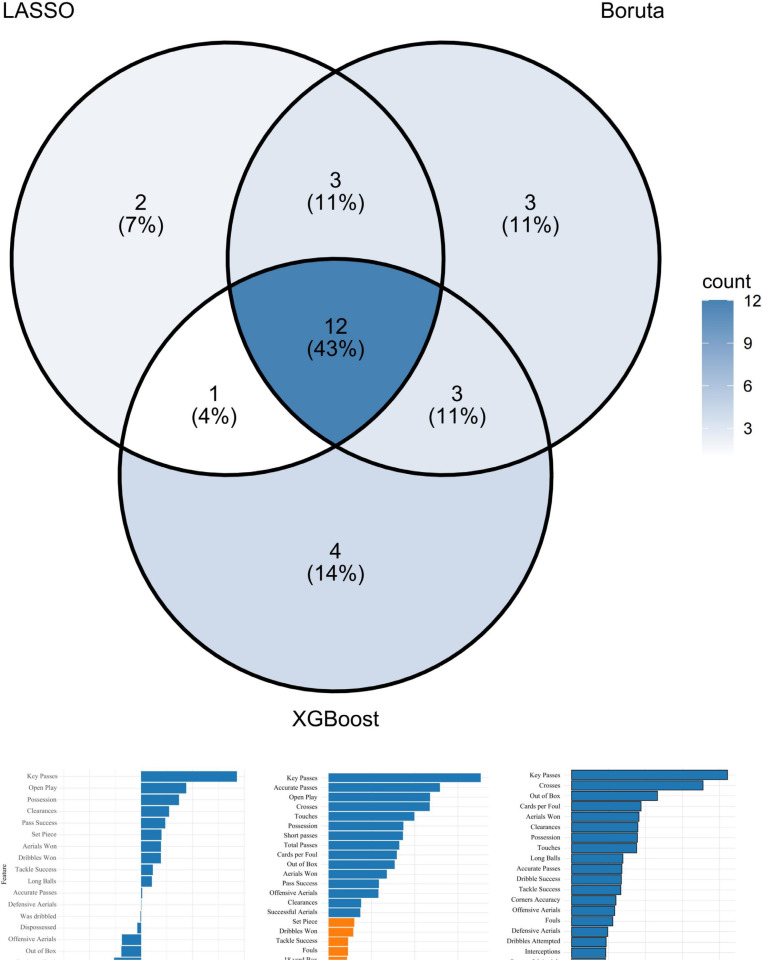
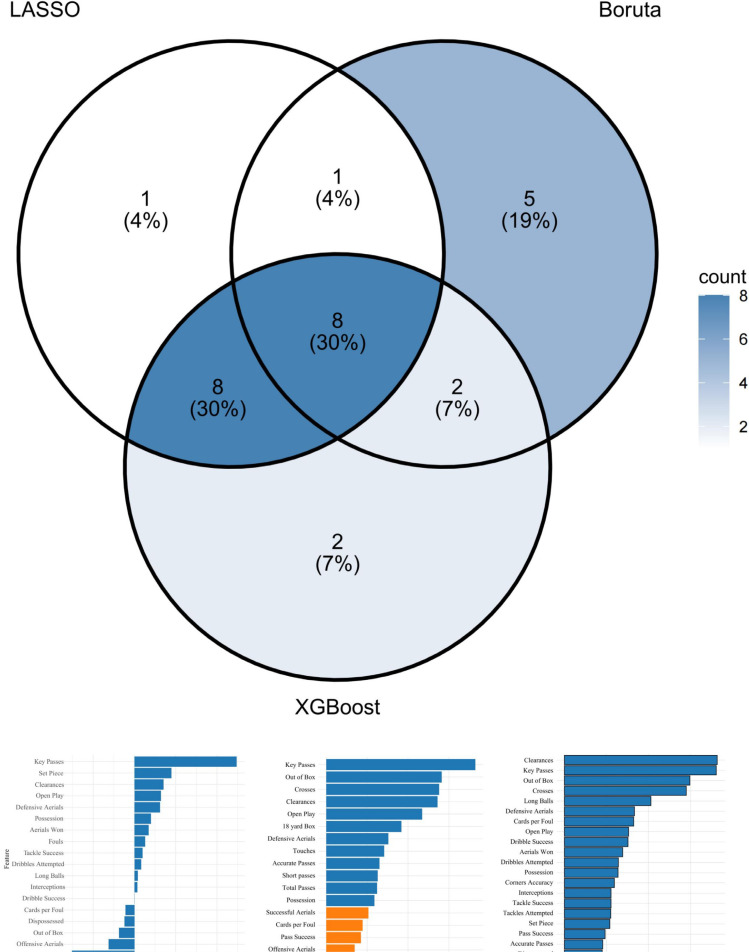
This study proposes a data-driven framework for classifying UEFA Champions League teams into possession-based and counterattacking styles and predicting match outcomes based on key performance indicators (KPIs). Dimensionality reduction via an autoencoder was combined with K-means clustering to identify underlying tactical patterns beyond traditional possession metrics. Feature selection was performed using LASSO, Boruta, and XGBoost to determine the most relevant KPIs. Predictive models, including Support Vector Machine (SVM), K-Nearest Neighbors (KNN), and LightGBM, were evaluated using AUC and F1 Score. SVM achieved the highest performance for possession-based teams, whereas KNN outperformed other models for counterattacking teams. The results revealed distinct style-specific performance profiles. For possession-based teams, higher possession and key passes correlated negatively with winning probability, while crosses and long-range shots were positively associated with success. In counterattacking teams, increased possession and key passes improved match outcomes, whereas crosses and shots from outside the box showed negative associations. Defensive actions, particularly clearances, were strongly associated with improved defensive stability and match success, especially among counterattacking teams. This framework improves the accuracy of tactical classification and provides interpretable associations between KPIs and match outcomes. The findings can inform style-specific tactical planning and performance monitoring, enabling coaches to adjust offensive or defensive training priorities according to team strategy.
期刊介绍:
Biology of Sport is the official journal of the Institute of Sport in Warsaw, Poland, published since 1984.
Biology of Sport is an international scientific peer-reviewed journal, published quarterly in both paper and electronic format. The journal publishes articles concerning basic and applied sciences in sport: sports and exercise physiology, sports immunology and medicine, sports genetics, training and testing, pharmacology, as well as in other biological aspects related to sport. Priority is given to inter-disciplinary papers.


 求助内容:
求助内容: 应助结果提醒方式:

 京公网安备 11010802042870号


