Yupei Zhang, Xiaxiao Yan, Alyssa A Grimshaw, Yanhong Wang, Mengtao Li, Xiaofeng Zeng, Evelyn Hsieh, Nan Jiang
{"title":"Efficacy and safety of immunosuppressive therapy in connective tissue disease-related immune thrombocytopenia: a systematic review and meta-analysis.","authors":"Yupei Zhang, Xiaxiao Yan, Alyssa A Grimshaw, Yanhong Wang, Mengtao Li, Xiaofeng Zeng, Evelyn Hsieh, Nan Jiang","doi":"10.1177/20406207261422963","DOIUrl":null,"url":null,"abstract":"<p><strong>Background: </strong>Connective tissue diseases (CTDs) are a group of autoimmune disorders in which immune thrombocytopenia (ITP) represents a common and important manifestation. Current CTD-ITP management mainly relies on glucocorticoids and immunosuppressive agents.</p><p><strong>Objectives: </strong>This systematic review and meta-analysis aims to evaluate the efficacy and safety of immunosuppressive agents in patients with CTD-ITP.</p><p><strong>Design: </strong>Systematic review and meta-analysis.</p><p><strong>Methods: </strong>This study was conducted using eight databases up to July 22, 2024. Observational studies and experimental trials with relevant efficacy and safety data were included. Methodological quality were evaluated using the Newcastle-Ottawa Scale and the ROBINS-I tool. The Mantel-Haenszel formula with a random effect model was employed to estimate the overall effect size. Subgroup analyses were performed based on the study characteristics, clinical features, and treatment regimen.</p><p><strong>Results: </strong>Through integrating 24 studies (1 single-arm clinical trial, 1 case-control, and 22 cohort studies) involving 775 CTD-ITP patients, the pooled estimates of the optimal overall and complete response rate for immunosuppressive therapy were 82% (95% CI: 75-88) and 64% (95% CI: 56-72), with stable results after sensitivity analysis. The combined side-effect incidence was 31% (95% CI: 24-39). The pooled relapse rate was 30% (95% CI: 18-43) among 403 immunosuppressive therapy responders.</p><p><strong>Conclusion: </strong>Immunosuppressive treatments exhibited favorable efficacy and safety in CTD-ITP patients. Future larger-scale multicenter studies are needed.</p>","PeriodicalId":23048,"journal":{"name":"Therapeutic Advances in Hematology","volume":"17 ","pages":"20406207261422963"},"PeriodicalIF":3.1000,"publicationDate":"2026-02-28","publicationTypes":"Journal Article","fieldsOfStudy":null,"isOpenAccess":false,"openAccessPdf":"https://www.ncbi.nlm.nih.gov/pmc/articles/PMC12954039/pdf/","citationCount":"0","resultStr":null,"platform":"Semanticscholar","paperid":null,"PeriodicalName":"Therapeutic Advances in Hematology","FirstCategoryId":"3","ListUrlMain":"https://doi.org/10.1177/20406207261422963","RegionNum":3,"RegionCategory":"医学","ArticlePicture":[],"TitleCN":null,"AbstractTextCN":null,"PMCID":null,"EPubDate":"2026/1/1 0:00:00","PubModel":"eCollection","JCR":"Q2","JCRName":"HEMATOLOGY","Score":null,"Total":0}
引用次数: 0
Abstract
Background: Connective tissue diseases (CTDs) are a group of autoimmune disorders in which immune thrombocytopenia (ITP) represents a common and important manifestation. Current CTD-ITP management mainly relies on glucocorticoids and immunosuppressive agents.
Objectives: This systematic review and meta-analysis aims to evaluate the efficacy and safety of immunosuppressive agents in patients with CTD-ITP.
Design: Systematic review and meta-analysis.
Methods: This study was conducted using eight databases up to July 22, 2024. Observational studies and experimental trials with relevant efficacy and safety data were included. Methodological quality were evaluated using the Newcastle-Ottawa Scale and the ROBINS-I tool. The Mantel-Haenszel formula with a random effect model was employed to estimate the overall effect size. Subgroup analyses were performed based on the study characteristics, clinical features, and treatment regimen.
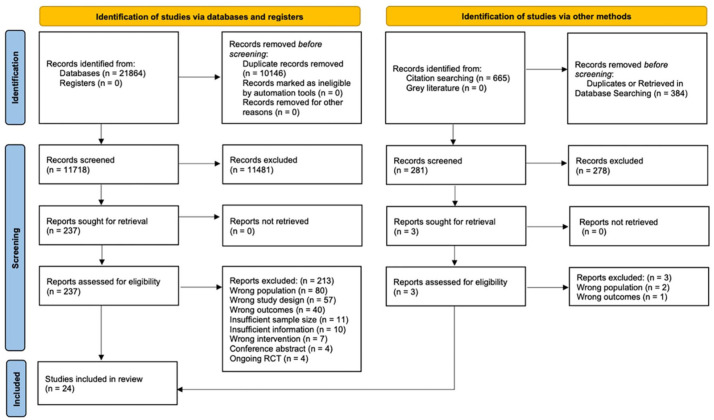
Results: Through integrating 24 studies (1 single-arm clinical trial, 1 case-control, and 22 cohort studies) involving 775 CTD-ITP patients, the pooled estimates of the optimal overall and complete response rate for immunosuppressive therapy were 82% (95% CI: 75-88) and 64% (95% CI: 56-72), with stable results after sensitivity analysis. The combined side-effect incidence was 31% (95% CI: 24-39). The pooled relapse rate was 30% (95% CI: 18-43) among 403 immunosuppressive therapy responders.
Conclusion: Immunosuppressive treatments exhibited favorable efficacy and safety in CTD-ITP patients. Future larger-scale multicenter studies are needed.
期刊介绍:
Therapeutic Advances in Hematology delivers the highest quality peer-reviewed articles, reviews, and scholarly comment on pioneering efforts and innovative studies across all areas of hematology. The journal has a strong clinical and pharmacological focus and is aimed at clinicians and researchers in hematology, providing a forum in print and online for publishing the highest quality articles in this area.



 求助内容:
求助内容: 应助结果提醒方式:

 京公网安备 11010802042870号


