
Randomized controlled trial on feedback-informed internet-delivered psychodynamic therapy for adolescents with depression: A trial that failed to recruit enough participants
IF 4.1
2区 医学
Q1 HEALTH CARE SCIENCES & SERVICES
Internet Interventions-The Application of Information Technology in Mental and Behavioural Health
Pub Date : 2026-03-01
Epub Date: 2026-02-22
DOI:10.1016/j.invent.2026.100923
引用次数: 0
Abstract
Background
Internet-delivered psychodynamic therapy (IPDT) has been found to be effective for adolescents with depression in previous randomized controlled trials. The present study aimed to evaluate an adaptive, feedback-informed version of IPDT, designed to improve outcomes for participants identified early as at risk of non-response.
Methods
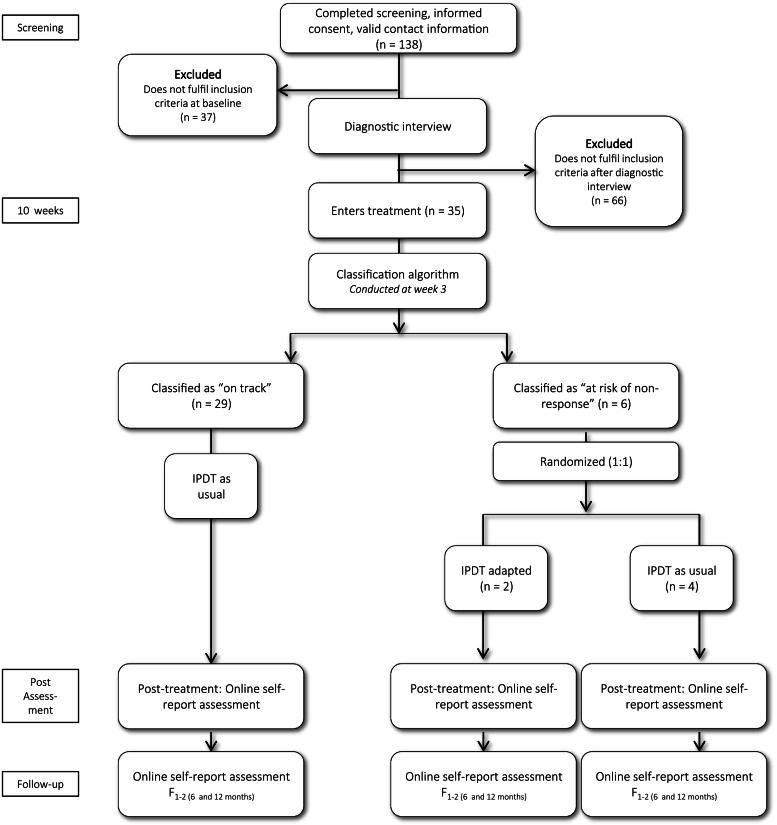
A randomized controlled trial targeting adolescents aged 15–19 years with mild to moderate major depressive disorder. Participants were recruited through social media, national and local advertising, schools, and user organizations. After three weeks of standard IPDT, participants classified as at risk by a prediction algorithm were randomized to either adapted or standard treatment. The planned sample size was 240 participants. Despite extensive nationwide recruitment efforts during 2024, only 35 participants were enrolled before the study was discontinued.
Results
Recruitment difficulties were primarily due to recent European Union regulations prohibiting profiling-based online advertising for minors, which eliminated access to previously effective social media recruitment channels. Participants who completed treatment showed significant pre- to post-treatment improvements in depressive symptoms (d = 1.08), anxiety (d = 0.74), and emotion regulation (d = 0.79). The predictive algorithm showed promising results in classifying patients as responders or non-responders.
Conclusions
Although the trial was underpowered, the findings provide promising within-group effects and valuable lessons for future digital mental health research involving minors. New recruitment infrastructures that comply with data protection laws are needed to ensure feasibility of online psychotherapy trials. Continued development of adaptive, feedback-informed IPDT for adolescents with depression is needed.
Trial registration
ClinicalTrials.gov Identifier: NCT06193772
青少年抑郁症反馈信息网络心理动力疗法的随机对照试验:一项未能招募到足够参与者的试验。
背景:在之前的随机对照试验中,互联网传递的心理动力疗法(IPDT)已被发现对青少年抑郁症有效。本研究旨在评估一种适应性的、反馈信息的IPDT版本,旨在改善早期发现有无反应风险的参与者的结果。方法:针对15-19岁轻中度重度抑郁症青少年进行随机对照试验。参与者是通过社交媒体、国家和地方广告、学校和用户组织招募的。在标准IPDT治疗三周后,通过预测算法分类为有风险的参与者被随机分配到适应治疗或标准治疗。计划的样本量为240名参与者。尽管在2024年期间在全国范围内进行了广泛的招募工作,但在研究停止之前,只有35名参与者被招募。结果:招聘困难主要是由于最近欧盟禁止针对未成年人的基于个人特征的在线广告的规定,这消除了以前有效的社交媒体招聘渠道。完成治疗的参与者在治疗前和治疗后的抑郁症状(d = 1.08)、焦虑(d = 0.74)和情绪调节(d = 0.79)方面均有显著改善。该预测算法在将患者分类为反应者或无反应者方面显示出令人鼓舞的结果。结论:虽然试验的力量不足,但研究结果为未来涉及未成年人的数字心理健康研究提供了有希望的组内效应和宝贵的经验教训。需要新的符合数据保护法的招聘基础设施,以确保在线心理治疗试验的可行性。需要继续发展针对青少年抑郁症的适应性的、反馈知情的IPDT。试验注册:ClinicalTrials.gov标识符:NCT06193772。
本文章由计算机程序翻译,如有差异,请以英文原文为准。
求助全文
约1分钟内获得全文
求助全文
来源期刊
Internet Interventions-The Application of Information Technology in Mental and Behavioural Health
Medicine-Health Informatics
CiteScore
6.50
自引率
9.30%
发文量
94
审稿时长
6 weeks
期刊介绍:
Official Journal of the European Society for Research on Internet Interventions (ESRII) and the International Society for Research on Internet Interventions (ISRII).
The aim of Internet Interventions is to publish scientific, peer-reviewed, high-impact research on Internet interventions and related areas.
Internet Interventions welcomes papers on the following subjects:
• Intervention studies targeting the promotion of mental health and featuring the Internet and/or technologies using the Internet as an underlying technology, e.g. computers, smartphone devices, tablets, sensors
• Implementation and dissemination of Internet interventions
• Integration of Internet interventions into existing systems of care
• Descriptions of development and deployment infrastructures
• Internet intervention methodology and theory papers
• Internet-based epidemiology
• Descriptions of new Internet-based technologies and experiments with clinical applications
• Economics of internet interventions (cost-effectiveness)
• Health care policy and Internet interventions
• The role of culture in Internet intervention
• Internet psychometrics
• Ethical issues pertaining to Internet interventions and measurements
• Human-computer interaction and usability research with clinical implications
• Systematic reviews and meta-analysis on Internet interventions
 求助内容:
求助内容: 应助结果提醒方式:

 京公网安备 11010802042870号


