
Targeted knockdown of Piezo1 in synovial macrophages attenuates osteoarthritis development
IF 9.8
1区 医学
Q1 ORTHOPEDICS
Journal of Orthopaedic Translation
Pub Date : 2026-03-01
Epub Date: 2026-02-26
DOI:10.1016/j.jot.2026.101053
引用次数: 0
Abstract
Objective
Osteoarthritis (OA) is a prevalent degenerative joint disease worldwide. Emerging therapies targeting the crosstalk between immune/inflammatory cells and chondrocytes have shown promise. Macrophage phenotypic reprogramming represents a potential therapeutic strategy, yet the molecular mechanisms by which mechanical signals regulate macrophage plasticity remain unclear. This study aimed to investigate the role of the mechanosensitive ion channel Piezo1 in synovial macrophage polarization and its contribution to OA pathogenesis.
Methods
Histological analyses were performed on synovial tissues from human OA patients and OA mouse models to assess Piezo1 expression in macrophages. Conditional Piezo1 knockout in macrophages was established in mice to evaluate its effect on OA progression. In vitro and in vivo experiments were conducted to explore the impact of Piezo1 deletion on macrophage polarization and chondrocyte metabolism. Mechanistic studies investigated the involvement of the DRP1-cGAS-STING axis in Piezo1-mediated inflammasome activation. Furthermore, mannose-modified liposomes carrying Si-Piezo1 were constructed to selectively target and inhibit Piezo1 expression in synovial macrophages.
Results
Piezo1 expression was significantly upregulated in synovial macrophages from OA joints compared to healthy joints. Macrophage-specific deletion of Piezo1 markedly alleviated OA symptoms and promoted chondrocyte anabolism. Mechanistically, Piezo1 facilitated M1 macrophage polarization by activating the NLRP3 inflammasome via the DRP1-cGAS-STING pathway, which in turn accelerated chondrocyte senescence and degeneration. Targeted delivery of Si-Piezo1 nanoparticles effectively suppressed Piezo1 expression in synovial macrophages, reduced the proportion of M1 macrophages, and alleviated OA progression in vivo.
Conclusion
Piezo1 plays a critical role in regulating synovial macrophage polarization through mechanotransduction, thereby promoting OA progression. Targeted inhibition of Piezo1 using mannose-modified nanoparticles provides a promising therapeutic strategy for OA treatment.
Translational potential
By offering experimental evidence on the role and mechanism of Piezo1 in OA synovium, this study underscores the potential of Man-LNP@Si-Piezo1 as a therapeutic strategy for OA.
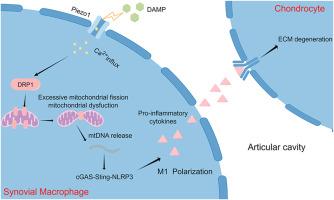
在滑膜巨噬细胞中靶向敲除Piezo1可减轻骨关节炎的发展。
目的:骨关节炎(OA)是一种常见的退行性关节疾病。针对免疫/炎症细胞和软骨细胞之间的串扰的新兴疗法已经显示出希望。巨噬细胞表型重编程是一种潜在的治疗策略,但机械信号调节巨噬细胞可塑性的分子机制尚不清楚。本研究旨在探讨机械敏感离子通道Piezo1在滑膜巨噬细胞极化中的作用及其在OA发病机制中的作用。方法:对OA患者和OA小鼠模型的滑膜组织进行组织学分析,评估巨噬细胞中Piezo1的表达。在小鼠巨噬细胞中建立条件敲除Piezo1以评估其对OA进展的影响。通过体外和体内实验探讨Piezo1缺失对巨噬细胞极化和软骨细胞代谢的影响。机制研究探讨了DRP1-cGAS-STING轴参与piezo1介导的炎性体激活。此外,我们构建了携带Si-Piezo1的甘露糖修饰脂质体,以选择性靶向和抑制滑膜巨噬细胞中Piezo1的表达。结果:与健康关节相比,OA关节滑膜巨噬细胞中Piezo1的表达明显上调。巨噬细胞特异性缺失Piezo1可显著缓解OA症状,促进软骨细胞合成代谢。在机制上,Piezo1通过DRP1-cGAS-STING途径激活NLRP3炎性体,促进M1巨噬细胞极化,进而加速软骨细胞衰老和变性。靶向递送Si-Piezo1纳米颗粒可有效抑制滑膜巨噬细胞中Piezo1的表达,降低M1巨噬细胞的比例,缓解体内OA的进展。结论:Piezo1通过机械转导调节滑膜巨噬细胞极化,从而促进OA进展。使用甘露糖修饰的纳米颗粒靶向抑制Piezo1为OA治疗提供了一种有前途的治疗策略。转化潜力:通过提供Piezo1在OA滑膜中的作用和机制的实验证据,本研究强调了Man-LNP@Si-Piezo1作为OA治疗策略的潜力。
本文章由计算机程序翻译,如有差异,请以英文原文为准。
求助全文
约1分钟内获得全文
求助全文
来源期刊
Journal of Orthopaedic Translation
Medicine-Orthopedics and Sports Medicine
CiteScore
11.80
自引率
13.60%
发文量
91
审稿时长
29 days
期刊介绍:
The Journal of Orthopaedic Translation (JOT) is the official peer-reviewed, open access journal of the Chinese Speaking Orthopaedic Society (CSOS) and the International Chinese Musculoskeletal Research Society (ICMRS). It is published quarterly, in January, April, July and October, by Elsevier.
 求助内容:
求助内容: 应助结果提醒方式:

 京公网安备 11010802042870号


