
Multi-omics profiling reveals cholic acid-mediated immunosuppression driven by peritumoral ductular reactions in hepatocellular carcinoma
IF 10.1
1区 医学
Q1 ONCOLOGY
引用次数: 0
Abstract
Hepatocellular carcinoma remains a leading cause of cancer mortality worldwide, with peritumoral microenvironment interactions playing a critical role in disease progression. This multi-omics study employed artificial intelligence-pathology, single-nucleus multi-omics, spatial transcriptomics, and metabolomics to characterize peritumoral ductular reactions. Ductular reaction scores strongly predicted poor clinical outcomes and correlated with cirrhosis severity. We identified three functionally distinct cholangiocyte subpopulations, with Small_duct_type_Cho exhibiting robust fibroblast interactions that promote stromal remodeling. Metabolomic profiling revealed tumor margin enrichment of cholic acid, which induced CD8+ T cell dysfunction via NR1H4-dependent PD1 upregulation. Importantly, NR1H4 inhibition synergized with anti-PD1 therapy in murine models, significantly suppressing tumor growth. These results position ductular reactions as both a prognostic biomarker and therapeutic target, with cholic acid/NR1H4 pathway inhibition representing a promising immunotherapeutic strategy for hepatocellular carcinoma patients.
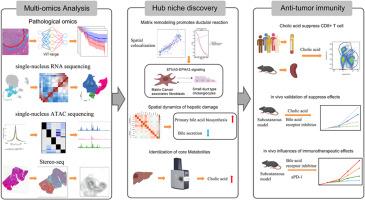
多组学分析揭示胆酸介导的肝细胞癌肿瘤周围小管反应驱动的免疫抑制。
肝细胞癌仍然是全球癌症死亡的主要原因,肿瘤周围微环境的相互作用在疾病进展中起着关键作用。这项多组学研究采用人工智能病理学、单核多组学、空间转录组学和代谢组学来表征肿瘤周围的导管反应。导管反应评分强烈预测不良临床结果,并与肝硬化严重程度相关。我们确定了三个功能不同的胆管细胞亚群,其中Small_duct_type_Cho表现出强大的成纤维细胞相互作用,促进基质重塑。代谢组学分析显示肿瘤边缘胆酸富集,通过nr1h4依赖性PD1上调诱导CD8+ T细胞功能障碍。重要的是,在小鼠模型中,NR1H4抑制与抗pd1治疗协同作用,显著抑制肿瘤生长。这些结果将导管反应定位为预后生物标志物和治疗靶点,胆酸/NR1H4通路抑制是肝癌患者有希望的免疫治疗策略。
本文章由计算机程序翻译,如有差异,请以英文原文为准。
求助全文
约1分钟内获得全文
求助全文
来源期刊
Cancer letters
医学-肿瘤学
CiteScore
17.70
自引率
2.10%
发文量
427
审稿时长
15 days
期刊介绍:
Cancer Letters is a reputable international journal that serves as a platform for significant and original contributions in cancer research. The journal welcomes both full-length articles and Mini Reviews in the wide-ranging field of basic and translational oncology. Furthermore, it frequently presents Special Issues that shed light on current and topical areas in cancer research.
Cancer Letters is highly interested in various fundamental aspects that can cater to a diverse readership. These areas include the molecular genetics and cell biology of cancer, radiation biology, molecular pathology, hormones and cancer, viral oncology, metastasis, and chemoprevention. The journal actively focuses on experimental therapeutics, particularly the advancement of targeted therapies for personalized cancer medicine, such as metronomic chemotherapy.
By publishing groundbreaking research and promoting advancements in cancer treatments, Cancer Letters aims to actively contribute to the fight against cancer and the improvement of patient outcomes.
 求助内容:
求助内容: 应助结果提醒方式:

 京公网安备 11010802042870号


