
Edge-Cloud Collaborative Computing on Distributed Intelligence and Model Optimization: A Survey
IF 34.4
1区 计算机科学
Q1 COMPUTER SCIENCE, INFORMATION SYSTEMS
引用次数: 0
Abstract
Edge-cloud collaborative computing (ECCC) has emerged as a pivotal paradigm for addressing the computational demands of modern intelligent applications, integrating cloud resources with edge devices to enable efficient, low-latency processing across distributed communication networks. Recent advancements in AI, particularly deep learning and large language models (LLMs), have dramatically enhanced the capabilities of these networked systems, yet introduce significant challenges in model deployment, network resource management, and cross-layer optimization. In this survey, we comprehensively examine the intersection of distributed intelligence and model optimization within edge-cloud environments, providing a structured tutorial on fundamental architectures, communication protocols, and network-aware computing frameworks. Additionally, we systematically analyze model optimization approaches, including compression, adaptation, and neural architecture search, alongside AI-driven resource management strategies that balance performance, energy efficiency, and communication overhead across heterogeneous networks. We further explore critical aspects of privacy protection and security enhancement within ECCC systems and examine practical deployments through diverse networked applications, spanning autonomous driving, healthcare, and industrial automation. Performance analysis and benchmarking techniques are also thoroughly explored to establish evaluation standards for these complex distributed systems. Furthermore, the review identifies critical research directions including LLMs deployment, 6G integration, neuromorphic computing, and quantum computing, offering a roadmap for addressing persistent challenges in heterogeneity management, real-time processing, and scalability. By bridging theoretical advancements in communications with practical deployments, this survey offers researchers and practitioners a holistic perspective on leveraging AI to optimize distributed computing environments over next-generation communication networks, fostering innovation in intelligent networked systems.基于分布式智能和模型优化的边缘云协同计算研究综述
边缘云协作计算(ECCC)已经成为解决现代智能应用计算需求的关键范例,它将云资源与边缘设备集成在一起,以实现跨分布式通信网络的高效、低延迟处理。人工智能的最新进展,特别是深度学习和大型语言模型(llm),极大地增强了这些网络系统的能力,但在模型部署、网络资源管理和跨层优化方面引入了重大挑战。在本调查中,我们全面研究了边缘云环境中分布式智能和模型优化的交集,提供了关于基本架构、通信协议和网络感知计算框架的结构化教程。此外,我们系统地分析了模型优化方法,包括压缩、自适应和神经架构搜索,以及人工智能驱动的资源管理策略,这些策略可以平衡异构网络的性能、能源效率和通信开销。我们进一步探讨了ECCC系统中隐私保护和安全增强的关键方面,并通过各种网络应用程序(涵盖自动驾驶、医疗保健和工业自动化)研究了实际部署。还深入探讨了性能分析和基准测试技术,以建立这些复杂分布式系统的评估标准。此外,该综述还确定了关键的研究方向,包括llm部署、6G集成、神经形态计算和量子计算,为解决异构管理、实时处理和可扩展性方面的持续挑战提供了路线图。通过将通信的理论进步与实际部署联系起来,本调查为研究人员和从业者提供了利用人工智能优化下一代通信网络上的分布式计算环境的整体视角,从而促进智能网络系统的创新。
本文章由计算机程序翻译,如有差异,请以英文原文为准。
求助全文
约1分钟内获得全文
求助全文
来源期刊
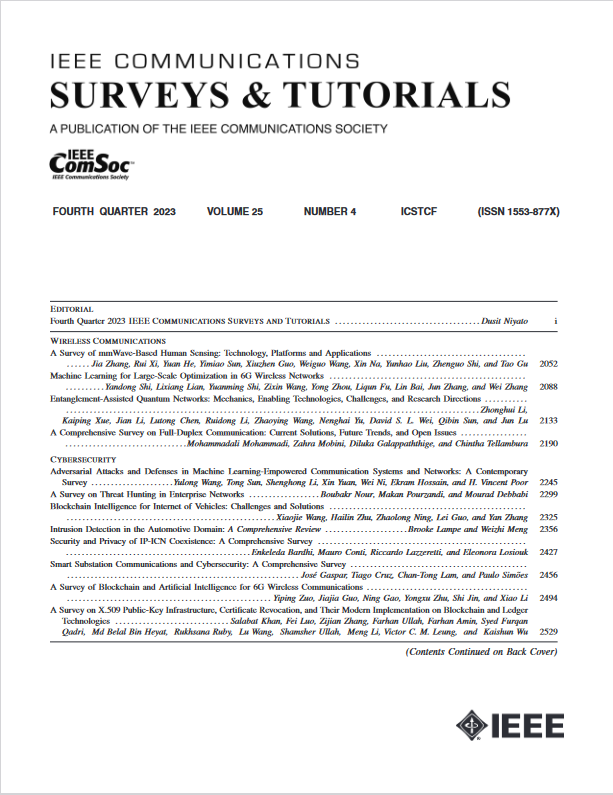
IEEE Communications Surveys and Tutorials
COMPUTER SCIENCE, INFORMATION SYSTEMS-TELECOMMUNICATIONS
CiteScore
80.20
自引率
2.50%
发文量
84
审稿时长
6 months
期刊介绍:
IEEE Communications Surveys & Tutorials is an online journal published by the IEEE Communications Society for tutorials and surveys covering all aspects of the communications field. Telecommunications technology is progressing at a rapid pace, and the IEEE Communications Society is committed to providing researchers and other professionals the information and tools to stay abreast. IEEE Communications Surveys and Tutorials focuses on integrating and adding understanding to the existing literature on communications, putting results in context. Whether searching for in-depth information about a familiar area or an introduction into a new area, IEEE Communications Surveys & Tutorials aims to be the premier source of peer-reviewed, comprehensive tutorials and surveys, and pointers to further sources. IEEE Communications Surveys & Tutorials publishes only articles exclusively written for IEEE Communications Surveys & Tutorials and go through a rigorous review process before their publication in the quarterly issues.
A tutorial article in the IEEE Communications Surveys & Tutorials should be designed to help the reader to become familiar with and learn something specific about a chosen topic. In contrast, the term survey, as applied here, is defined to mean a survey of the literature. A survey article in IEEE Communications Surveys & Tutorials should provide a comprehensive review of developments in a selected area, covering its development from its inception to its current state and beyond, and illustrating its development through liberal citations from the literature. Both tutorials and surveys should be tutorial in nature and should be written in a style comprehensible to readers outside the specialty of the article.
 求助内容:
求助内容: 应助结果提醒方式:

 京公网安备 11010802042870号


