
Reliability and Availability in Virtualized Networks: A Survey on Standards, Modeling Approaches, and Research Challenges
IF 34.4
1区 计算机科学
Q1 COMPUTER SCIENCE, INFORMATION SYSTEMS
引用次数: 0
Abstract
Virtualized networks are built on the principle of replacing bulky and rather static hardware-based functions with software-based, virtualized instances of those functions, enabling more agile and cost-effective communication infrastructures. However, this shift brings new challenges for ensuring reliability and availability due to increased dependencies among system components introduced by virtualization technologies. Reliability, i.e., the ability of a system to perform regularly under specified conditions, and availability, i.e., the probability of a system of being ready to use, are critical requirements that must be guaranteed to maintain seamless network operations. Accurate modeling of these aspects is crucial for designing robust, fault-tolerant virtualized systems that can withstand service disruptions, ensuring continuous user access. Accordingly, this survey focuses on reliability and availability attributes of virtualized networks from a modeling perspective. We first introduce the Network Function Virtualization (NFV) architecture and relevant definitions, followed by a review of the European Telecommunications Standards Institute (ETSI) standardization efforts. We then explore key modeling formalisms and illustrate their use in characterizing failure and repair behaviors. A survey of related literature and supporting software tools is provided, along with a discussion on lessons learned and open research challenges to guide future work in designing fault-tolerant NFV systems.虚拟化网络中的可靠性和可用性:标准、建模方法和研究挑战综述
虚拟网络的构建原则是,用这些功能的基于软件的虚拟化实例取代庞大且相当静态的基于硬件的功能,从而实现更灵活和更具成本效益的通信基础设施。然而,由于虚拟化技术引入的系统组件之间的依赖性增加,这种转变为确保可靠性和可用性带来了新的挑战。可靠性,即系统在特定条件下正常运行的能力,以及可用性,即系统随时可用的可能性,是必须保证保持无缝网络运行的关键要求。这些方面的准确建模对于设计健壮、容错的虚拟化系统至关重要,这些系统可以承受服务中断,确保用户持续访问。因此,本调查从建模的角度关注虚拟化网络的可靠性和可用性属性。我们首先介绍网络功能虚拟化(NFV)架构和相关定义,然后回顾欧洲电信标准协会(ETSI)的标准化工作。然后,我们探索了关键的建模形式,并说明了它们在描述故障和修复行为中的使用。提供了相关文献和支持软件工具的调查,以及对经验教训和开放研究挑战的讨论,以指导未来设计容错NFV系统的工作。
本文章由计算机程序翻译,如有差异,请以英文原文为准。
求助全文
约1分钟内获得全文
求助全文
来源期刊
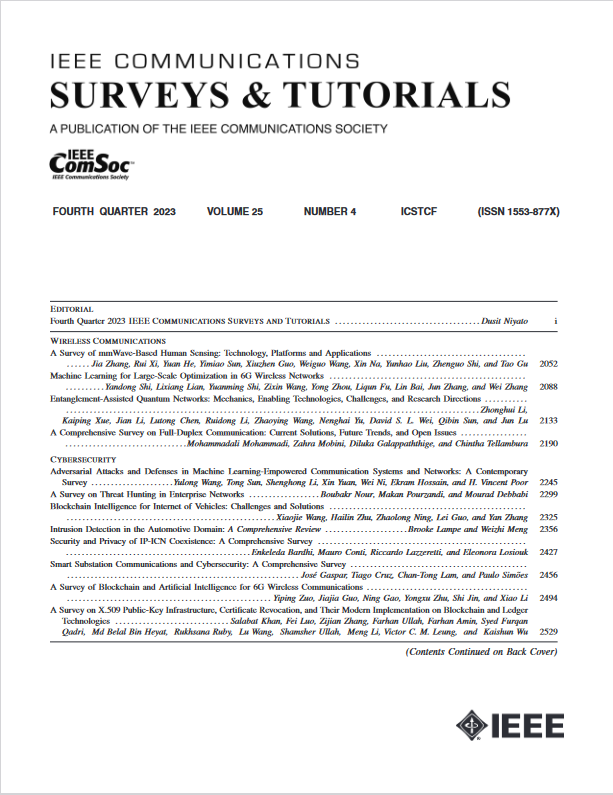
IEEE Communications Surveys and Tutorials
COMPUTER SCIENCE, INFORMATION SYSTEMS-TELECOMMUNICATIONS
CiteScore
80.20
自引率
2.50%
发文量
84
审稿时长
6 months
期刊介绍:
IEEE Communications Surveys & Tutorials is an online journal published by the IEEE Communications Society for tutorials and surveys covering all aspects of the communications field. Telecommunications technology is progressing at a rapid pace, and the IEEE Communications Society is committed to providing researchers and other professionals the information and tools to stay abreast. IEEE Communications Surveys and Tutorials focuses on integrating and adding understanding to the existing literature on communications, putting results in context. Whether searching for in-depth information about a familiar area or an introduction into a new area, IEEE Communications Surveys & Tutorials aims to be the premier source of peer-reviewed, comprehensive tutorials and surveys, and pointers to further sources. IEEE Communications Surveys & Tutorials publishes only articles exclusively written for IEEE Communications Surveys & Tutorials and go through a rigorous review process before their publication in the quarterly issues.
A tutorial article in the IEEE Communications Surveys & Tutorials should be designed to help the reader to become familiar with and learn something specific about a chosen topic. In contrast, the term survey, as applied here, is defined to mean a survey of the literature. A survey article in IEEE Communications Surveys & Tutorials should provide a comprehensive review of developments in a selected area, covering its development from its inception to its current state and beyond, and illustrating its development through liberal citations from the literature. Both tutorials and surveys should be tutorial in nature and should be written in a style comprehensible to readers outside the specialty of the article.
 求助内容:
求助内容: 应助结果提醒方式:

 京公网安备 11010802042870号


