
Foot and ankle biomaterials: a comprehensive review of current applications, challenges, and future directions

IF 5.9 1区 医学 Q1 ORTHOPEDICS
Journal of Orthopaedic Translation Pub Date : 2026-03-01 Epub Date: 2026-02-24 DOI:10.1016/j.jot.2026.101051
Peter Elvin , Amayrani Sanchez , Anthony Allen Reyes , Hagner Andrade , Meelad Karami , Hooman T. Mir , Javier La Fontaine , Danieli C Rodrigues , Claudia Biguetti
{"title":"Foot and ankle biomaterials: a comprehensive review of current applications, challenges, and future directions","authors":"Peter Elvin ,&nbsp;Amayrani Sanchez ,&nbsp;Anthony Allen Reyes ,&nbsp;Hagner Andrade ,&nbsp;Meelad Karami ,&nbsp;Hooman T. Mir ,&nbsp;Javier La Fontaine ,&nbsp;Danieli C Rodrigues ,&nbsp;Claudia Biguetti","doi":"10.1016/j.jot.2026.101051","DOIUrl":null,"url":null,"abstract":"<div><div>Metallic biomaterials enable successful reconstruction and fixation of skeletal tissues by supporting repair, load-bearing function, and anatomical alignment in foot and ankle surgery. However, the unique anatomic and biomechanical demands of this region, combined with challenging pathologies such as flatfoot and Charcot neuroarthropathy, present distinct challenges, with effective intervention requiring targeted biomaterial solutions and precise indications. Furthermore, metallic biomaterials currently represent the most predominant and clinically validated fixation systems in foot and ankle surgical reconstructions, while also generating the largest body of outcome-based evidence. This review summarizes and discusses their contemporary applications, outcomes, limitations, unmeet needs, and future directions based on clinical literature between 2020 and 2024. Emerging innovations, including 3D-printed titanium implants for patient-specific reconstructions, surface-engineered alloys designed to improve osseointegration, with infection mitigation properties for at risk patient populations, and the exploration of bioresorbable/biointegrative magnesium, as well as non-metallic alternative materials (e.g. polymerics) were examined. Persistent unmet needs identified in the literature include hardware challenges in osteoporotic bone and neuropathic patients, ion leeching, cyclic fatigue, economic burden, imaging artifact interference, and lack of long-term data or clinical trials on innovative implant designs and manufacturing approaches. Lastly, scanning electron microscopy (SEM) imaging of titanium, nitinol, and stainless steel is provided to offer an analysis on biomaterial-specific microstructural features, such as surface roughness and porosity, that play a role in influencing tissue integration, corrosion behavior, and mechanical performance in reconstructive surgeries. The Translational Potential of this Article: This review provides clinically actionable guidance for selecting metallic biomaterials tailored to the biomechanical and pathological demands of foot and ankle surgery, supporting evidence-based decisions of selection of hardwares, improved fixation strategies, and reduced complication rates. It also adds recent insights to inform the development and optimization of next-generation devices based on patient- and site-specific requirements, such as 3D-printed constructs and surface-engineered implants, designed to enhance fusion, reconstruction, and limb salvage outcomes.</div></div>","PeriodicalId":16636,"journal":{"name":"Journal of Orthopaedic Translation","volume":"57 ","pages":"Article 101051"},"PeriodicalIF":5.9000,"publicationDate":"2026-03-01","publicationTypes":"Journal Article","fieldsOfStudy":null,"isOpenAccess":false,"openAccessPdf":"","citationCount":"0","resultStr":null,"platform":"Semanticscholar","paperid":null,"PeriodicalName":"Journal of Orthopaedic Translation","FirstCategoryId":"3","ListUrlMain":"https://www.sciencedirect.com/science/article/pii/S2214031X26000069","RegionNum":1,"RegionCategory":"医学","ArticlePicture":[],"TitleCN":null,"AbstractTextCN":null,"PMCID":null,"EPubDate":"2026/2/24 0:00:00","PubModel":"Epub","JCR":"Q1","JCRName":"ORTHOPEDICS","Score":null,"Total":0}
引用次数: 0

Abstract

Metallic biomaterials enable successful reconstruction and fixation of skeletal tissues by supporting repair, load-bearing function, and anatomical alignment in foot and ankle surgery. However, the unique anatomic and biomechanical demands of this region, combined with challenging pathologies such as flatfoot and Charcot neuroarthropathy, present distinct challenges, with effective intervention requiring targeted biomaterial solutions and precise indications. Furthermore, metallic biomaterials currently represent the most predominant and clinically validated fixation systems in foot and ankle surgical reconstructions, while also generating the largest body of outcome-based evidence. This review summarizes and discusses their contemporary applications, outcomes, limitations, unmeet needs, and future directions based on clinical literature between 2020 and 2024. Emerging innovations, including 3D-printed titanium implants for patient-specific reconstructions, surface-engineered alloys designed to improve osseointegration, with infection mitigation properties for at risk patient populations, and the exploration of bioresorbable/biointegrative magnesium, as well as non-metallic alternative materials (e.g. polymerics) were examined. Persistent unmet needs identified in the literature include hardware challenges in osteoporotic bone and neuropathic patients, ion leeching, cyclic fatigue, economic burden, imaging artifact interference, and lack of long-term data or clinical trials on innovative implant designs and manufacturing approaches. Lastly, scanning electron microscopy (SEM) imaging of titanium, nitinol, and stainless steel is provided to offer an analysis on biomaterial-specific microstructural features, such as surface roughness and porosity, that play a role in influencing tissue integration, corrosion behavior, and mechanical performance in reconstructive surgeries. The Translational Potential of this Article: This review provides clinically actionable guidance for selecting metallic biomaterials tailored to the biomechanical and pathological demands of foot and ankle surgery, supporting evidence-based decisions of selection of hardwares, improved fixation strategies, and reduced complication rates. It also adds recent insights to inform the development and optimization of next-generation devices based on patient- and site-specific requirements, such as 3D-printed constructs and surface-engineered implants, designed to enhance fusion, reconstruction, and limb salvage outcomes.
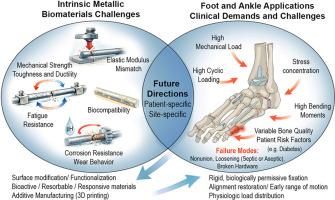
Abstract Image

足部和踝关节生物材料:当前应用、挑战和未来方向的综合综述。
在足部和踝关节手术中,金属生物材料通过支持修复、承重功能和解剖对齐,使骨骼组织成功重建和固定。然而,该区域独特的解剖和生物力学需求,加上具有挑战性的病理,如扁平足和Charcot神经关节病,提出了独特的挑战,有效的干预需要有针对性的生物材料解决方案和精确的适应症。此外,金属生物材料目前代表了足部和踝关节手术重建中最主要和临床验证的固定系统,同时也产生了最大的基于结果的证据。本文根据2020年至2024年的临床文献,总结并讨论了其在当代的应用、结果、局限性、未满足的需求和未来的发展方向。新兴的创新,包括用于患者特异性重建的3d打印钛植入物,旨在改善骨整合的表面工程合金,具有风险患者群体的感染缓解特性,以及生物可吸收/生物整合镁的探索,以及非金属替代材料(例如聚合物)。文献中发现的持续未满足的需求包括骨质疏松症和神经病变患者的硬件挑战、离子吸收、循环疲劳、经济负担、成像人工干扰,以及缺乏创新植入物设计和制造方法的长期数据或临床试验。最后,我们提供了钛、镍钛诺和不锈钢的扫描电镜(SEM)成像,以分析生物材料特定的微观结构特征,如表面粗糙度和孔隙度,这些特征在重建手术中影响组织整合、腐蚀行为和机械性能。本文的转化潜力:该综述为选择适合足部和踝关节手术生物力学和病理要求的金属生物材料提供了临床可操作的指导,支持基于证据的硬件选择决策,改进固定策略,降低并发症发生率。它还增加了最新的见解,为基于患者和部位特定要求的下一代设备的开发和优化提供信息,例如3d打印结构和表面工程植入物,旨在增强融合、重建和肢体保留结果。
本文章由计算机程序翻译,如有差异,请以英文原文为准。
求助全文
约1分钟内获得全文 求助全文
来源期刊
Journal of Orthopaedic Translation
Journal of Orthopaedic Translation Medicine-Orthopedics and Sports Medicine
CiteScore
11.80
自引率
13.60%
发文量
91
审稿时长
29 days
期刊介绍: The Journal of Orthopaedic Translation (JOT) is the official peer-reviewed, open access journal of the Chinese Speaking Orthopaedic Society (CSOS) and the International Chinese Musculoskeletal Research Society (ICMRS). It is published quarterly, in January, April, July and October, by Elsevier.

×
引用
GB/T 7714-2015
复制
MLA
复制
APA
复制
导出至
BibTeX EndNote RefMan NoteFirst NoteExpress
×
提示
您的信息不完整,为了账户安全,请先补充。
现在去补充
×
提示
您因"违规操作"
具体请查看互助需知
我知道了
×
提示
确定
请完成安全验证×
copy
已复制链接
快去分享给好友吧!
我知道了
右上角分享
点击右上角分享
0
联系我们:info@booksci.cn Book学术提供免费学术资源搜索服务,方便国内外学者检索中英文文献。致力于提供最便捷和优质的服务体验。 Copyright © 2023 布克学术 All rights reserved.
京ICP备2023020795号-1
ghs 京公网安备 11010802042870号
Book学术文献互助
Book学术文献互助群
群 号:604180095
Book学术官方微信
小红书


