Romina Aparecida Dos Santos Gomes, Manu L N G Malbrain, Adriana Teixeira Rodrigues, Maria do Carmo Barros De Melo, Flávia Cordeiro Valério, Jaisson Gustavo Da Fonseca, Gabriel Carlos Santos Dutra, Alexandre Rodrigues Ferreira
{"title":"The ROSE framework for fluid therapy in critically ill pediatric patients.","authors":"Romina Aparecida Dos Santos Gomes, Manu L N G Malbrain, Adriana Teixeira Rodrigues, Maria do Carmo Barros De Melo, Flávia Cordeiro Valério, Jaisson Gustavo Da Fonseca, Gabriel Carlos Santos Dutra, Alexandre Rodrigues Ferreira","doi":"10.5114/ait/217698","DOIUrl":null,"url":null,"abstract":"<p><strong>Introduction: </strong>The study aimed to assess the applicability of the ROSE conceptual framework (Resuscitation, Optimization, Stabilization, Evacuation) for fluid therapy in critically ill pediatric patients, focusing on its distinct phases, prevention of fluid accumulation, and clinical outcomes.</p><p><strong>Material and methods: </strong>A quasi-experimental study was conducted including 122 (retrospective: n = 71; prospective: n = 51) mechanically ventilated and vasoactive-dependent children. A retrospective cohort was compared with a prospective cohort following structured training on ROSE-guided fluid management. Outcomes included fluid accumulation percentage (FA%), duration of mechanical ventilation, pediatric intensive care unit (PICU) length of stay, and need for renal replacement therapy (RRT). Adherence to phase-specific FA% targets was also assessed.</p><p><strong>Results: </strong>FA% was similar between cohorts (retrospective vs. prospective) on PICU days 1, 3, and 10 (median [IQR] 1.8% [0.2-4.3] vs. 1.9% [0.8-3.2], P = 0.934; 5.5% [1.7-10.3] vs. 6.1% [3.8-10.2], P = 0.565; 8.3% [0.8-24.8] vs. 7.2% [2.6-18.7], P = 0.848). By ROSE phase, FA% was comparable in Resuscitation (3.5% [2.0-6.0] vs. 4.7% [2.4-6.9], P = 0.244), Optimization (3.0% [0.1-6.7] vs. 4.2% [1.0-7.9], P = 0.261), and Evacuation (2.5% [-2.6-5.3] vs. 2.4% [-0.0-7.4], P = 0.256), but higher during Stabilization (2.5% [0.0-6.9] vs. 4.2% [2.0-8.9], P = 0.043). Mechanical ventilation, length of PICU stay, RRT, and fluid elimination were similar. No independent predictors emerged in logistic regression. FA% target adherence rose from 67.9% to 72.4% after ROSE.</p><p><strong>Conclusions: </strong>The ROSE framework in pediatric fluid management is feasible, provides benchmarking for FA% control, and shows promise for individualizing fluid management. Future validation in ROSE-naive centers is warranted.</p>","PeriodicalId":7750,"journal":{"name":"Anaesthesiology intensive therapy","volume":"58 1","pages":"20-29"},"PeriodicalIF":2.3000,"publicationDate":"2026-02-21","publicationTypes":"Journal Article","fieldsOfStudy":null,"isOpenAccess":false,"openAccessPdf":"https://www.ncbi.nlm.nih.gov/pmc/articles/PMC12969978/pdf/","citationCount":"0","resultStr":null,"platform":"Semanticscholar","paperid":null,"PeriodicalName":"Anaesthesiology intensive therapy","FirstCategoryId":"1085","ListUrlMain":"https://doi.org/10.5114/ait/217698","RegionNum":0,"RegionCategory":null,"ArticlePicture":[],"TitleCN":null,"AbstractTextCN":null,"PMCID":null,"EPubDate":"","PubModel":"","JCR":"Q2","JCRName":"ANESTHESIOLOGY","Score":null,"Total":0}
引用次数: 0
Abstract
Introduction: The study aimed to assess the applicability of the ROSE conceptual framework (Resuscitation, Optimization, Stabilization, Evacuation) for fluid therapy in critically ill pediatric patients, focusing on its distinct phases, prevention of fluid accumulation, and clinical outcomes.
Material and methods: A quasi-experimental study was conducted including 122 (retrospective: n = 71; prospective: n = 51) mechanically ventilated and vasoactive-dependent children. A retrospective cohort was compared with a prospective cohort following structured training on ROSE-guided fluid management. Outcomes included fluid accumulation percentage (FA%), duration of mechanical ventilation, pediatric intensive care unit (PICU) length of stay, and need for renal replacement therapy (RRT). Adherence to phase-specific FA% targets was also assessed.
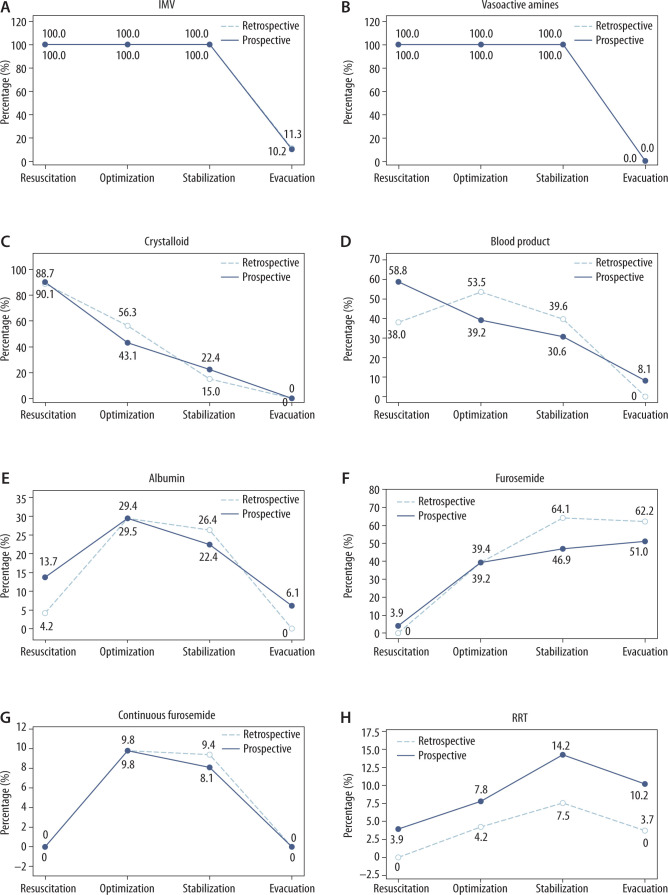
Results: FA% was similar between cohorts (retrospective vs. prospective) on PICU days 1, 3, and 10 (median [IQR] 1.8% [0.2-4.3] vs. 1.9% [0.8-3.2], P = 0.934; 5.5% [1.7-10.3] vs. 6.1% [3.8-10.2], P = 0.565; 8.3% [0.8-24.8] vs. 7.2% [2.6-18.7], P = 0.848). By ROSE phase, FA% was comparable in Resuscitation (3.5% [2.0-6.0] vs. 4.7% [2.4-6.9], P = 0.244), Optimization (3.0% [0.1-6.7] vs. 4.2% [1.0-7.9], P = 0.261), and Evacuation (2.5% [-2.6-5.3] vs. 2.4% [-0.0-7.4], P = 0.256), but higher during Stabilization (2.5% [0.0-6.9] vs. 4.2% [2.0-8.9], P = 0.043). Mechanical ventilation, length of PICU stay, RRT, and fluid elimination were similar. No independent predictors emerged in logistic regression. FA% target adherence rose from 67.9% to 72.4% after ROSE.
Conclusions: The ROSE framework in pediatric fluid management is feasible, provides benchmarking for FA% control, and shows promise for individualizing fluid management. Future validation in ROSE-naive centers is warranted.



 求助内容:
求助内容: 应助结果提醒方式:

 京公网安备 11010802042870号


