{"title":"A glutamatergic Sp5C-STN circuit mediates chronic migraine in mice.","authors":"Liu Tang, Ying-Qi Cheng, Wei Gui, Yan Zhang","doi":"","DOIUrl":null,"url":null,"abstract":"<p><p>Chronic migraine (CM) is a prevalent and highly debilitating neurological disorder. Functional magnetic resonance imaging (fMRI) studies have demonstrated associations between abnormal brain region activation and CM, yet the underlying complex neural circuitry mechanisms remain unclear. The spinal trigeminal nucleus caudalis (Sp5C) serves as the primary central hub for orofacial nociceptive input, receiving trigeminal pain signals and projecting to higher-order centers such as the thalamus. Therefore, we sought to investigate whether the Sp5C region and its associated circuits were involved in CM pathogenesis. In this study, we established a CM mouse model through repeated intraperitoneal injections of nitroglycerin (NTG). Using a combination of <i>in vivo</i> fiber photometry and <i>in vitro</i> c-Fos immunohistochemistry, we found a marked periorbital and plantar mechanical allodynia in CM mice, accompanied by increased glutamatergic neuronal activity in Sp5C. Chemogenetic manipulation of Sp5C glutamatergic neurons (Sp5C<sup>Vglut2</sup>) bidirectionally modulated migraine-like behaviors and induced pain-related affective states, as evidenced by conditioned place preference/aversion (CPP/CPA) paradigms. Anterograde viral tracing revealed dense projections from Sp5C<sup>Vglut2</sup> to the subthalamic nucleus (STN), which was activated in CM mice. Optogenetic activation of the Sp5C-STN pathway similarly produced migraine-like behaviors and pain-related aversive memory in mice. Altogether, we revealed a critical role of the Sp5C<sup>Vglut2</sup>-STN circuit in the development and modulation of CM. Our findings provide novel mechanistic insights into the central mechanisms underlying CM, establishing potential theoretical foundations for clinical diagnosis and therapeutic development.</p>","PeriodicalId":7134,"journal":{"name":"生理学报","volume":"78 1","pages":"159-172"},"PeriodicalIF":0.0000,"publicationDate":"2026-02-25","publicationTypes":"Journal Article","fieldsOfStudy":null,"isOpenAccess":false,"openAccessPdf":"","citationCount":"0","resultStr":null,"platform":"Semanticscholar","paperid":null,"PeriodicalName":"生理学报","FirstCategoryId":"1087","ListUrlMain":"","RegionNum":0,"RegionCategory":null,"ArticlePicture":[],"TitleCN":null,"AbstractTextCN":null,"PMCID":null,"EPubDate":"","PubModel":"","JCR":"Q3","JCRName":"Medicine","Score":null,"Total":0}
引用次数: 0
Abstract
Chronic migraine (CM) is a prevalent and highly debilitating neurological disorder. Functional magnetic resonance imaging (fMRI) studies have demonstrated associations between abnormal brain region activation and CM, yet the underlying complex neural circuitry mechanisms remain unclear. The spinal trigeminal nucleus caudalis (Sp5C) serves as the primary central hub for orofacial nociceptive input, receiving trigeminal pain signals and projecting to higher-order centers such as the thalamus. Therefore, we sought to investigate whether the Sp5C region and its associated circuits were involved in CM pathogenesis. In this study, we established a CM mouse model through repeated intraperitoneal injections of nitroglycerin (NTG). Using a combination of in vivo fiber photometry and in vitro c-Fos immunohistochemistry, we found a marked periorbital and plantar mechanical allodynia in CM mice, accompanied by increased glutamatergic neuronal activity in Sp5C. Chemogenetic manipulation of Sp5C glutamatergic neurons (Sp5CVglut2) bidirectionally modulated migraine-like behaviors and induced pain-related affective states, as evidenced by conditioned place preference/aversion (CPP/CPA) paradigms. Anterograde viral tracing revealed dense projections from Sp5CVglut2 to the subthalamic nucleus (STN), which was activated in CM mice. Optogenetic activation of the Sp5C-STN pathway similarly produced migraine-like behaviors and pain-related aversive memory in mice. Altogether, we revealed a critical role of the Sp5CVglut2-STN circuit in the development and modulation of CM. Our findings provide novel mechanistic insights into the central mechanisms underlying CM, establishing potential theoretical foundations for clinical diagnosis and therapeutic development.
期刊介绍:
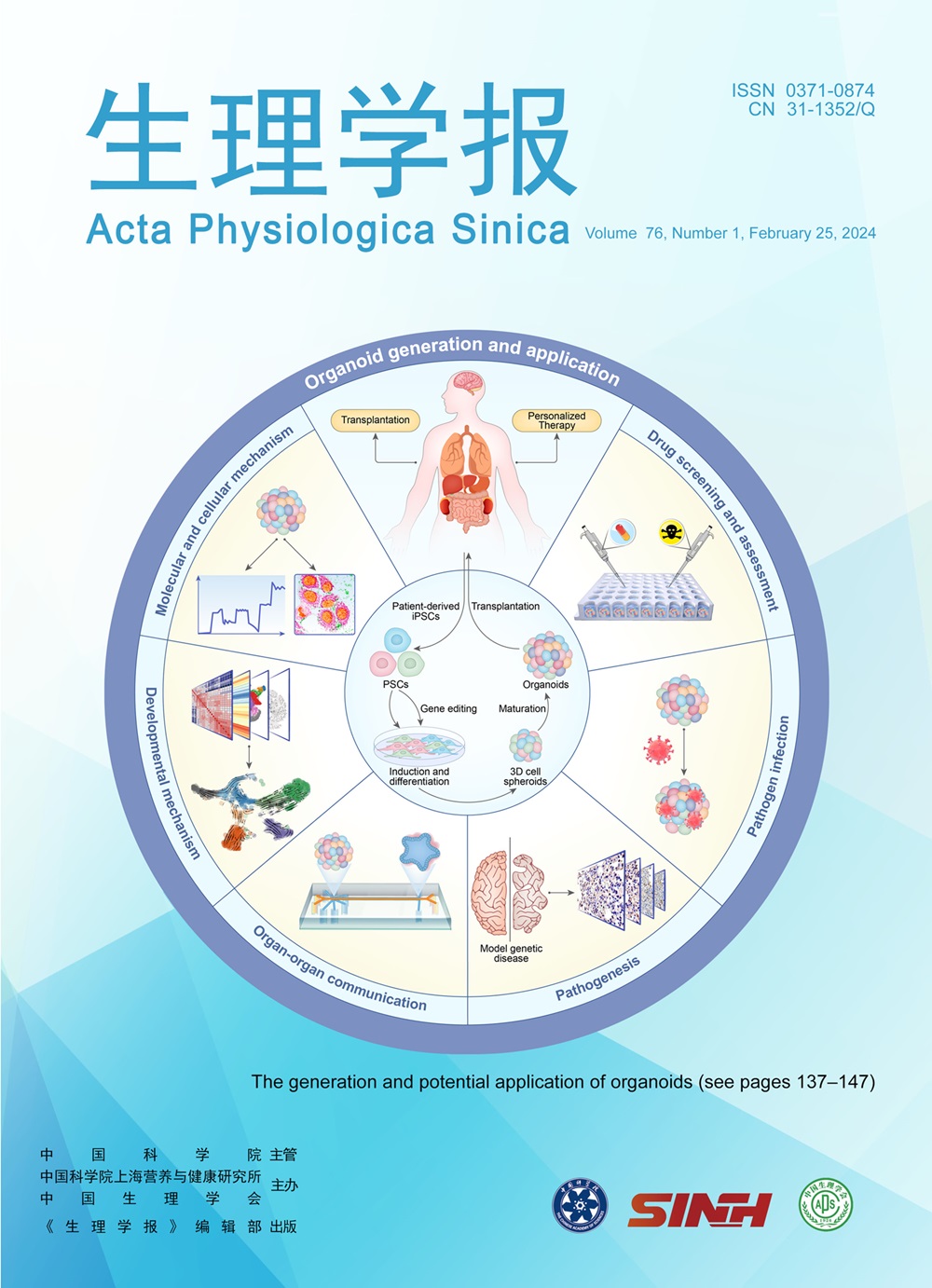
Acta Physiologica Sinica (APS) is sponsored by the Chinese Association for Physiological Sciences and Shanghai Institutes of Biological Sciences, Chinese Academy of Sciences (CAS), and is published bimonthly by the Science Press, China. APS publishes original research articles in the field of physiology as well as research contributions from other biomedical disciplines and proceedings of conferences and symposia of physiological sciences. Besides “Original Research Articles”, the journal also provides columns as “Brief Review”, “Rapid Communication”, “Experimental Technique”, and “Letter to the Editor”. Articles are published in either Chinese or English according to authors’ submission.

 求助内容:
 应助结果提醒方式:


 京公网安备 11010802042870号


