Zi-Han Liu, Yi-Qian Liu, Qian-Li Zhang, Chun Lin, Yang Huang
{"title":"[Spinal lncRNA_RT1-CE10 attenuates chronic visceral hypersensitivity in rats with irritable bowel syndrome via inhibiting microglial activation].","authors":"Zi-Han Liu, Yi-Qian Liu, Qian-Li Zhang, Chun Lin, Yang Huang","doi":"","DOIUrl":null,"url":null,"abstract":"<p><p>The purpose of the study was to investigate the role of the long non-coding RNA (lncRNA)_RT1-CE10 and its molecular mechanisms in chronic visceral pain of rats with irritable bowel syndrome (IBS). Sprague-Dawley (SD) rats were exposed to colorectal distention (CRD) stimulation at a pressure of 60 mmHg for 1 min from 8 to 14 days after birth. The visceral hypersensitivity was assessed by measuring electromyographic (EMG) responses of external oblique muscle to CRD at 40 mmHg and 60 mmHg when the rats were 6 weeks old. The expression of lncRNA_RT1-CE10, Iba-1 and MHCII in the spinal cord was detected by RT-qPCR or Western blot. After intrathecal injection of minocycline (an inhibitor of microglia), the expression of Iba-1, MHCII and the visceral hypersensitivity were determined by Western blot and EMG, respectively. After intrathecal injection of AAV-lncRT1-CE10 and AAV-shlncRT1-CE10, the expression of Iba-1 and MHCII was examined by Western blot, respectively. The results showed that the expression of lncRNA_RT1-CE10 was decreased in the spinal cord of IBS rats, while the expression of Iba-1 and MHCII was increased. Inhibition of microglial activation by minocycline attenuated visceral hypersensitivity in IBS rats. Over-expression of lncRNA_RT1-CE10 decreased the Iba-1 and MHCⅡ levels in IBS rats, while knockdown of lncRNA_RT1-CE10 increased the Iba-1 and MHCⅡ levels in control rats. Collectively, these results demonstrate that lncRNA_RT1-CE10 attenuates visceral hypersensitivity by inhibiting microglial activation in IBS rats.</p>","PeriodicalId":7134,"journal":{"name":"生理学报","volume":"78 1","pages":"246-252"},"PeriodicalIF":0.0000,"publicationDate":"2026-02-25","publicationTypes":"Journal Article","fieldsOfStudy":null,"isOpenAccess":false,"openAccessPdf":"","citationCount":"0","resultStr":null,"platform":"Semanticscholar","paperid":null,"PeriodicalName":"生理学报","FirstCategoryId":"1087","ListUrlMain":"","RegionNum":0,"RegionCategory":null,"ArticlePicture":[],"TitleCN":null,"AbstractTextCN":null,"PMCID":null,"EPubDate":"","PubModel":"","JCR":"Q3","JCRName":"Medicine","Score":null,"Total":0}
引用次数: 0
Abstract
The purpose of the study was to investigate the role of the long non-coding RNA (lncRNA)_RT1-CE10 and its molecular mechanisms in chronic visceral pain of rats with irritable bowel syndrome (IBS). Sprague-Dawley (SD) rats were exposed to colorectal distention (CRD) stimulation at a pressure of 60 mmHg for 1 min from 8 to 14 days after birth. The visceral hypersensitivity was assessed by measuring electromyographic (EMG) responses of external oblique muscle to CRD at 40 mmHg and 60 mmHg when the rats were 6 weeks old. The expression of lncRNA_RT1-CE10, Iba-1 and MHCII in the spinal cord was detected by RT-qPCR or Western blot. After intrathecal injection of minocycline (an inhibitor of microglia), the expression of Iba-1, MHCII and the visceral hypersensitivity were determined by Western blot and EMG, respectively. After intrathecal injection of AAV-lncRT1-CE10 and AAV-shlncRT1-CE10, the expression of Iba-1 and MHCII was examined by Western blot, respectively. The results showed that the expression of lncRNA_RT1-CE10 was decreased in the spinal cord of IBS rats, while the expression of Iba-1 and MHCII was increased. Inhibition of microglial activation by minocycline attenuated visceral hypersensitivity in IBS rats. Over-expression of lncRNA_RT1-CE10 decreased the Iba-1 and MHCⅡ levels in IBS rats, while knockdown of lncRNA_RT1-CE10 increased the Iba-1 and MHCⅡ levels in control rats. Collectively, these results demonstrate that lncRNA_RT1-CE10 attenuates visceral hypersensitivity by inhibiting microglial activation in IBS rats.
期刊介绍:
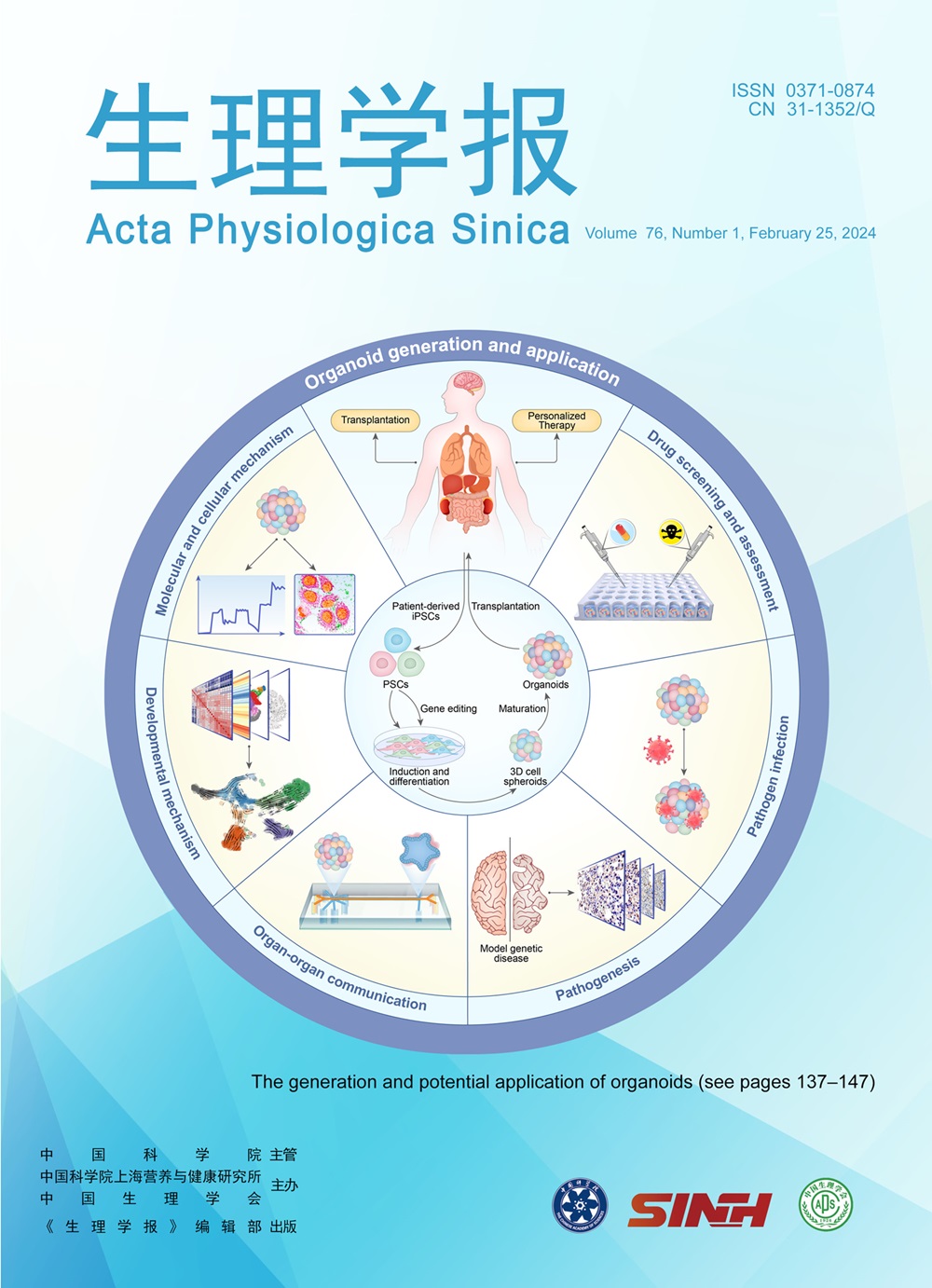
Acta Physiologica Sinica (APS) is sponsored by the Chinese Association for Physiological Sciences and Shanghai Institutes of Biological Sciences, Chinese Academy of Sciences (CAS), and is published bimonthly by the Science Press, China. APS publishes original research articles in the field of physiology as well as research contributions from other biomedical disciplines and proceedings of conferences and symposia of physiological sciences. Besides “Original Research Articles”, the journal also provides columns as “Brief Review”, “Rapid Communication”, “Experimental Technique”, and “Letter to the Editor”. Articles are published in either Chinese or English according to authors’ submission.

 求助内容:
 应助结果提醒方式:


 京公网安备 11010802042870号


