D. A. Sharin, K. E. Vorobyev, T. D. Kazarkin, L. A. Taskina
{"title":"Modeling the Behavior of a Flock of Birds to Generate Synthetic Data in Unreal Engine 5","authors":"D. A. Sharin, K. E. Vorobyev, T. D. Kazarkin, L. A. Taskina","doi":"10.3103/S1060992X25700274","DOIUrl":null,"url":null,"abstract":"<p>The paper proposes a system for modeling the collective behavior of flocks of birds to generate synthetic data in Unreal Engine 5. The system provides flexible adjustment of flock dynamics parameters, including species, speed and flight radius, as well as simulation of complex interactions in a virtual environment. Automated data markup is performed in YOLO (You Only Look Once) formats and with the preservation of spatial metadata of objects. A comparative analysis of the influence of the proportion of synthetic data in training samples on the quality of detection of computer vision models using the example of YOLOv11 is carried out. The results showed that the inclusion of up to 60 to 80 percent of synthetically generated data in the training dataset allows achieving an optimal balance between the accuracy of the model and the cost of collecting real data. The experiments showed that combining real and synthetic data significantly improves detection quality. For example, with 20% real and 80% synthetic data the YOLO v11 model achieved mAP@0.5 = 0.7157, Precision = 0.8157, and Recall = 0.6396, which substantially exceeds the results obtained when training only on real images. The developed system opens up prospects for application in the tasks of airspace monitoring, environmental research and virtual reality.</p>","PeriodicalId":721,"journal":{"name":"Optical Memory and Neural Networks","volume":"34 3","pages":"S457 - S464"},"PeriodicalIF":0.8000,"publicationDate":"2026-02-27","publicationTypes":"Journal Article","fieldsOfStudy":null,"isOpenAccess":false,"openAccessPdf":"","citationCount":"0","resultStr":null,"platform":"Semanticscholar","paperid":null,"PeriodicalName":"Optical Memory and Neural Networks","FirstCategoryId":"1085","ListUrlMain":"https://link.springer.com/article/10.3103/S1060992X25700274","RegionNum":0,"RegionCategory":null,"ArticlePicture":[],"TitleCN":null,"AbstractTextCN":null,"PMCID":null,"EPubDate":"","PubModel":"","JCR":"Q4","JCRName":"OPTICS","Score":null,"Total":0}
引用次数: 0
Abstract
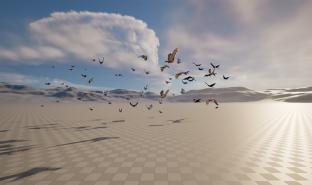
The paper proposes a system for modeling the collective behavior of flocks of birds to generate synthetic data in Unreal Engine 5. The system provides flexible adjustment of flock dynamics parameters, including species, speed and flight radius, as well as simulation of complex interactions in a virtual environment. Automated data markup is performed in YOLO (You Only Look Once) formats and with the preservation of spatial metadata of objects. A comparative analysis of the influence of the proportion of synthetic data in training samples on the quality of detection of computer vision models using the example of YOLOv11 is carried out. The results showed that the inclusion of up to 60 to 80 percent of synthetically generated data in the training dataset allows achieving an optimal balance between the accuracy of the model and the cost of collecting real data. The experiments showed that combining real and synthetic data significantly improves detection quality. For example, with 20% real and 80% synthetic data the YOLO v11 model achieved mAP@0.5 = 0.7157, Precision = 0.8157, and Recall = 0.6396, which substantially exceeds the results obtained when training only on real images. The developed system opens up prospects for application in the tasks of airspace monitoring, environmental research and virtual reality.
期刊介绍:
The journal covers a wide range of issues in information optics such as optical memory, mechanisms for optical data recording and processing, photosensitive materials, optical, optoelectronic and holographic nanostructures, and many other related topics. Papers on memory systems using holographic and biological structures and concepts of brain operation are also included. The journal pays particular attention to research in the field of neural net systems that may lead to a new generation of computional technologies by endowing them with intelligence.

 求助内容:
求助内容: 应助结果提醒方式:

 京公网安备 11010802042870号


