A. I. Lotkov, V. N. Grishkov, N. V. Girsova, D. Y. Zhapova, Y. P. Mironov, A. A. Gusarenko, D. I. Bobrov
{"title":"Structural-Phase State, Mechanical and Inelastic Properties of Ti49.8Ni50.2 Alloy after Severe Plastic Deformation by abc Pressing at 573 K","authors":"A. I. Lotkov, V. N. Grishkov, N. V. Girsova, D. Y. Zhapova, Y. P. Mironov, A. A. Gusarenko, D. I. Bobrov","doi":"10.1134/S1029959924602045","DOIUrl":null,"url":null,"abstract":"<p>The structural-phase state, mechanical and inelastic properties of Ti<sub>49.8</sub>Ni<sub>50.2</sub> alloy after severe plastic deformation by abc pressing at 573 K were investigated. It was found that abc pressing of the Ti<sub>49.8</sub>Ni<sub>50.2</sub> alloy specimens at a relatively low temperature (573 K) to high true strain (<i>e</i> = 7.43) did not affect the start temperature of B2→R martensite transformation (MT). At the same time, the start and finish temperatures of direct MT to the B19' phase and reverse MT decreased by only 14 ± 2 degrees. After abc pressing at 573 K to <i>е</i> = 7.43, the martensitic shear stress τ<sub>m</sub> sharply decreased (from 230 MPa to 100 MPa), and the pseudo-yield plateau significantly shortened (from 7.5 to 3.5%). In addition, the stress of transition from the strain hardening stage to the active plastic deformation stage sharply increased (from 835 to 1300 MPa). It was found that the dependences of the shape memory effect γ<sub>SME</sub>, superelasticity γ<sub>SE</sub>, and plastic strain component γ<sub>pl</sub> on the total strain γ<sub>t</sub> both in the initial state and after abc pressing had a similar pattern and were close in magnitude. It was shown that abc pressing to <i>e</i> = 7.43 induced the total inelastic strain γ<sub>TIS</sub> = γ<sub>SE</sub> + γ<sub>SME</sub> of about 8% in the specimens, which recovered after unloading due to the superelasticity and shape memory effects.</p>","PeriodicalId":726,"journal":{"name":"Physical Mesomechanics","volume":"29 1","pages":"93 - 102"},"PeriodicalIF":2.2000,"publicationDate":"2026-02-25","publicationTypes":"Journal Article","fieldsOfStudy":null,"isOpenAccess":false,"openAccessPdf":"","citationCount":"0","resultStr":null,"platform":"Semanticscholar","paperid":null,"PeriodicalName":"Physical Mesomechanics","FirstCategoryId":"88","ListUrlMain":"https://link.springer.com/article/10.1134/S1029959924602045","RegionNum":4,"RegionCategory":"材料科学","ArticlePicture":[],"TitleCN":null,"AbstractTextCN":null,"PMCID":null,"EPubDate":"","PubModel":"","JCR":"Q2","JCRName":"MATERIALS SCIENCE, CHARACTERIZATION & TESTING","Score":null,"Total":0}
引用次数: 0
Abstract
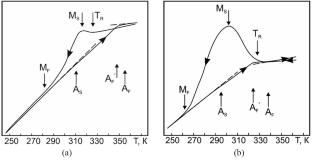
The structural-phase state, mechanical and inelastic properties of Ti49.8Ni50.2 alloy after severe plastic deformation by abc pressing at 573 K were investigated. It was found that abc pressing of the Ti49.8Ni50.2 alloy specimens at a relatively low temperature (573 K) to high true strain (e = 7.43) did not affect the start temperature of B2→R martensite transformation (MT). At the same time, the start and finish temperatures of direct MT to the B19' phase and reverse MT decreased by only 14 ± 2 degrees. After abc pressing at 573 K to е = 7.43, the martensitic shear stress τm sharply decreased (from 230 MPa to 100 MPa), and the pseudo-yield plateau significantly shortened (from 7.5 to 3.5%). In addition, the stress of transition from the strain hardening stage to the active plastic deformation stage sharply increased (from 835 to 1300 MPa). It was found that the dependences of the shape memory effect γSME, superelasticity γSE, and plastic strain component γpl on the total strain γt both in the initial state and after abc pressing had a similar pattern and were close in magnitude. It was shown that abc pressing to e = 7.43 induced the total inelastic strain γTIS = γSE + γSME of about 8% in the specimens, which recovered after unloading due to the superelasticity and shape memory effects.
期刊介绍:
The journal provides an international medium for the publication of theoretical and experimental studies and reviews related in the physical mesomechanics and also solid-state physics, mechanics, materials science, geodynamics, non-destructive testing and in a large number of other fields where the physical mesomechanics may be used extensively. Papers dealing with the processing, characterization, structure and physical properties and computational aspects of the mesomechanics of heterogeneous media, fracture mesomechanics, physical mesomechanics of materials, mesomechanics applications for geodynamics and tectonics, mesomechanics of smart materials and materials for electronics, non-destructive testing are viewed as suitable for publication.

 求助内容:
求助内容: 应助结果提醒方式:

 京公网安备 11010802042870号


