{"title":"Ionospheric Responses in the Low-Latitude Region of Africa during the Geomagnetic Storm of 27 August 2021","authors":"Chukwuma Moses Anoruo, Francisca Nneka Okeke","doi":"10.1134/S0016793225600286","DOIUrl":null,"url":null,"abstract":"<p>In this paper, we employ equatorial-latitude Global Navigation Satellite System (GNSS) data from TERONET to investigate the storm that occurred on August 27, 2021. To characterize the equatorial and mid-latitude ionosphere during the storm, the 10 quietest days of August 2021 were selected as background TECs, and we calculated the relative TEC (rTEC) from the deviation of the disturbed days using a median value of the TEC at each timestep, considering all 10 days and selecting the threshold |–30 ≤ rTEC ≥ 30| for the TEC anomaly. Additionally, we employ the African geodetic reference frame (AFREF) GNSS network to analyze the data from 19 stations in the African region during storms. We employ ROTI<sub>ave</sub> as a proxy for scintillation to study irregularities and GNSS fluctuations during storm main and recovery phases and examine thermospheric variations from the [O]/[N<sub>2</sub>] ratio. Again, we employ the depression of the horizontal component (<i>H</i>) of the Earth’s magnetic field obtained from equatorial and mid-latitude magnetometers to feature the seeding of the TEC enhancements and depression. Our major findings reveal that ionospheric irregularities at low latitudes, as observed from GNSS measurements, show distinct latitudinal differences and seem not well experienced at the dip equator. The equatorial and mid-latitude ionosphere of the Africa sector shows a complex irregularity occurrence that may not have a stronger effect of the solar activity cycle but seems to follow storm-enhanced density, where morning-hour positive storms govern irregularities during the commencement of storms preceded by the equatorial ionization anomaly (EIA) due to localized expansion of the neutral atmosphere. </p>","PeriodicalId":55597,"journal":{"name":"Geomagnetism and Aeronomy","volume":"65 7-8","pages":"159 - 173"},"PeriodicalIF":0.7000,"publicationDate":"2026-02-24","publicationTypes":"Journal Article","fieldsOfStudy":null,"isOpenAccess":false,"openAccessPdf":"","citationCount":"0","resultStr":null,"platform":"Semanticscholar","paperid":null,"PeriodicalName":"Geomagnetism and Aeronomy","FirstCategoryId":"89","ListUrlMain":"https://link.springer.com/article/10.1134/S0016793225600286","RegionNum":4,"RegionCategory":"地球科学","ArticlePicture":[],"TitleCN":null,"AbstractTextCN":null,"PMCID":null,"EPubDate":"","PubModel":"","JCR":"Q4","JCRName":"GEOCHEMISTRY & GEOPHYSICS","Score":null,"Total":0}
引用次数: 0
Abstract
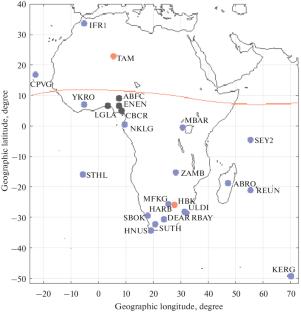
In this paper, we employ equatorial-latitude Global Navigation Satellite System (GNSS) data from TERONET to investigate the storm that occurred on August 27, 2021. To characterize the equatorial and mid-latitude ionosphere during the storm, the 10 quietest days of August 2021 were selected as background TECs, and we calculated the relative TEC (rTEC) from the deviation of the disturbed days using a median value of the TEC at each timestep, considering all 10 days and selecting the threshold |–30 ≤ rTEC ≥ 30| for the TEC anomaly. Additionally, we employ the African geodetic reference frame (AFREF) GNSS network to analyze the data from 19 stations in the African region during storms. We employ ROTIave as a proxy for scintillation to study irregularities and GNSS fluctuations during storm main and recovery phases and examine thermospheric variations from the [O]/[N2] ratio. Again, we employ the depression of the horizontal component (H) of the Earth’s magnetic field obtained from equatorial and mid-latitude magnetometers to feature the seeding of the TEC enhancements and depression. Our major findings reveal that ionospheric irregularities at low latitudes, as observed from GNSS measurements, show distinct latitudinal differences and seem not well experienced at the dip equator. The equatorial and mid-latitude ionosphere of the Africa sector shows a complex irregularity occurrence that may not have a stronger effect of the solar activity cycle but seems to follow storm-enhanced density, where morning-hour positive storms govern irregularities during the commencement of storms preceded by the equatorial ionization anomaly (EIA) due to localized expansion of the neutral atmosphere.
期刊介绍:
Geomagnetism and Aeronomy is a bimonthly periodical that covers the fields of interplanetary space; geoeffective solar events; the magnetosphere; the ionosphere; the upper and middle atmosphere; the action of solar variability and activity on atmospheric parameters and climate; the main magnetic field and its secular variations, excursion, and inversion; and other related topics.

 求助内容:
求助内容: 应助结果提醒方式:

 京公网安备 11010802042870号


