M. A. Vetoshkin, E. D. Voblikov, V. A. Zhuravlev, A. V. Bulatova, D. N. Moskalev, A. A. Kozlov, U. O. Salgaeva, V. V. Krishtop
{"title":"Methods of Measurement Propagation Losses in Thin Film Lithium Niobate Waveguides","authors":"M. A. Vetoshkin, E. D. Voblikov, V. A. Zhuravlev, A. V. Bulatova, D. N. Moskalev, A. A. Kozlov, U. O. Salgaeva, V. V. Krishtop","doi":"10.1134/S1062873825714965","DOIUrl":null,"url":null,"abstract":"<p>We studied the methods for measuring propagation losses in thin-film lithium niobate (TFLN) waveguides. Thin-film lithium niobate is a promising platform for integrated photonics, enabling the fabrication of compact waveguide structures and topologies. The fabrication process of TFLN waveguides includes several stages: design, fabrication, and testing. This paper focuses on the testing stage, which allows for an objective evaluation of the fabrication process and the correctness of the design. The methodology for measuring propagation losses in waveguides is an important research topic in integrated photonics. Several measurement approaches are considered, including interferometric methods based on Fabry–Pérot resonances within the waveguide and the cut-back method. A comparison of these methods in terms of universality, repeatability, and accuracy shows that the cut-back method is the most promising among those considered.</p>","PeriodicalId":504,"journal":{"name":"Bulletin of the Russian Academy of Sciences: Physics","volume":"89 4","pages":"S578 - S585"},"PeriodicalIF":0.4800,"publicationDate":"2026-02-19","publicationTypes":"Journal Article","fieldsOfStudy":null,"isOpenAccess":false,"openAccessPdf":"","citationCount":"0","resultStr":null,"platform":"Semanticscholar","paperid":null,"PeriodicalName":"Bulletin of the Russian Academy of Sciences: Physics","FirstCategoryId":"1085","ListUrlMain":"https://link.springer.com/article/10.1134/S1062873825714965","RegionNum":0,"RegionCategory":null,"ArticlePicture":[],"TitleCN":null,"AbstractTextCN":null,"PMCID":null,"EPubDate":"","PubModel":"","JCR":"Q4","JCRName":"Physics and Astronomy","Score":null,"Total":0}
引用次数: 0
Abstract
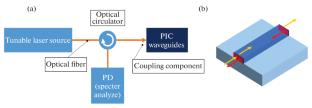
We studied the methods for measuring propagation losses in thin-film lithium niobate (TFLN) waveguides. Thin-film lithium niobate is a promising platform for integrated photonics, enabling the fabrication of compact waveguide structures and topologies. The fabrication process of TFLN waveguides includes several stages: design, fabrication, and testing. This paper focuses on the testing stage, which allows for an objective evaluation of the fabrication process and the correctness of the design. The methodology for measuring propagation losses in waveguides is an important research topic in integrated photonics. Several measurement approaches are considered, including interferometric methods based on Fabry–Pérot resonances within the waveguide and the cut-back method. A comparison of these methods in terms of universality, repeatability, and accuracy shows that the cut-back method is the most promising among those considered.
期刊介绍:
Bulletin of the Russian Academy of Sciences: Physics is an international peer reviewed journal published with the participation of the Russian Academy of Sciences. It presents full-text articles (regular, letters to the editor, reviews) with the most recent results in miscellaneous fields of physics and astronomy: nuclear physics, cosmic rays, condensed matter physics, plasma physics, optics and photonics, nanotechnologies, solar and astrophysics, physical applications in material sciences, life sciences, etc. Bulletin of the Russian Academy of Sciences: Physics focuses on the most relevant multidisciplinary topics in natural sciences, both fundamental and applied. Manuscripts can be submitted in Russian and English languages and are subject to peer review. Accepted articles are usually combined in thematic issues on certain topics according to the journal editorial policy. Authors featured in the journal represent renowned scientific laboratories and institutes from different countries, including large international collaborations. There are globally recognized researchers among the authors: Nobel laureates and recipients of other awards, and members of national academies of sciences and international scientific societies.

 求助内容:
求助内容: 应助结果提醒方式:

 京公网安备 11010802042870号


