Melvyn Billon, Jacqueline Vander Auwera, Olivier Namur, Marian B. Holness, Bernard Charlier
{"title":"Dynamics of plagioclase textural evolution and the impact of thermal history on nucleation","authors":"Melvyn Billon, Jacqueline Vander Auwera, Olivier Namur, Marian B. Holness, Bernard Charlier","doi":"10.1007/s00410-026-02301-4","DOIUrl":null,"url":null,"abstract":"<div><p>The solidification history of silicate melts strongly controls melt composition and the textures and compositions of crystalline phases. In particular, increasing supersaturation markedly affects crystal nucleation and growth dynamics. Here, we investigate how different crystallization paths influence plagioclase nucleation and crystal habit. Three sets of solidification experiments were performed at atmospheric pressure using a crystal-poor anhydrous andesitic starting material containing plagioclase fragments: (1) isothermal experiments across super- and sub-liquidus conditions, (2) continuous cooling from super-liquidus conditions, and (3) cooling runs held at final temperature. To evaluate the effect of initial superheating, we repeated the isothermal and continuous cooling experiments with a crystal-free melt pre-heated to 1450 °C from a higher initial temperature. Isothermal runs produced numerous small, homogeneous crystals, reflecting spontaneous nucleation. Continuous cooling promoted both growth and nucleation, yielding euhedral to dendritic plagioclase habits with increasing cooling rate. Greater initial superheating or nucleation suppression led to fewer but larger dendritic crystals, similar to those in the fastest cooled seeded runs. These results demonstrate the strong control of thermal pre-treatment on crystal habit and clarify the relative roles of homogeneous and heterogeneous nucleation. Superheating suppresses nucleation by reducing sites for heterogeneous crystallization, favoring growth-dominated textures with limited morphological variability. Although sample edges and Pt wire promote early crystallization, most nucleation occurs on heterogeneities such as gas bubbles, seeds, or impurities, suggesting that homogeneous nucleation may be indistinguishable from heterogeneous nucleation on nano- to micrometric heterogeneities.</p></div>","PeriodicalId":526,"journal":{"name":"Contributions to Mineralogy and Petrology","volume":"181 3","pages":""},"PeriodicalIF":3.7000,"publicationDate":"2026-02-16","publicationTypes":"Journal Article","fieldsOfStudy":null,"isOpenAccess":false,"openAccessPdf":"","citationCount":"0","resultStr":null,"platform":"Semanticscholar","paperid":null,"PeriodicalName":"Contributions to Mineralogy and Petrology","FirstCategoryId":"89","ListUrlMain":"https://link.springer.com/article/10.1007/s00410-026-02301-4","RegionNum":2,"RegionCategory":"地球科学","ArticlePicture":[],"TitleCN":null,"AbstractTextCN":null,"PMCID":null,"EPubDate":"","PubModel":"","JCR":"Q1","JCRName":"GEOCHEMISTRY & GEOPHYSICS","Score":null,"Total":0}
引用次数: 0
Abstract
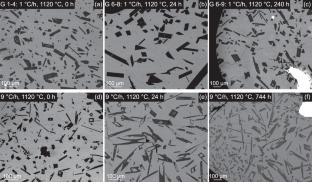
The solidification history of silicate melts strongly controls melt composition and the textures and compositions of crystalline phases. In particular, increasing supersaturation markedly affects crystal nucleation and growth dynamics. Here, we investigate how different crystallization paths influence plagioclase nucleation and crystal habit. Three sets of solidification experiments were performed at atmospheric pressure using a crystal-poor anhydrous andesitic starting material containing plagioclase fragments: (1) isothermal experiments across super- and sub-liquidus conditions, (2) continuous cooling from super-liquidus conditions, and (3) cooling runs held at final temperature. To evaluate the effect of initial superheating, we repeated the isothermal and continuous cooling experiments with a crystal-free melt pre-heated to 1450 °C from a higher initial temperature. Isothermal runs produced numerous small, homogeneous crystals, reflecting spontaneous nucleation. Continuous cooling promoted both growth and nucleation, yielding euhedral to dendritic plagioclase habits with increasing cooling rate. Greater initial superheating or nucleation suppression led to fewer but larger dendritic crystals, similar to those in the fastest cooled seeded runs. These results demonstrate the strong control of thermal pre-treatment on crystal habit and clarify the relative roles of homogeneous and heterogeneous nucleation. Superheating suppresses nucleation by reducing sites for heterogeneous crystallization, favoring growth-dominated textures with limited morphological variability. Although sample edges and Pt wire promote early crystallization, most nucleation occurs on heterogeneities such as gas bubbles, seeds, or impurities, suggesting that homogeneous nucleation may be indistinguishable from heterogeneous nucleation on nano- to micrometric heterogeneities.
期刊介绍:
Contributions to Mineralogy and Petrology is an international journal that accepts high quality research papers in the fields of igneous and metamorphic petrology, geochemistry and mineralogy.
Topics of interest include: major element, trace element and isotope geochemistry, geochronology, experimental petrology, igneous and metamorphic petrology, mineralogy, major and trace element mineral chemistry and thermodynamic modeling of petrologic and geochemical processes.

 求助内容:
求助内容: 应助结果提醒方式:

 京公网安备 11010802042870号


