{"title":"The Solubility Effect on the Cavity Bottom Structure as a Result of Drop Coalescence in an Impact Regime","authors":"Yu. D. Chashechkin, A. Yu. Ilinykh","doi":"10.1134/S0015462825603699","DOIUrl":null,"url":null,"abstract":"<p>The multipoint illumination is used to visualize the flow pattern produced by a free falling drop in a fluid at rest. The initial stage of merging of a potassium permanganate solution drop with water and a water drop with ammonium thodanide solution as well as the spreading of a drop of aniline and crude oil in a pool of water is studied. Emphasis is placed on an analysis of the flow pattern near the cavity bottom in the impact regime, when the kinetic energy of the drop is considerably greater than its potential surface energy. An “intermediate layer” is formed under the cavity bottom upon the contact of the mixing fluids. This layer is the product of dissolution of thin fibers of the drop substance intruding into the target fluid. Poorly soluble aniline forces partially through the cavity bottom. In the experimental conditions the oil does not penetrate through the surface of the fluid in the initial stage of the flow. The values of the conventional dimensionless parameters, which are the Reynolds, Froude, Weber, Bond, and Ohnesorge numbers, are presented, together with certain additional parameters, namely, the ratios of energy components and their densities, as well as the relative densities and surface tension coefficients of the media in contact.</p>","PeriodicalId":560,"journal":{"name":"Fluid Dynamics","volume":"60 8","pages":""},"PeriodicalIF":0.6000,"publicationDate":"2026-02-16","publicationTypes":"Journal Article","fieldsOfStudy":null,"isOpenAccess":false,"openAccessPdf":"","citationCount":"0","resultStr":null,"platform":"Semanticscholar","paperid":null,"PeriodicalName":"Fluid Dynamics","FirstCategoryId":"5","ListUrlMain":"https://link.springer.com/article/10.1134/S0015462825603699","RegionNum":4,"RegionCategory":"工程技术","ArticlePicture":[],"TitleCN":null,"AbstractTextCN":null,"PMCID":null,"EPubDate":"","PubModel":"","JCR":"Q4","JCRName":"MECHANICS","Score":null,"Total":0}
引用次数: 0
Abstract
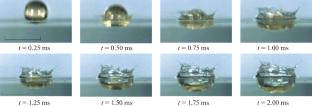
The multipoint illumination is used to visualize the flow pattern produced by a free falling drop in a fluid at rest. The initial stage of merging of a potassium permanganate solution drop with water and a water drop with ammonium thodanide solution as well as the spreading of a drop of aniline and crude oil in a pool of water is studied. Emphasis is placed on an analysis of the flow pattern near the cavity bottom in the impact regime, when the kinetic energy of the drop is considerably greater than its potential surface energy. An “intermediate layer” is formed under the cavity bottom upon the contact of the mixing fluids. This layer is the product of dissolution of thin fibers of the drop substance intruding into the target fluid. Poorly soluble aniline forces partially through the cavity bottom. In the experimental conditions the oil does not penetrate through the surface of the fluid in the initial stage of the flow. The values of the conventional dimensionless parameters, which are the Reynolds, Froude, Weber, Bond, and Ohnesorge numbers, are presented, together with certain additional parameters, namely, the ratios of energy components and their densities, as well as the relative densities and surface tension coefficients of the media in contact.
期刊介绍:
Fluid Dynamics is an international peer reviewed journal that publishes theoretical, computational, and experimental research on aeromechanics, hydrodynamics, plasma dynamics, underground hydrodynamics, and biomechanics of continuous media. Special attention is given to new trends developing at the leading edge of science, such as theory and application of multi-phase flows, chemically reactive flows, liquid and gas flows in electromagnetic fields, new hydrodynamical methods of increasing oil output, new approaches to the description of turbulent flows, etc.

 求助内容:
求助内容: 应助结果提醒方式:

 京公网安备 11010802042870号


